%20scale(1.05)%20translate(-12,-14.25)'%3e%3cpath%20d='M12%2021s-7.5-4.7-7.5-10.2A4.3%204.3%200%200%201%2012%207.5a4.3%204.3%200%200%201%207.5%203.3C19.5%2016.3%2012%2021%2012%2021Z'%20fill='%23F0384A'%3e%3c/path%3e%3c/g%3e%3c/svg%3e)

A Tinder profile lookup is the process of finding whether someone has an active Tinder account using external identifiers like a phone number, email address, or photo, since Tinder itself provides no public search directory. If you suspect your partner is secretly active on the app, you are not alone. Tinder has approximately 47 million monthly active users yet zero public-facing search tools. That gap between scale and transparency is exactly why external lookup methods exist, and why knowing which ones actually work matters.
Why you can’t search Tinder profiles directly in the app
Tinder’s design deliberately blocks direct profile searches. The app’s internal search only surfaces people within your active swipe feed, based on location and mutual compatibility settings. No public directory exists. No name search bar. No way to type in your partner’s name and see their profile.
Profile visibility on Tinder depends entirely on mutual compatibility signals and active usage. A profile does not appear to you unless it falls within your swipe feed and matches your set preferences. This means even creating your own account and searching nearby gives you no guarantee of finding a specific person.
“Since Tinder lacks an open directory, investigators should focus on digital footprints tied to public email, phone, or social media linked to the dating profile.”
That insight reframes the entire approach. Searching within Tinder is a dead end. Searching around Tinder, using the identifiers your partner tied to their account, is where real results come from. The methods below follow that logic.
Effective methods to find Tinder profiles using external identifiers
Several techniques work with varying degrees of reliability. The right one depends on what information you already have.

Phone number lookup
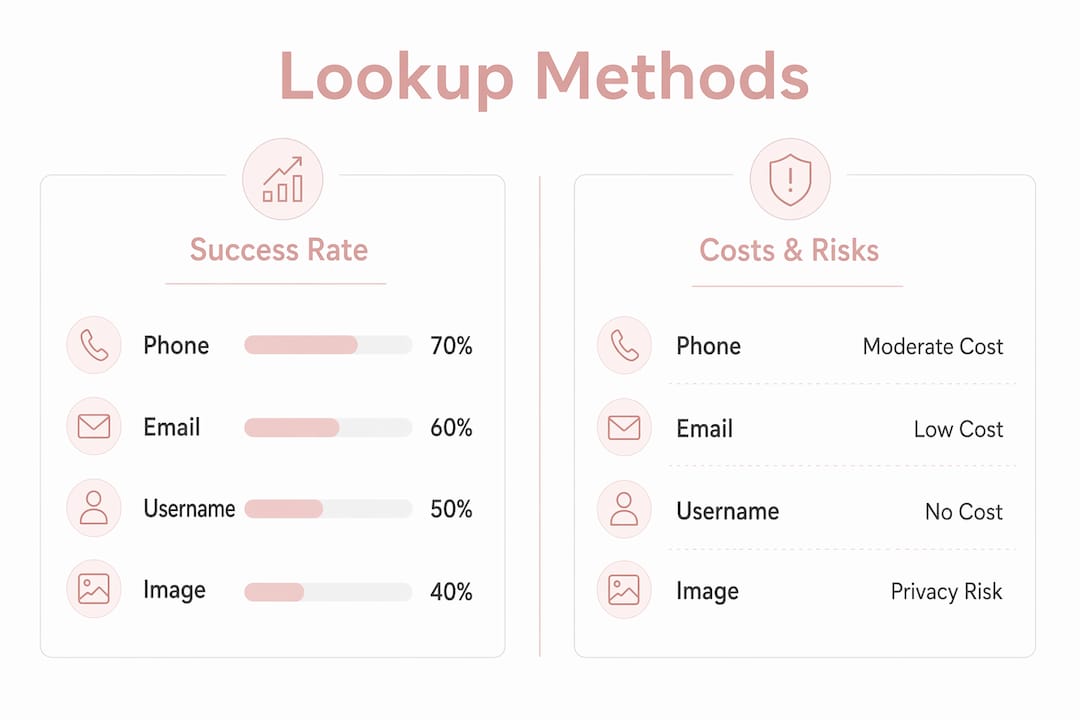
Phone number searches are the most effective method for finding Tinder profiles, with roughly a 70% success rate. Tinder requires phone verification during signup, so the phone number is almost always tied to the account. Third-party people-search services cross-reference phone numbers against known dating app registrations to confirm an active profile.
Email address lookup
Email searches succeed about 60% of the time. Many people reuse the same email across multiple platforms, making it a reliable secondary identifier. Paid people-search services typically cost $26–$30 per month, though trial options lower the entry cost significantly.
Username URL check
Tinder allows custom usernames, and you can check whether a profile exists by visiting tinder.com/@username directly in a browser. Only a small minority of users set custom usernames, so this method is limited. When the username is known or can be reasonably guessed, though, it is the fastest and most direct verification available.
Reverse image search
Reverse image search engines like Google Images or TinEye can identify reused profile photos across social platforms. This technique carries about 30% effectiveness for confirming Tinder profiles specifically. Many people reuse the same photos across Instagram, Facebook, and dating apps, which makes cross-platform photo matching a useful secondary check.
Method comparison
| Method | Success rate | Typical cost | Privacy risk |
|---|---|---|---|
| Phone number lookup | ~70% | $26–$30/month | Low with reputable services |
| Email address lookup | ~60% | $26–$30/month | Low with reputable services |
| Username URL check | Direct if known | Free | None |
| Reverse image search | ~30% | Free | None |
| Paid people-search services | 50–70% | $26–$30/month | Low with reputable services |
Pro Tip: Start with the username URL check if you know or can guess the username. It costs nothing and gives an immediate answer before you spend time or money on other methods.
How to perform a discreet Tinder profile lookup step by step
A discreet search requires preparation. Jumping straight to a tool without organizing your information wastes time and increases the chance of false positives.
-
Gather every identifier you have. Write down your partner’s full name, phone number, email addresses, known usernames, and any photos you can access. The more identifiers you bring to a search, the more accurate the result.
-
Check the username URL first. Open a private browser window and visit
tinder.com/@[username]. If a profile loads, you have your answer immediately. If not, move to the next step. -
Use Tinder’s forgot password feature cautiously. Go to Tinder’s login page and enter the suspected email or phone number in the “forgot password” field. This technique confirms whether that identifier is linked to an account without alerting the target, as long as you stop before completing the reset. Do not proceed past the confirmation screen.
-
Run a reverse image search. Save a clear photo of your partner from social media. Upload it to Google Images or TinEye and scan the results for dating app profiles or unfamiliar accounts using the same image.
-
Use a paid people-search service. Reputable services cross-reference phone numbers, emails, and names against dating app databases. Look for services that offer a trial period and clearly state their privacy practices before entering any personal information.
-
Verify results carefully. A single match is not proof. Confirm findings across at least two methods before drawing conclusions. Tinder profiles can be old, inactive, or belong to someone with a similar name or photo.
-
Avoid sketchy free tools. Free “Tinder finder” sites frequently demand excessive permissions or personal data. Submitting your own contact details to these services creates a new privacy risk without delivering reliable results.
Pro Tip: Always use a private or incognito browser window during your search. This prevents your own browsing history from being tied to the investigation and keeps your digital footprint clean.
Troubleshooting common issues and ethical considerations
Many searches hit dead ends, and knowing why helps you interpret results accurately.
Tinder’s Incognito Mode, available to Gold and Platinum subscribers, hides a profile from everyone except people the user has already swiped right on. If your partner uses Incognito Mode, standard lookup methods will not surface their profile. A negative result does not automatically mean no account exists.
- Free tools are often scams. Many free Tinder profile finder sites harvest your data rather than search for your partner’s. They require your email, phone, or payment details and deliver nothing useful in return.
- False positives happen. Common names, shared photos, and recycled usernames can all produce misleading matches. Always cross-reference before acting on a result.
- Legal boundaries are real. Accessing someone’s account without permission violates the Computer Fraud and Abuse Act. Lookup methods that use publicly available identifiers are generally legal. Hacking, impersonation, or unauthorized account access is not.
- Your own data is at risk. Many free finder services require your own email or contact details, which exposes your digital identity to tracking.
“Many ‘free’ Tinder search tools are scams designed to harvest your data. Honest detection requires caution and privacy awareness.”
Interpreting a negative result honestly is just as important as finding a positive one. If three independent methods return nothing, the evidence points toward no active profile. Emotional certainty is not the same as factual confirmation.
Key Takeaways
The most reliable way to find Tinder profiles in 2026 is to use external identifiers like phone numbers and emails through reputable paid services, since Tinder itself provides no public search directory.
| Point | Details |
|---|---|
| Tinder has no public search | You cannot find profiles inside the app; all effective methods use external identifiers. |
| Phone number is most effective | Phone lookups succeed roughly 70% of the time due to Tinder’s mandatory phone verification. |
| Username URL is fastest | Visiting tinder.com/@username is free, instant, and leaves no trace if the username is known. |
| Free tools carry real risk | Many free finder sites harvest your personal data instead of returning useful results. |
| Verify across multiple methods | One match is not proof; confirm findings through at least two independent techniques. |
What I’ve learned from watching people search for the truth
People who suspect infidelity often want certainty before they are ready to have the conversation. That instinct makes sense. Confronting a partner with nothing but suspicion rarely ends well for either person.
What I have seen, though, is that the search itself can become its own trap. Someone spends hours on sketchy free tools, enters their own email address into a data-harvesting site, and ends up more anxious and less informed than when they started. The technical methods described here work, but only when applied with discipline and realistic expectations.
The “forgot password” trick, for example, is genuinely useful. It is also easy to misread. A confirmation that an email is linked to a Tinder account tells you an account exists. It does not tell you when it was last active, whether it was ever used seriously, or what the context was. Results require interpretation, not just collection.
My honest advice: use the phone number lookup or a reputable paid service first, because those carry the highest accuracy. If the result is positive, you then face a different question entirely, one that no tool can answer for you. Digital evidence opens a door. What you do with what is behind it is a human decision, not a technical one. Approach the whole process with the same care you would want someone to apply if they were investigating you.
— Oleg
Cheaterdetector: a privacy-first way to check dating app activity
Suspecting infidelity is stressful enough without spending hours on unreliable tools or risking your own data.
Cheaterdetector is built specifically for this situation. You enter minimal information about your partner, and the AI-powered system scans major dating apps, including Tinder, through an anonymous and encrypted process. Your partner receives no notification. You receive a detailed report with profile photos and timestamps. Over 5,000 people have used the service, which holds a 4.9 average rating. If you want a clear answer without the guesswork of manual searches, run a discreet scan through Cheaterdetector and get results you can actually trust.
FAQ
Can you search for someone on Tinder by name?
Tinder does not offer a name search feature. The app only shows profiles within your swipe feed based on location and compatibility settings.
How do I find a Tinder profile using a phone number?
Use a reputable third-party people-search service that cross-references phone numbers against dating app databases. Phone number searches succeed roughly 70% of the time because Tinder requires phone verification at signup.
Does checking the “forgot password” field notify the account holder?
No. Entering an email or phone number in Tinder’s “forgot password” field does not alert the user unless you proceed all the way through the password reset process.
Are free Tinder profile finder tools safe to use?
Most are not. Many free finder sites are data-harvesting operations that collect your personal information without returning useful results. Use paid services with clear privacy policies instead.
What if my search returns no results?
A negative result may mean no active profile exists, or it may mean the account is hidden behind Tinder’s Incognito Mode. Cross-reference at least two methods before treating a negative result as conclusive.