%20scale(1.05)%20translate(-12,-14.25)'%3e%3cpath%20d='M12%2021s-7.5-4.7-7.5-10.2A4.3%204.3%200%200%201%2012%207.5a4.3%204.3%200%200%201%207.5%203.3C19.5%2016.3%2012%2021%2012%2021Z'%20fill='%23F0384A'%3e%3c/path%3e%3c/g%3e%3c/svg%3e)

A dating profile search is the process of locating someone’s active or hidden online dating accounts using publicly accessible methods such as username lookups, reverse image searches, and contact information checks. About 25% of couples report suspicion about hidden dating app activity and turn to investigative methods for answers. That number reflects how common this concern has become across American relationships. The good news is that legal, discreet techniques exist, and when combined correctly, they produce reliable results without tipping off your partner or crossing any legal lines.
What do you need before starting a dating profile search?
The quality of your search depends entirely on the information you start with. Entering a full name alone rarely produces useful results. The more identifiers you have, the narrower and more accurate your search becomes.
The most useful identifiers to gather before you begin:
- Full legal name and any known nicknames or usernames
- Email addresses, including older or secondary accounts
- Phone numbers, both current and any numbers you’ve seen on their device
- Recent photos, especially selfies or profile-style images
- Social media handles used on Instagram, Snapchat, or Twitter/X
Access to their device, even briefly, can also reveal a great deal. Checking app purchase history on the App Store or Google Play Store uncovers deleted dating apps that no longer appear on the home screen. This method catches deleted installs that would otherwise be invisible. It takes under two minutes and leaves no trace on the device.
Pro Tip: Always conduct your searches using a VPN and incognito mode. This prevents cookies, cached pages, and browser history from exposing your investigation, especially on shared networks or devices.

Privacy matters on your end too. Using a personal device on a private network keeps your activity separate from any shared accounts or household Wi-Fi logs.
How to find dating profiles legally and discreetly
The most effective approach combines multiple methods rather than relying on any single technique. A combination of name searches, reverse image lookups, and email or phone checks consistently outperforms single-method searches in accuracy. Each method catches what the others miss.
Step-by-step search methods
-
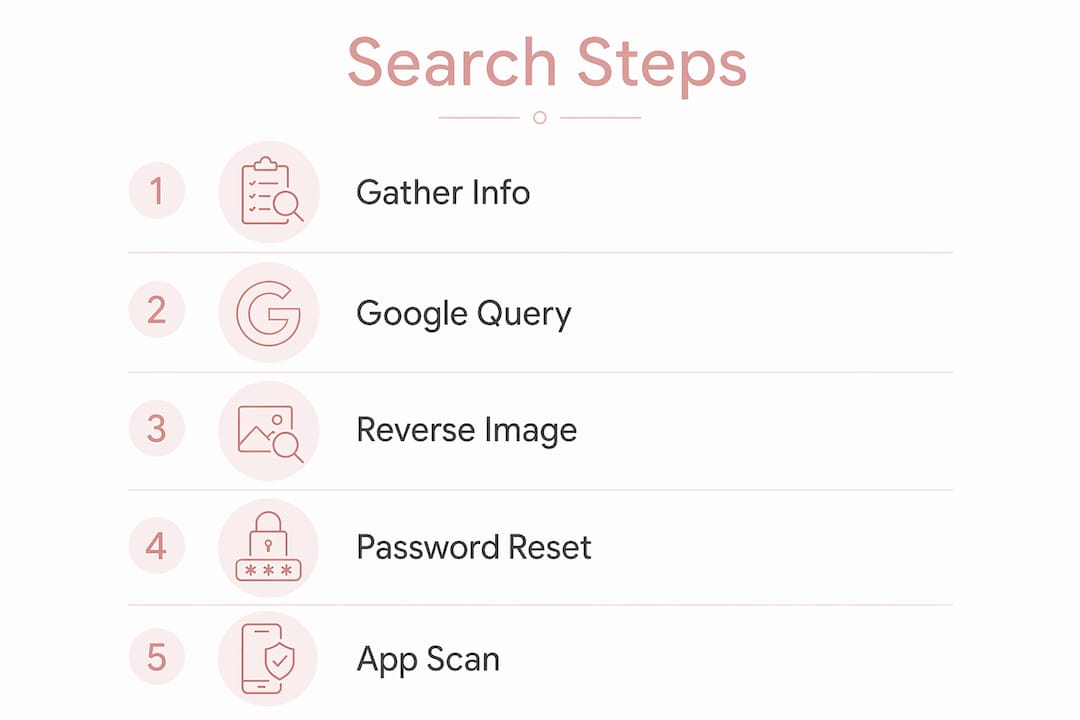
Run targeted Google queries. Search engines with advanced queries can surface publicly indexed dating profiles using full names, usernames, or contact details. Try queries like
site:tinder.com "First Last Name"orsite:match.com "username"in Google. If their profile is public or was ever indexed, it will appear in results. -
Use reverse image search. Take a clear photo of your partner and upload it to Google Lens or TinEye. Reverse image search carries an 80% hit rate in finding matching profiles across platforms. People frequently reuse the same photos across multiple apps, which makes this method especially effective for common names or when you only have a nickname.
-
Cross-check usernames across platforms. If you know a username they use on social media, search that exact string on major dating platforms manually. Many people reuse usernames out of habit. A username that appears on Reddit or Instagram may also appear on a dating app profile.
-
Try the password reset method. Go to the login page of a major dating platform and enter their email address or phone number in the “Forgot Password” field. The password recovery feature confirms account existence discreetly. If the site sends a “Reset link sent” confirmation, an account linked to that contact information exists. The account holder receives no notification that someone attempted this.
-
Check app store purchase and download history. If you have brief access to their phone, open the App Store or Google Play and check the purchase or download history under their account. This method uncovers roughly 40% of deleted installs that no longer appear on the device itself. A deleted dating app still shows in the download history unless manually removed.
Pro Tip: Run each search from a fresh incognito window. Close and reopen the window between methods to prevent any session data from one platform leaking into another.
Work through these steps in order. Google queries and reverse image searches are the lowest-effort starting points. The password reset method and app store check require more access but deliver the most direct confirmation.
What challenges make a dating profile search harder?
Several real obstacles can limit your results, even when you follow every step correctly. Knowing these barriers in advance helps you adjust your approach rather than give up too early.
Common challenges and how to handle them:
-
Private or hidden profiles. Many dating apps allow users to hide their profiles from non-matches or set them to “invisible” mode. A hidden profile will not appear in Google results or manual searches. In this case, the password reset method becomes your most reliable option since it bypasses the profile’s visibility settings entirely.
-
Fake names and secret email addresses. Some people create dating accounts under aliases or with email addresses you have never seen. If standard name searches return nothing, shift focus to reverse image search and phone number lookups, which are harder to fake.
-
Deleted or inactive accounts. An account that was deleted months ago may still appear in cached Google results for a short period. Check Google’s cache by clicking the three-dot menu next to a search result. App store history also catches recently deleted apps before the record clears.
-
Common names producing too many results. A name like “Michael Johnson” returns thousands of results across platforms. Narrow your search by adding a city, workplace, or known username to the query. Reverse image search sidesteps this problem entirely since it searches by photo rather than name.
Digital investigation must rely only on publicly accessible information to stay within legal boundaries. Accessing someone’s account without permission, installing tracking software, or reading private messages without consent crosses into illegal territory under federal and state computer fraud laws. Every method described here uses only publicly available data or information you already have legitimate access to.
Comparing search methods by effort and accuracy
Not every method fits every situation. The table below maps each technique to its effort level, accuracy, and best use case so you can prioritize based on what you already know.
| Method | Effort level | Accuracy | Best use case |
|---|---|---|---|
| Google advanced query | Low | Moderate | Public profiles with real names or usernames |
| Reverse image search | Low | High (80% hit rate) | Reused photos, common names, or nicknames |
| Username cross-check | Medium | High | Known social media handles |
| Password reset check | Medium | Very high | Confirmed email or phone number on hand |
| App store history check | Low (requires device access) | High (catches ~40% of deleted apps) | Brief access to partner’s phone |
| AI-powered profile scan | Low | Very high | Fast, wide-coverage search across multiple apps |
Free methods like Google queries and reverse image search cost nothing but require patience and some technical comfort. The password reset method is free and highly accurate but depends on knowing the right email or phone number. AI-powered services like Cheaterdetector handle the heavy lifting automatically, scanning across major dating apps simultaneously without requiring you to run each method manually.
Legal and ethical investigation treats digital searches as a supplement to communication, not a replacement for it. Finding a profile answers the factual question. What you do with that answer is a separate decision that deserves careful thought.
Key Takeaways
A dating profile search is most effective when it combines multiple methods, including reverse image search, Google queries, and password reset checks, rather than relying on any single technique.
| Point | Details |
|---|---|
| Start with identifiers | Gather full name, email, phone, photos, and usernames before searching. |
| Reverse image search works | Google Lens and TinEye find reused photos with an 80% hit rate across platforms. |
| Password reset confirms accounts | Entering an email or phone in the “Forgot Password” field reveals account existence without alerting the holder. |
| App store history catches deletions | Deleted dating apps still appear in purchase history, uncovering roughly 40% of hidden installs. |
| Combine methods for best results | Name search, image lookup, and email checks together outperform any single approach. |
Why I think most people search the wrong way first
When someone suspects their partner is active on a dating app, the first instinct is usually to scroll through their phone or check their messages. That approach almost always backfires. Either you don’t find anything because the app is hidden or deleted, or you find something and now you’ve invaded their privacy in a way that complicates any conversation that follows.
The methods that actually work are less obvious. The password reset trick, for example, is something most people have never considered. It takes 30 seconds, leaves no trace, and gives you a clear yes or no. That’s more useful than an hour of scrolling through a phone and second-guessing yourself.
I also think people underestimate how often the same photo appears across multiple platforms. Someone might use a fake name on a dating app, but they almost always use a real photo. Reverse image search exploits exactly that habit. It’s the one method that works even when everything else is hidden behind an alias.
The harder truth is that finding a profile is the easy part. Deciding what to do with that information is where most people get stuck. My honest advice is to go into the search knowing what you’ll do if you find something. Prepare emotionally before you start, not after. And if you find nothing, take that result seriously too. A clean search result is not proof of innocence, but it is meaningful data worth factoring into how you approach the conversation.
— Oleg
Cheaterdetector makes the search faster and more private
Running every method manually takes time, technical skill, and repeated access to information you may not always have on hand. Cheaterdetector removes that friction entirely.
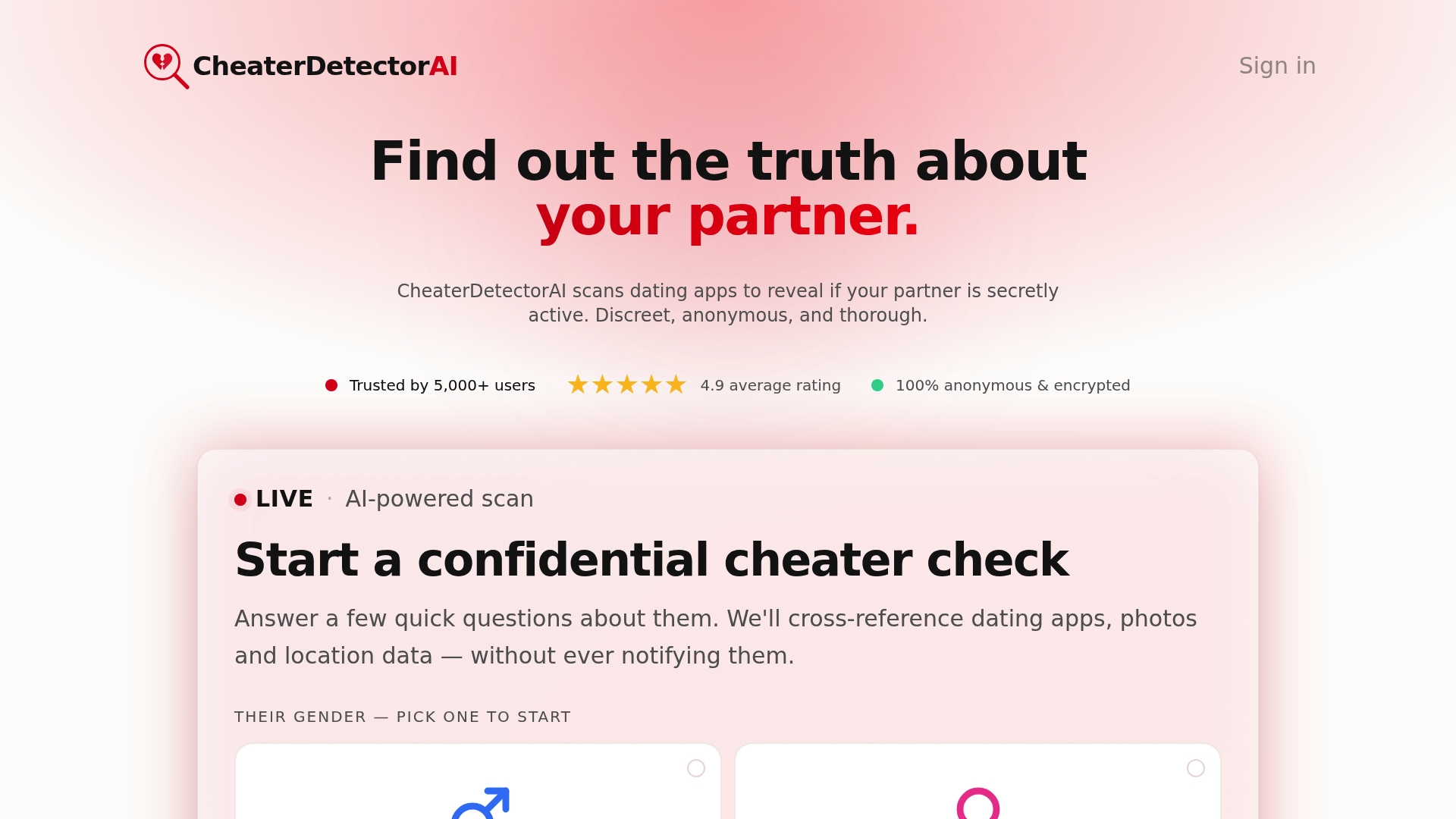
Cheaterdetector scans major dating apps simultaneously using AI, requiring only minimal information about your partner to get started. The scan runs anonymously and encrypted, meaning your partner receives no notification and your search leaves no trace. Results include profile photos and timestamps, giving you specific, verifiable details rather than vague indicators. Over 5,000 people have used the service, and it holds a 4.9 average rating. For anyone who wants answers without the manual effort or the risk of being discovered mid-search, Cheaterdetector is the most direct path to clarity.
FAQ
What is a dating profile search?
A dating profile search is the process of locating someone’s active dating app accounts using publicly accessible methods such as username lookups, reverse image searches, and contact information checks. It is used most often to verify whether a partner is secretly active on dating platforms.
Can I find dating profiles without them knowing?
Yes. Methods like the password reset check and reverse image search produce results without alerting the account holder. Using a VPN and incognito browsing also prevents your search activity from being traced back to you.
How accurate is reverse image search for finding dating profiles?
Reverse image search carries an 80% hit rate for finding matching profiles across platforms. It works best when the person reuses the same photo across multiple apps or social media accounts.
What if my partner used a fake name on a dating app?
Fake names reduce the effectiveness of name-based searches but do not defeat reverse image search or phone number lookups. Most people reuse real photos even under aliases, making image-based searches the most reliable fallback.
Is it legal to search for someone’s dating profile?
Searching publicly indexed data, using reverse image tools, and checking password reset pages are all legal. Accessing someone’s account without permission or installing monitoring software without consent violates federal computer fraud laws and is not recommended.