%20scale(1.05)%20translate(-12,-14.25)'%3e%3cpath%20d='M12%2021s-7.5-4.7-7.5-10.2A4.3%204.3%200%200%201%2012%207.5a4.3%204.3%200%200%201%207.5%203.3C19.5%2016.3%2012%2021%2012%2021Z'%20fill='%23F0384A'%3e%3c/path%3e%3c/g%3e%3c/svg%3e)

Knowing how to find hidden dating profiles is the first step toward getting real answers about your relationship. The technical term for this type of search is open-source intelligence, or OSINT, which refers to gathering information from publicly available sources without unauthorized access. Combining targeted search methods like Google operators, reverse image searches, and email lookups gives you the best shot at finding a secret account. No single method works every time, but layering several techniques together raises your success rate considerably. This guide walks you through every practical approach, from free beginner tactics to advanced OSINT strategies.
How to find hidden dating profiles for free
Free methods work better than most people expect. Manual searches using Google operators and phone lookups find hidden dating profiles 35–60% of the time. That range reflects how much your results depend on whether your partner reuses usernames, emails, or photos across platforms. Each search typically takes 20–30 minutes per subject, so plan your time accordingly.
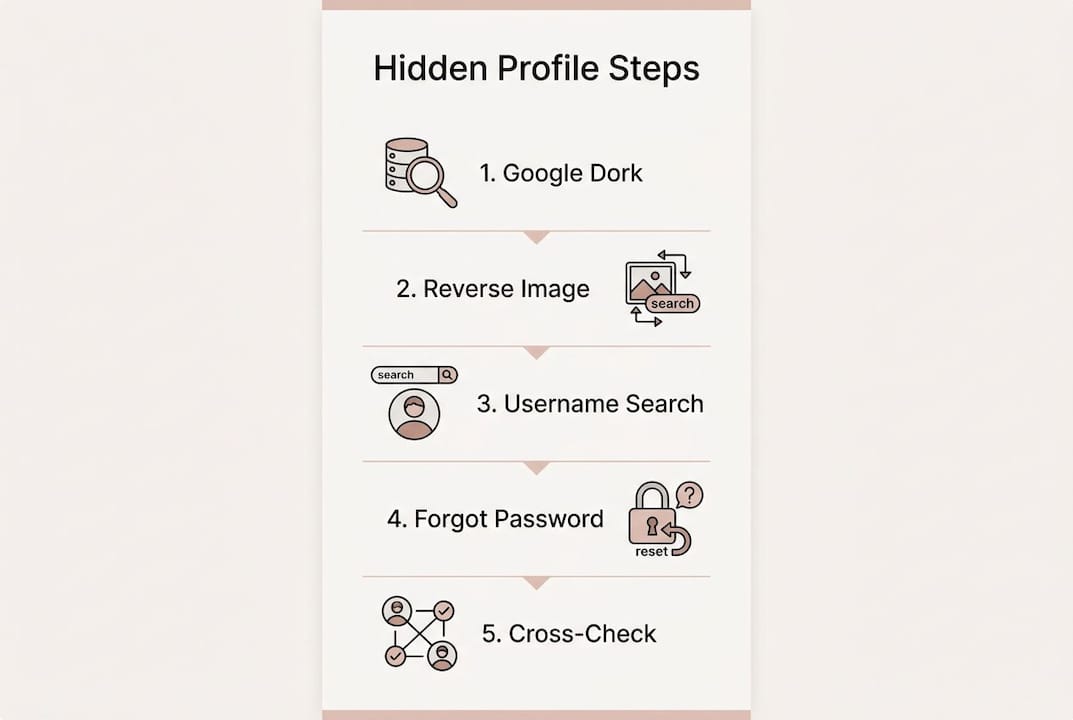
1. Google dorking with site operators
Google dorking means using advanced search operators to narrow results to specific websites. Site operators and exact phrase matching improve search precision significantly. For example, typing site:tinder.com "John Doe" into Google returns only indexed Tinder pages that mention that exact name. You can swap in a username, nickname, or even a phone number formatted as text. This method surfaces profiles that are technically public but not easy to find through normal browsing.

2. Reverse image search
Reverse image search is one of the most underrated free tools available. Upload a photo of your partner to Google Images, Yandex, or TinEye, and the engine returns pages where that image appears. Yandex Images outperforms Google Images in facial recognition for finding profile matches. That means Yandex is the better first stop when you are searching by face rather than by exact image file. Try multiple photos, including casual shots, since dating profiles often use pictures pulled from Instagram or Facebook.
3. Username and email cross-platform search
Most people reuse the same username across multiple accounts. Username searching achieves a 65% success rate when handles are reused across platforms. Type a suspected username directly into the URL bar for major dating apps. For example, tinder.com/@username or hinge.co/username will either load a profile or return an error. Email and phone lookups push that success rate even higher. Email and phone lookups achieve 80% success when those identifiers are linked to existing accounts.
4. The forgot password test
The forgot password test is a reliable, free verification method that most people overlook. Enter a suspected email address or phone number into the “forgot password” field on a dating app. The forgot password test confirms account existence without alerting the user, because no recovery notification is sent unless the reset is actually completed. If the app says “we sent a reset link,” an account exists with that email. If it says “no account found,” that identifier is not registered.
Pro Tip: Save every result in a dedicated folder with screenshots and timestamps. Cross-referencing findings from multiple searches later is much easier when everything is organized in one place.
What are the best OSINT techniques for secret online profiles?
OSINT, or open-source intelligence, is the practice of collecting data from publicly available sources. Applied to finding secret online profiles, it means using multiple identifiers, such as emails, phone numbers, usernames, and photos, to build a picture of someone’s digital footprint. OSINT experts stress combining multiple search methods rather than relying on a single approach. The logic is simple: one method might fail, but three methods pointing to the same result are hard to dismiss.
Key OSINT techniques for this type of search include:
- Selector-based searches: Use every known identifier, including email addresses, phone numbers, and usernames, as separate search inputs across multiple platforms.
- Social network pattern analysis: Check mutual friends, followers, and public interactions on Instagram, Facebook, and Snapchat. Social media connections can reveal hidden accounts through network trail analysis, since accounts often link as followers or friends.
- Phone number lookups: Manual phone number searches on platforms can surface linked accounts on Instagram, Facebook, Snapchat, and TikTok if privacy settings allow it. Syncing contacts on these apps sometimes shows the account in “people you may know” suggestions.
- Specialized lookup tools: Generic people-search platforms and email verification services can confirm whether an address is active and tied to social accounts.
- AI-powered scanning services: Paid tools with AI capabilities reach 70–85% success in finding active profiles quickly, scanning across multiple apps simultaneously.
Verifying whether a profile is currently active matters as much as finding it. An old, dormant account from before your relationship is not the same as an active one. Jumping to conclusions based on an inactive profile can cause serious, unnecessary harm.
Cross-check every finding across at least two different tools or methods before drawing any conclusions. A single result is a lead, not proof.
Step-by-step: how to verify hidden dating profiles
Follow these steps in order for the most reliable results.
-
Collect all known identifiers. Write down every email address, phone number, and username you know your partner uses. Include variations, such as adding numbers or underscores to a username.
-
Run the forgot password test. Go to the login page of major dating apps, including Tinder, Hinge, Bumble, and Badoo. Enter each email address and phone number into the “forgot password” field. Record which apps return a “reset link sent” message.
-
Search usernames directly in app URLs. Type known usernames into the URL structure of each platform. A loaded profile page confirms the account exists. An error page does not confirm absence, since some profiles are set to private.
-
Perform a reverse image search. Use Yandex’s advanced facial recognition to search by face rather than exact image. Upload three to five different photos and compare results across Yandex, Google Images, and TinEye.
-
Run Google dork searches. Use
site:tinder.com "full name"andsite:hinge.co "username"for each platform. Expand to other dating sites relevant to your situation, including Badoo profile searches and Hinge. -
Cross-reference all results. Look for overlap between findings. Two or more methods pointing to the same account is strong evidence of an active profile.
Pro Tip: When interpreting ambiguous results, check the profile’s last active date or photo upload timestamps if visible. A profile last active three years ago tells a very different story than one active last week.
Common obstacles when searching for hidden profiles
Some profiles stay hidden despite your best efforts. Understanding why helps you avoid wasted time and false conclusions.
- Incognito or privacy modes: Many dating apps offer a “hidden” or “incognito” mode that prevents profiles from appearing in searches. These accounts still exist but are invisible to standard browsing.
- Burner accounts: A partner using a secondary email address or a prepaid phone number creates an account with no connection to their known identifiers. These are the hardest to find through free methods.
- False positives: Common names return multiple profiles that belong to different people. Always verify a photo, bio detail, or location before treating a result as a match.
- Outdated profiles: Finding old or dormant profiles does not prove current infidelity. Verifying account activity is critical before drawing any conclusion.
- Changing usernames: Some people regularly change their handles to avoid being found. If a username search fails, try variations or search by photo instead.
Verify at least three independent data points before confronting your partner. One result is a lead. Three consistent results across different methods are a pattern worth addressing.
Ethical and legal boundaries you need to know
Searching public data is legal. Accessing private accounts without permission is not. The line between the two is clear: if a piece of information is visible to any logged-out visitor or accessible through a standard search engine, using it is legal. Logging into someone’s account, installing tracking software without consent, or accessing private messages crosses into unauthorized access, which carries legal consequences in most U.S. states.
The goal of this kind of search is clarity, not control. Using findings to start an honest conversation is constructive. Using them to monitor, harass, or manipulate someone is harmful and potentially illegal.
Emotional preparedness matters as much as legal awareness. Finding a profile does not automatically explain why it exists. Approach any conversation with your partner from a place of wanting answers, not delivering accusations. If the search is affecting your mental health, speaking with a licensed therapist before or after conducting it is a sound decision.
Key Takeaways
Combining multiple OSINT methods, including username searches, email lookups, reverse image searches, and the forgot password test, gives you the highest and most reliable success rate when searching for hidden dating profiles.
| Point | Details |
|---|---|
| Layer your methods | No single search method works every time; combining three or more raises accuracy significantly. |
| Forgot password test | Enter a known email into dating app login pages to confirm account existence without alerting anyone. |
| Yandex for image searches | Yandex outperforms Google in facial recognition, making it the better tool for photo-based profile searches. |
| Verify activity, not just existence | An old, inactive profile is not proof of current infidelity; always check for recent activity. |
| Stay within legal limits | Searching public data is legal; accessing private accounts or messages without consent is not. |
What I’ve learned about searching for hidden profiles
The biggest mistake I see people make is treating a single search result as proof. One username match on an obscure platform means almost nothing on its own. The person who finds a profile and immediately confronts their partner, without cross-referencing it, risks a damaging argument based on a false positive. I have seen this play out badly, and it is entirely avoidable.
The second mistake is the opposite: spending weeks obsessively searching without ever reaching a conclusion. OSINT methods are genuinely powerful, but they have limits. Burner accounts, privacy modes, and changed usernames can all block even thorough searches. At some point, the absence of evidence is also information. If you have run every method described here and found nothing, that matters.
Technology can assist, but it can also mislead. A profile photo match from a reverse image search might be a stock photo used by multiple people. A “reset link sent” message might reflect an account created years ago and never used. The most responsible approach is to treat each finding as a data point, not a verdict. Combine what you find with what you know about your partner’s behavior, and let the full picture guide you. If the picture stays unclear, a direct, calm conversation is still the most reliable method humans have ever invented.
— Oleg
Cheaterdetector: a faster way to check dating apps
Manual searches take time and require technical patience that not everyone has. Cheaterdetector was built specifically for this situation.
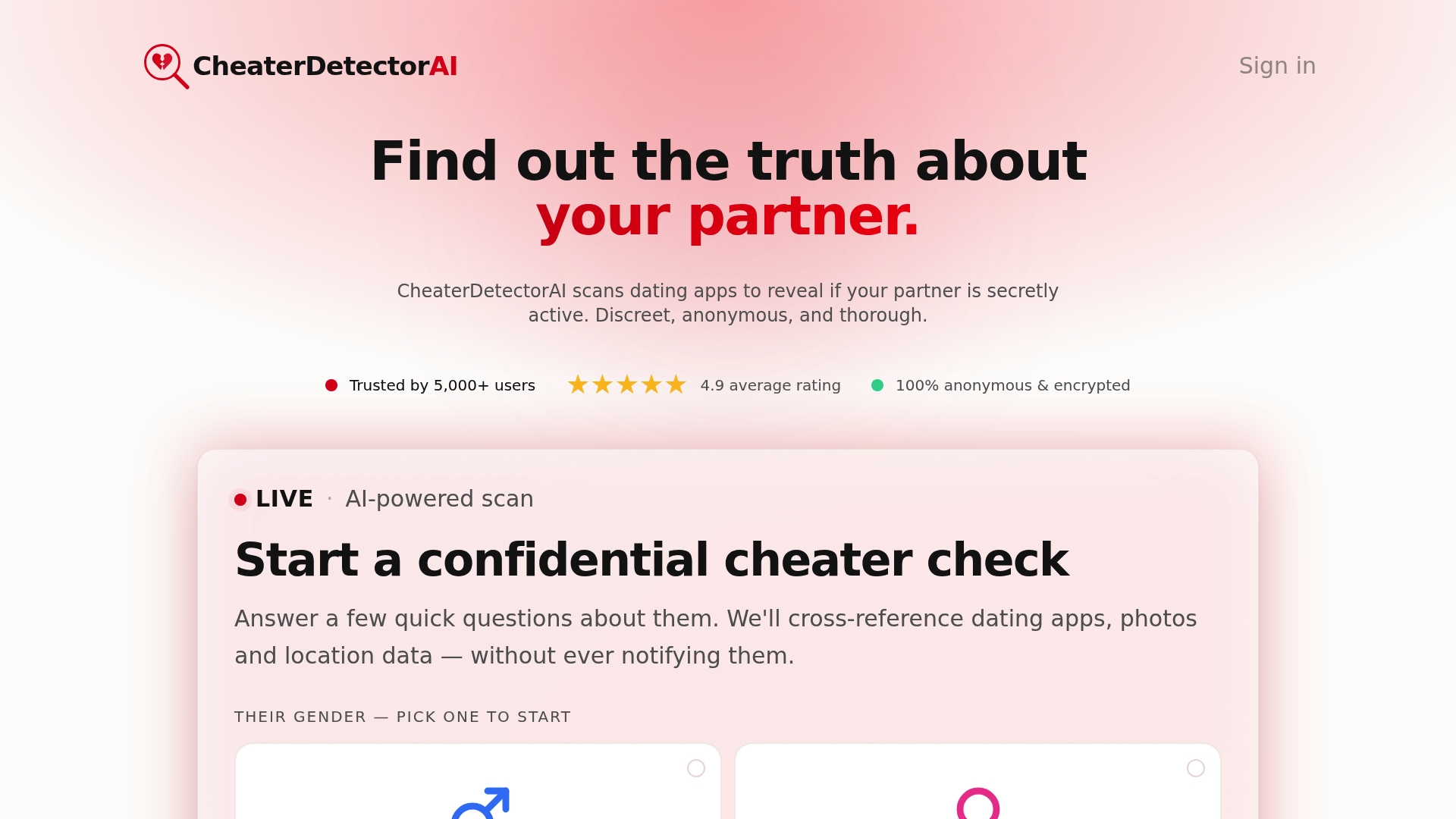
Cheaterdetector’s Deep Person Scan cross-references a partner’s information against major dating apps using an encrypted, anonymous process. The person being searched receives no notification. Results include profile photos and timestamps, giving you concrete evidence rather than ambiguous leads. Over 5,000 people have used the service, and it holds a 4.9 average rating. If you want to check anonymously whether your partner is active on dating apps right now, Cheaterdetector delivers a clear answer without the hours of manual searching.
FAQ
How do I find hidden dating profiles for free?
Start with the forgot password test on major dating apps using your partner’s known email addresses and phone numbers. Combine that with Google dork searches and a reverse image search on Yandex for the most reliable free results.
Can I find secret dating profiles using just an email address?
Yes. Email and phone lookups achieve an 80% success rate when those identifiers are linked to existing accounts. Enter the email into the forgot password field on dating apps, and run it through people-search platforms to find connected profiles.
What is the forgot password method for finding dating accounts?
The forgot password method involves entering a suspected email or phone number into a dating app’s login page. If the app confirms a reset link was sent, an account exists with that identifier, and the account owner receives no alert unless they complete the reset.
Does reverse image search work for finding dating profiles?
Reverse image search works well, especially on Yandex, which uses advanced facial recognition algorithms that outperform Google’s for this purpose. Upload multiple photos of the person to increase the chance of finding a matching profile.
Is it legal to search for someone’s hidden dating profiles?
Searching publicly available data is legal in the United States. Accessing private accounts, reading private messages, or installing tracking software without consent is not legal and can carry criminal penalties depending on the state.