%20scale(1.05)%20translate(-12,-14.25)'%3e%3cpath%20d='M12%2021s-7.5-4.7-7.5-10.2A4.3%204.3%200%200%201%2012%207.5a4.3%204.3%200%200%201%207.5%203.3C19.5%2016.3%2012%2021%2012%2021Z'%20fill='%23F0384A'%3e%3c/path%3e%3c/g%3e%3c/svg%3e)

Yes, emotional cheating online is real, and it can hurt as much as a physical affair. It usually shows up first in DMs, dating apps, or gaming chats. Do not install spyware or read your partner’s private messages to find out. That tends to backfire. Instead, write down what you have noticed and look into public ways to check the facts.
TL;DR:
- Around 65% of women indicate they would be more hurt by emotional infidelity than physical cheating, making online betrayal often deeply damaging.
- Signatures of online emotional cheating include secret device behavior, delayed online activity, defensiveness, and emotional withdrawal, especially if patterns persist over weeks.
- Publicly visible dating profiles and behaviors can be checked without privacy violations, but installing spyware or reading private messages crosses the line and is risky.
- Online affairs develop quickly due to constant access and trailable digital footprints, often starting from small, seemingly harmless interactions that escalate over time.
- Rebuilding trust after online emotional cheating typically requires therapy, transparency, accountability, and patience, with some cases leading to separation if accountability is refused.
What Counts as Emotional Cheating Online?
Emotional cheating online happens when secrecy, emotional energy, and broken boundaries mix together. It is not just about attraction. It is about where your partner puts his or her heart when you are not looking.
Here is the plain version: if your partner hides conversations, shares your relationship problems with someone else, and gets emotional comfort from that person instead of you, that is an emotional affair. The platform does not matter. What matters is the secrecy and the redirected intimacy.
Some clear examples make this easier to spot:
- Long, private text or DM threads with someone your partner has never mentioned to you
- Venting about your relationship’s problems to another person instead of you
- A secret dating app account, even if your partner insists he or she “never talks to anyone”
- Pet names, inside jokes, or flirty banter with someone outside the relationship
- Deleting message threads or hiding notifications from a specific person
Not every online friendship is a threat. A coworker chatting about a shared hobby, or an old friend catching up once in a while, is not automatically cheating. The difference is whether it is hidden and whether it replaces emotional closeness with you.
This is where micro-cheating enters the picture. Micro-cheating is a small act that alone might seem harmless, like a flirty comment or keeping a dating app “just to browse.” One incident rarely breaks a relationship. But small acts pile up. A dozen private compliments, a few hidden late-night chats, and one dating profile “just in case” can add up to the same betrayal as a full affair. If you have noticed a pattern of small dating-app behaviors, it is worth taking seriously rather than dismissing as nothing.
Researchers who study infidelity have found that secrecy, not the platform, predicts the harm. A hidden relationship on a gaming app can wound just as deeply as a hidden relationship at the office, according to peer-reviewed research on online infidelity. The device is not the problem. The hiding is.
Couples also do not always agree on where the line sits. What feels harmless to your partner might feel like betrayal to you, and vice versa. Therapists who work with couples on digital boundaries stress that partners need to define these lines out loud, not assume the other person already knows where they stand. If you have never had that conversation, that gap itself might be part of why you feel uneasy right now.
Signs and Red Flags You Can Actually See
You do not need to snoop to notice that something feels off. Your own eyes and gut are often enough to start.
Watch for these behavioral changes:
- Device secrecy. Your partner turns the phone screen away, takes calls in another room, or suddenly changes the passcode.
- New passwords or locked apps. Accounts that used to be open are suddenly private.
- Deleted history. Browser history, texts, or app data disappear more often than usual.
- Late-night online time. Your partner is on the phone long after you have gone to bed, and it becomes a pattern, not a one-off.
- Defensive reactions. A simple question like “who were you texting?” turns into an argument.
- Emotional withdrawal. Less conversation, less affection, less interest in your day.
Common consumer-facing guidance from therapists lists device secrecy, late-night scrolling, deleted history, and secret accounts as the most reported red flags for online affairs. None of these on their own proves anything. Your partner might just be stressed at work or dealing with something unrelated to you.
What actually matters is the pattern. One late night means nothing. Three weeks of late nights, paired with a new passcode and sudden defensiveness, means something. Cross-check the timeline. Did the secrecy start after a new coworker joined his team? After she reconnected with an old friend online? Patterns and timing tell you more than any single moment ever will.
Pro Tip: Keep a private, simple log with dates and short notes (“Tuesday, phone face down at dinner, got defensive when I asked”). A pattern is easier to see on paper than in your memory, and it keeps you from second-guessing yourself later.
Here is what you should never do, no matter how anxious you feel:
- Do not install spyware or a tracking app on his or her phone
- Do not log into accounts you do not have permission to access
- Do not read private messages without consent
- Do not forge, alter, or plant evidence to “prove” a point
These are not just relationship no-nos. Spyware and unauthorized account access can put you, not your partner, in real trouble. If you are building a case for yourself or a future conversation, stick to publicly visible information instead of anything that requires breaking into a device or account.
Where It Happens: Signals by Platform
Different platforms create different kinds of secrecy. Knowing what to look for on each one helps you separate a real concern from a false alarm.
Social media DMs. A sudden shift to private messaging with one specific person, especially someone who was not part of your partner’s life before, is worth noticing. So is a new or secondary username your partner uses to follow or message someone. Deleted message threads with a particular contact, when everything else stays intact, is another signal.
Dating apps. An active profile is the clearest sign of all, since there is no innocent reason for a committed partner to keep one live. Fresh matches, a new app installed on a shared tablet or old device, or an unexplained subscription charge on a shared account all point the same direction.
Gaming platforms, Discord, and forums. Daily private chats with one particular username, inside jokes that reference conversations you were never part of, and voice calls your partner steps away to take are common patterns. Some of these relationships stay platonic. Others slowly become the emotional center of your partner’s day, quietly replacing the closeness that used to belong to you. Chatbot and AI companion apps have added a newer wrinkle here too. Some people form intense emotional attachments to AI roleplay and companion tools, and while that is not the same as human infidelity, it can still crowd out emotional connection with a real partner.
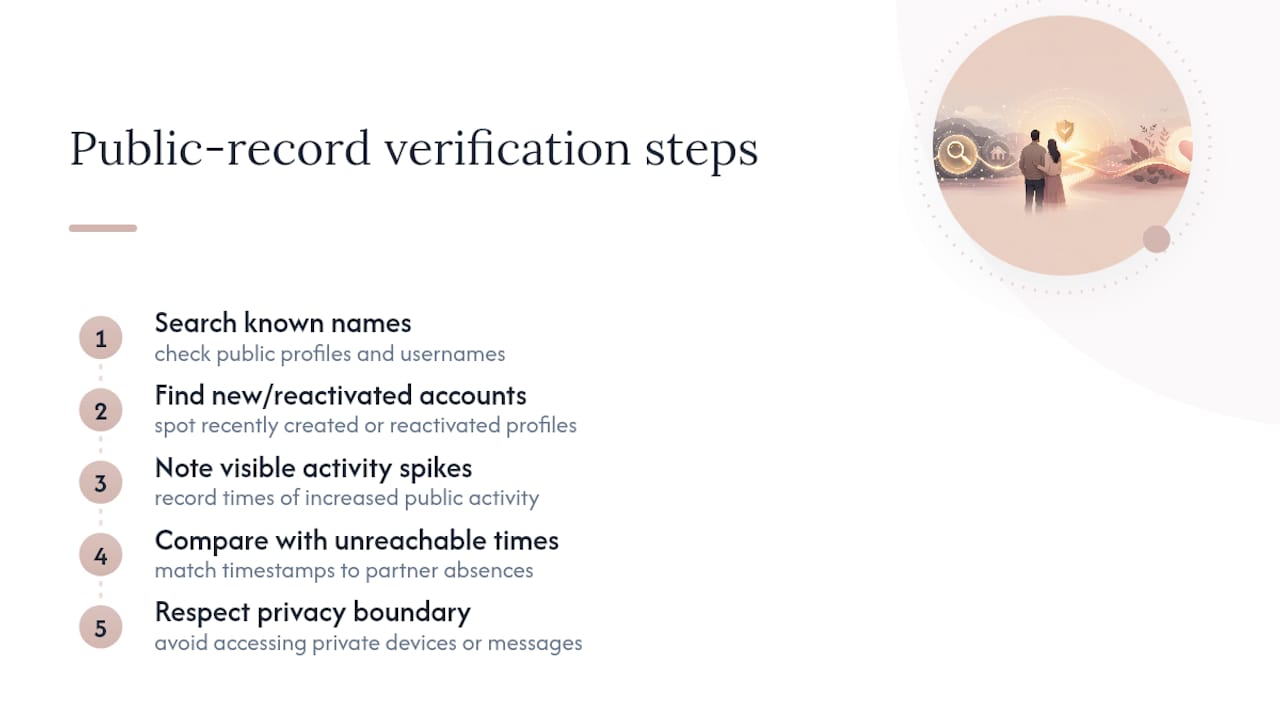
The good news: you can check a lot of this without touching anyone’s device. Search public profiles under names or usernames you already know. Look for accounts that seem new or recently reactivated. Note the times activity spikes, and see if that lines up with the moments your partner has been “busy” or unreachable. This kind of public-record search is fine because you are not accessing anything private. You are looking at what is already visible to anyone.
How Emotional Cheating Online Affects Your Mind and Body
The pain from an online emotional affair is not “less real” just because nothing physical happened. Clinical case reviews describe online infidelity as potentially devastating, and they link it to depression and serious relationship breakdown in the betrayed partner.
A striking number: 65% of women in one Psychology Today survey said they would be more upset by emotional infidelity than by sexual cheating. Emotional betrayal is not the “lighter” version of an affair. For many people, it is the deeper wound.
If you are living through this right now, your reactions probably make more sense than you think. Betrayed partners commonly report:
- Intrusive thoughts that replay the discovery over and over
- Trouble sleeping or nightmares about the relationship
- Anxiety that spikes around phones, notifications, or specific names
- Depression, low motivation, or trouble functioning at work
- A racing need to check, search, or confirm what happened
Research summaries on betrayal trauma report that 30 to 60 percent of betrayed partners develop symptoms that look like PTSD, including flashbacks and hypervigilance. That is not a small number, and it is not a sign that you are overreacting. It is a documented pattern.
On the other side, the partner who strayed often moves through a predictable emotional arc: denial first, then rationalization (“it wasn’t a real relationship,” “we never met in person”), and only later, if at all, genuine remorse. Recognizing this pattern will not fix anything on its own, but it can help you make sense of confusing responses if you decide to have the conversation.
What to Do First: A Calm Action Plan
The urge to check everything right now is normal. Slowing down for a day changes almost nothing about the outcome, but it protects you, practically and emotionally.
- Pause before you act. Strong emotion pushes people toward decisions they regret, like grabbing a phone or confronting someone in public. Give yourself a few hours or a day before doing anything.
- Document observable facts. Write down dates, times, screenshots of anything public, and specific behaviors you noticed. Stick to facts, not interpretations.
- Do not install trackers or read private messages. This bears repeating because it is the single most common mistake people make, and it is the one that can turn you from the wronged party into the one in trouble.
- Consider a public-profile check. A legal, public search can confirm whether your partner has an active dating profile, without touching his or her phone or accounts.
- Plan the conversation, if you choose to have one. Pick a private time and place, not the middle of an argument or in front of others.
When you do talk to your partner, keep it specific. “I noticed you’ve been on your phone until 2 AM for three weeks and you get upset when I ask about it” lands very differently than “I think you’re cheating on me.” Vague accusations invite defensiveness. Specific observations invite honesty, or at least a real conversation.
If emotions run high on either side, having a therapist present, or scheduling the conversation as your first couples counseling session, keeps things from spiraling into pure conflict.
Pro Tip: Write out what you want to say beforehand, even just a few bullet points. Betrayal makes people forget their own points mid-sentence. A note on your phone (not spyware, just your own notes) keeps you grounded.
One more thing matters more than any evidence-gathering step: your safety. If your partner has ever threatened you, become physically aggressive, or made you afraid to bring up hard topics, this is no longer just an infidelity question. Contact a domestic violence hotline or a legal professional familiar with emotional and psychological abuse before doing anything else. No relationship question is worth your physical safety.
Recovery Pathways: Therapy, Trust, and Realistic Timelines
Recovery is possible, but it rarely happens on its own. Cleveland Clinic’s guidance on emotional affairs is direct about this: rebuilding trust usually requires therapy plus real, sustained behavior change, not just an apology and a promise to do better.
Three therapy approaches show up again and again in professional recommendations:
- Emotionally Focused Therapy (EFT) works on the underlying attachment wounds, helping both partners understand the fear and need hiding underneath anger or withdrawal.
- The Gottman Method focuses on rebuilding trust through specific, structured exercises and repairing communication patterns that broke down before the affair even started.
- Trauma-informed care treats the betrayed partner’s symptoms, like flashbacks and hypervigilance, as real trauma responses that need their own attention, not just couples work. In clinical practice, therapists often watch for these avoidance and hypervigilance patterns and use structured interventions to calm them faster than open-ended talk alone.
Beyond picking a modality, the actual rebuild tends to follow the same shape: full transparency that both partners agreed to (not surveillance, agreement), some form of verified accountability for a period of time, clearly stated boundaries going forward, and regular check-ins to see if trust is actually returning or just being performed.
Do not skip your own support system in favor of only “fixing” the relationship. Individual therapy helps you process the betrayal trauma on its own terms, while couples work rebuilds the relationship itself. These are different jobs, and trying to do both at once, alone, rarely works. Peer support groups for betrayed partners can also remind you that what you are feeling is common, not a personal failing.
Sometimes, honestly, separation is the healthier outcome. If your partner refuses accountability, minimizes what happened, or repeats the same secrecy after promising change, that is information too. Finding your own peace does not always require staying in the relationship that hurt you.
How Cheater Detector AI Fits Into Your Recovery
Cheater Detector AI scans public dating app profiles to see if your partner has an active account, using only minimal details you already know, like a name or a photo. It never touches his or her phone, and it never accesses private messages.
That distinction is what keeps this clean. Spyware and message-reading require secretly accessing someone else’s device or account. A public-profile scan does not; it looks only at information dating platforms already show to anyone browsing. Cheater Detector AI’s own guidance on proving infidelity legally walks through exactly why that line matters.
A report from a scan like this can serve a few honest purposes:
- Confirming or ruling out an active dating profile before a difficult conversation
- Giving your therapist concrete facts to work with instead of vague suspicion
- Providing personal clarity so you can stop guessing and start deciding
Used this way, a report is a starting point for conversation or therapy, not a weapon to ambush someone with.
Why People Cheat Emotionally Online in the First Place
Understanding the “why” will not undo the hurt, but it can help you make sense of something that otherwise feels senseless.
Online emotional affairs often start small and almost by accident. A conversation that begins as venting about work stress slowly becomes the highlight of someone’s day. Anonymity plays a role too. Typing to a stranger feels lower stakes than talking to a friend, which makes people say things they would never say out loud, and that honesty can feel intoxicating.
Loneliness inside an existing relationship is one of the most common drivers. If your partner feels unseen or unheard at home, a message thread where someone listens closely and responds instantly can fill that gap fast, even without any physical attraction involved. Novelty matters as well. A new person online has none of the friction of daily life, no arguments about chores, no history of old fights, just curated, easy connection.
None of this excuses the secrecy or the broken boundary. But it does explain why so many people who cheat emotionally online insist “it wasn’t really cheating.” In their mind, low stakes and no physical contact made it feel safe to minimize. To the partner who finds out, it rarely feels small at all.
Online vs. Offline Emotional Cheating: What Actually Differs
An emotional affair that happens over text and one that happens at the office share the same core ingredients: secrecy, redirected intimacy, and broken trust. The wound underneath both is nearly identical.
What differs is speed and access. Online conversations can happen at 2 AM without either person leaving the house, which means an emotional affair can develop in weeks instead of months. Physical proximity is not required, so someone across the country, or someone your partner has never met in person, can become emotionally central to his or her life. That can feel especially disorienting to a betrayed partner. “But you’ve never even met her” is a common and painful reaction, even though it does nothing to reduce the betrayal.
Online affairs also leave more of a trail, and more places to hide that trail. Deleted DMs, secret usernames, and app-specific privacy settings create new hiding spots that a workplace affair never had. At the same time, that trail sometimes makes public verification easier than it would be for something like an in-person emotional affair with a colleague, where there is no digital footprint at all to check.
Setting Digital Boundaries Without Starting a Fight
Most couples never explicitly discuss what counts as crossing a line online, which is exactly why so many disagreements happen after the fact instead of before it.
Start the conversation when things are calm, not mid-argument. Ask direct questions: is it okay to have private conversations with an ex? What about keeping a dating app “just to browse” out of curiosity? Is deleting messages from a specific person okay, and if so, why would that be necessary in a relationship built on trust? There are no universal right answers here. What matters is that both partners say their expectations out loud instead of assuming the other one already agrees.
Revisit these boundaries periodically, especially after a big life change like a new job, a reconnection with an old friend, or a new hobby that involves a lot of online interaction. Boundaries set once during a calm conversation two years ago might not cover the situation you are dealing with today.
Preventing Emotional Cheating Before It Starts
Most online emotional affairs do not start because someone set out to betray their partner. They start in the gap left by disconnection, and they grow because nobody named the problem early enough.
Regular, honest check-ins matter more than any single rule. A five-minute conversation once a week about how connected you both feel catches drift long before it turns into secrecy. Curiosity about your partner’s day, actually asking and listening, does more preventive work than any restriction on who he or she can talk to online.
Transparency about new friendships, especially ones that involve a lot of one-on-one messaging, keeps things from ever needing to be hidden in the first place. If your partner mentions a new online friend openly, that openness itself is protective. Secrecy is what turns a harmless connection into a threat.
Ethical Lines You Should Know
The single most important fact in this entire topic is simple: installing spyware, using a tracking app, or reading someone else’s private messages without consent is illegal in most places, and it can come back on the person doing it, not just the person being checked on.
This matters even if your intentions feel justified. Courts generally do not weigh “I had a good reason” against unauthorized access to someone’s private accounts or devices. That is why every path in this article points toward public, visible information: profile searches, observed behavior, timestamps on public posts. None of that requires breaking into anything.
Ethically, there is also a difference between verifying a suspicion and building a surveillance habit. A single, bounded check to confirm or rule something out is different from repeatedly monitoring a partner’s every move indefinitely. The goal is clarity, not control.
A Straight Answer From Someone Who Has Seen This Play Out
Here is what most articles on this topic get wrong: they treat emotional cheating like a lesser offense, something to feel embarrassed about being upset over because “at least nothing physical happened.” That framing does real damage. If the Psychology Today numbers on emotional betrayal tell us anything, it’s that plenty of people experience this as the deeper wound, not the smaller one.
The other thing worth saying plainly: your instinct to want proof before confronting someone is not paranoid. It is reasonable. Betrayal makes people doubt their own perception, and having something concrete, even a simple confirmation that a dating profile exists, can steady you enough to have the conversation clearly instead of in a panic.
What I would push back on is the idea that you need to become a detective who snoops through phones to get that clarity. You do not. The information that actually matters is usually sitting in public view.
— Oleg
Check Their Profile Without Touching Their Phone
Cheater Detector AI exists for exactly this moment, when you need answers but refuse to become the person who installed spyware or read someone’s private texts without permission. It scans public dating app profiles using only basic details you already have, and it never touches your partner’s phone or accounts.
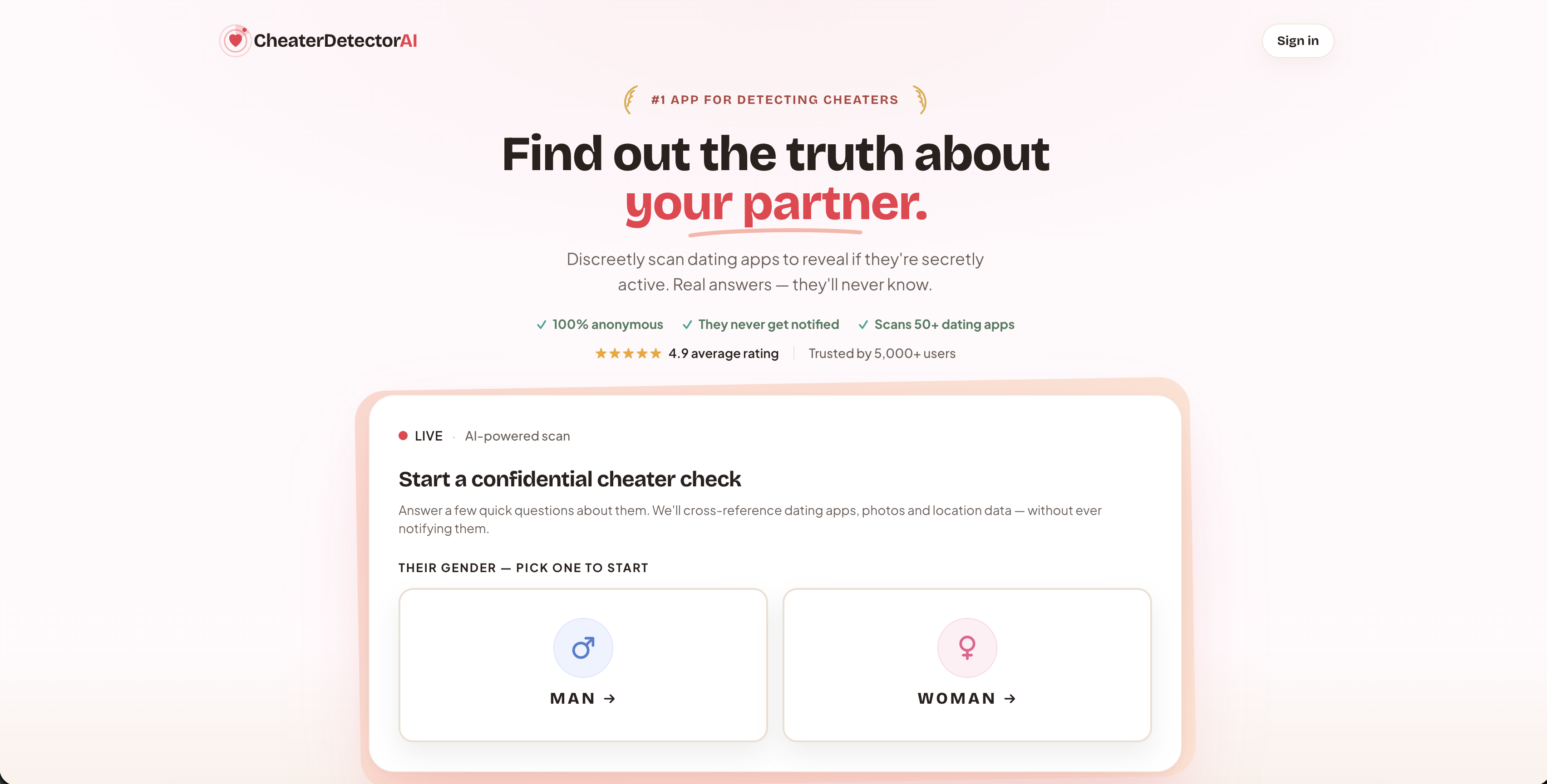
Every report comes back encrypted and anonymous, so your partner never knows you looked. That is the difference between this and a traditional private investigator, who charges far more and takes far longer for the same kind of public information. Cheater Detector AI has helped many users get answers, with high average ratings, and results typically come back quickly, not after weeks of waiting.
If you specifically want to know whether your partner has an active profile on a particular app, check the Hinge Profile Search or the OkCupid Profile Search. If you only have a photo and no other details, try the reverse image dating search. For a broader check across major platforms, run a deep person scan today and get the clarity you need without any snooping.
Search their name now. You deserve a straight answer, and you deserve to get it without snooping.
Sources
For readers who want to look deeper into the research or find professional support, these resources informed the claims in this article:
- What Is Emotional Cheating? A Therapist Explains — Cleveland Clinic (2024)
- Signs your spouse is having a cyber affair — Verywell Mind
This article is general information, not a substitute for advice from a qualified doctor. Consult a qualified healthcare professional about your own circumstances before acting on anything here.
FAQ
Can You Come Back From Emotional Cheating?
Yes, many couples recover with real effort. It typically requires full transparency from the partner who strayed, structured therapy like EFT or the Gottman Method, and enough time for trust to rebuild through consistent behavior, not just apologies.
What Does It Mean to Be Emotionally Cheated On?
Being emotionally cheated on means your partner secretly redirected emotional intimacy, confiding, comfort, closeness, toward someone else while hiding it from you. It does not require physical contact to count as a real betrayal, and research suggests many people find it more painful than physical infidelity.
What Are the Stages of an Emotional Affair?
Definitions vary across sources, but most describe a similar arc: an innocent connection, growing emotional reliance, secrecy about the relationship, increasing intimacy and comparison to the primary partner, and eventually either confrontation or, in some cases, ending of the primary relationship. Not every affair passes through every stage in the same order.
Is It OK to Check if My Partner Has a Dating Profile?
Checking a publicly visible dating profile is fine, since you are only viewing information the platform already shows to anyone browsing. Installing spyware or accessing private accounts without permission is a different matter entirely and can carry real risk for the person doing it.
How Do I Know if It’s Micro-Cheating or a Full Affair?
Micro-cheating is usually a smaller, isolated act, like a flirty comment or a dormant dating profile, while a full emotional affair involves ongoing secrecy and redirected emotional closeness. The pattern and frequency matter more than any single incident when you’re trying to tell the difference.