%20scale(1.05)%20translate(-12,-14.25)'%3e%3cpath%20d='M12%2021s-7.5-4.7-7.5-10.2A4.3%204.3%200%200%201%2012%207.5a4.3%204.3%200%200%201%207.5%203.3C19.5%2016.3%2012%2021%2012%2021Z'%20fill='%23F0384A'%3e%3c/path%3e%3c/g%3e%3c/svg%3e)

Catching a cheater online is defined as using publicly accessible data and Open-Source Intelligence (OSINT) techniques to verify whether a partner is secretly active on dating apps or maintaining hidden relationships. This guide covers legal, discreet methods that protect your rights and your emotional wellbeing. You will learn how to use reverse lookups, behavioral pattern analysis, and systematic documentation to find the truth without touching your partner’s phone or breaking any laws.
How to catch a cheater online: legal and ethical boundaries first
The single most important rule is this: unauthorized account access is illegal in most U.S. jurisdictions and can destroy your legal standing. The Computer Fraud and Abuse Act prohibits accessing any device or account without permission, regardless of your relationship to the person. Evidence gathered through hacking or spyware is inadmissible in court and can expose you to criminal liability.
OSINT, or Open-Source Intelligence, is the practice of collecting information from publicly available sources. It is the standard method used by private investigators, journalists, and law enforcement when they cannot obtain a warrant. For your purposes, it means searching public profiles, public records, and open databases rather than reading private messages.
The ethical line is clear. Public posts, public profiles, and public records are fair game. Private messages, locked accounts, and device contents are not.
- Public data (legal): Social media public profiles, dating app profiles visible without login, public records databases, Google search results
- Private data (illegal): Email inboxes, locked phone apps, private messages, location tracking without consent
- Gray areas: Shared family accounts, joint email addresses, devices you co-own
Most divorce attorneys report that social media evidence is commonly used in legal proceedings, but only when collected lawfully through public data. That distinction matters enormously if your situation ever reaches a courtroom.
Pro Tip: If you are unsure whether a specific search method crosses a legal line, consult a family law attorney before proceeding. A 30-minute consultation is far cheaper than a legal defense.
Which free tools and public data sources reveal hidden activity?
The most effective free approach combines several lookup methods rather than relying on any single search. Each tool type surfaces a different layer of your partner’s digital footprint.
Reverse phone lookup
A reverse phone lookup tells you the carrier, account type, and sometimes the name registered to a number. VoIP numbers, such as those from Google Voice, are a specific red flag because they are commonly used to communicate without leaving a traceable record on a standard phone bill. If your partner has an unexplained second number that routes through a VoIP service, that warrants further investigation.
Reverse email lookup
An email address is often the key that unlocks an entire digital identity. Entering a suspected email into a people-search database can surface linked social media accounts, dating profiles, and forum registrations. Many dating apps require email verification, so a secondary email your partner uses for “work” may actually connect to a Tinder or OkCupid account.
Username and handle searches
Experienced investigators search for usernames with specific variations: removing trailing numbers, combining the handle with a city name, or pairing it with a platform name. This technique, known as username enumeration, catches people who reuse a consistent handle across platforms but add slight modifications to avoid detection. Tools like Namechk and similar username search services scan dozens of platforms simultaneously.

Reverse image search
Reverse image search catches a significant portion of fake or reused profile photos, particularly when you use multiple search engines and crop the image to different sections. The workflow is straightforward: save the photo, upload it to Google Images and at least one additional engine, then review the results for matching profiles on dating sites or social platforms.
Pro Tip: Crop the image to the face only, then search again. Profile photos are often cropped differently across platforms, and a full-image search may miss matches that a face-only crop catches.
| Tool type | What it commonly reveals |
|---|---|
| Reverse phone lookup | Carrier type, VoIP status, registered name |
| Reverse email lookup | Linked accounts, dating app registrations |
| Username search | Cross-platform profiles, alias patterns |
| Reverse image search | Reused photos, fake profiles, alternate identities |
| People-search databases | Address history, public registrations, relatives |
What digital and behavioral patterns signal cheating on dating apps?
Behavioral changes are meaningful only when they represent a shift from an established baseline. A single late night at the office means nothing. A consistent pattern of new privacy behaviors, unexplained absences, and changed digital habits is a different matter entirely.
Changes from an established digital baseline are the signals worth tracking. Isolated anomalies almost always have innocent explanations. Converging patterns rarely do.
Watch for these specific shifts:
- New privacy settings: A partner who suddenly locks their phone with a new passcode, enables screen-time restrictions, or turns off location sharing has changed their baseline behavior.
- Secondary accounts: A second Instagram, Snapchat, or email account with no clear purpose is a concrete finding, not speculation.
- Late-night activity spikes: Consistent phone use between midnight and 3:00 AM, especially when they step away from you to use it, is a behavioral pattern worth noting.
- Deleted interactions: Cleared message threads, deleted apps, or browser history wiped immediately after use suggest deliberate concealment.
- Unexplained expenses: Small recurring charges from unfamiliar apps or subscription services can indicate paid dating platform memberships.
The difference between innocent behavior and converging evidence is volume and consistency. One changed behavior is a data point. Four or five changed behaviors over the same two-week period is a pattern.
Pro Tip: Keep a written log with dates and times for each observation. Memory distorts under emotional stress, and a timestamped record protects you from misremembering details later.
Step-by-step process for a safe online investigation
Professional investigators build patterns and cross-reference timelines rather than searching for a single smoking-gun piece of proof. That approach is slower but far more credible.
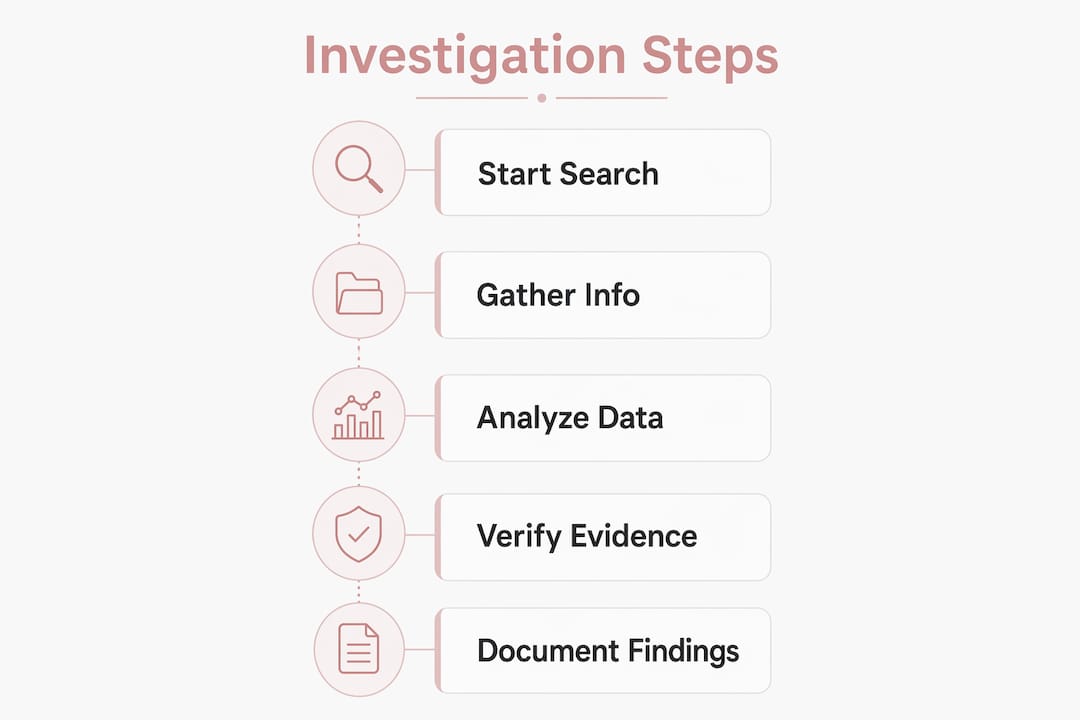
- List what you already know. Write down every data point you have: phone numbers, email addresses, known usernames, and platforms your partner uses openly. This is your starting inventory.
- Run layered searches. Start with the phone number, then the email, then any usernames. Each search may surface new data points that feed the next search. Correlating independent data points across phone registrations, location tags, and account histories produces stronger evidence than any single finding.
- Search dating platforms directly. Many platforms allow profile browsing without an account. Check hidden dating profiles by searching your partner’s known photos, email variations, and username patterns on major apps.
- Build a timeline. Map each finding to a date. Note when a profile was created, when it was last active, and whether those dates align with behavioral changes you observed.
- Save and timestamp everything. Take screenshots with the date and time visible. Use a free tool like Google Keep or a dedicated folder in Google Drive to organize findings chronologically.
- Separate fact from assumption. A dating profile exists or it does not. A number is VoIP or it is not. Write only confirmed findings in your record. Keep suspicions in a separate column.
Combining multiple evidence types like profile similarity, timing evidence, and account activity achieves far greater accuracy than relying on isolated clues. Do not confront your partner until your timeline is complete and your findings are documented. Premature confrontation ends the investigation and rarely produces honest answers.
| Investigation stage | Common mistake | Better approach |
|---|---|---|
| Starting the search | Jumping to conclusions from one finding | Build a multi-source timeline first |
| Saving evidence | Relying on memory | Screenshot with visible timestamps |
| Confrontation timing | Acting on suspicion alone | Wait for documented, cross-referenced findings |
How to protect your emotional wellbeing during the process
Investigating a partner’s potential infidelity causes real psychological harm. Mental health experts recommend managing your emotions carefully throughout the process because the investigation itself can generate as much stress as the original suspicion.
“Grounding your approach in open communication instead of surveillance supports emotional health and builds a foundation of trust, regardless of the outcome.” This principle does not mean ignoring evidence. It means staying anchored to facts rather than worst-case scenarios while you gather them.
Practical steps to protect yourself:
- Tell one trusted person. A close friend or family member who can offer perspective without escalating the situation is a genuine asset.
- Consider professional counseling. A therapist who specializes in relationship issues can help you process findings without making impulsive decisions.
- Set time limits on searching. Spending hours every day on investigation work accelerates anxiety. Limit active searching to defined windows.
- Do not share findings on social media. Posting suspicions publicly damages your legal position and your partner’s reputation before facts are confirmed.
- Maintain your normal routines. Exercise, sleep, and social connection are not optional during high-stress periods. They are what keep your judgment clear.
The goal of the investigation is clarity, not revenge. Keeping that goal in mind protects both your mental health and the quality of your findings.
Key Takeaways
Catching a cheater online requires OSINT methods, layered searches, documented timelines, and strict adherence to legal boundaries around public data.
| Point | Details |
|---|---|
| Stay within public data | Only search publicly accessible profiles, records, and databases to protect your legal standing. |
| Layer your searches | Combine phone, email, username, and image searches to build cross-referenced evidence. |
| Document with timestamps | Save screenshots with visible dates and times to create a credible, organized record. |
| Track patterns, not incidents | Converging behavioral changes over time are far more meaningful than isolated anomalies. |
| Protect your mental health | Set search time limits, confide in one trusted person, and consider professional counseling. |
Why patience matters more than any single tool
I have spent years watching people make the same mistake: they find one suspicious thing and confront their partner immediately. The partner denies it, deletes everything, and the investigation is over. The person who suspected infidelity is left with nothing confirmed and a relationship that is now openly hostile.
The OSINT approach works because it is methodical. You are not trying to catch someone in a single moment. You are building a picture from dozens of small, verifiable data points. That picture either confirms your suspicion or clears it. Either outcome is better than living in uncertainty.
What I find most underappreciated is the legal protection that comes with staying in public data territory. If your situation ever involves a divorce attorney or a custody dispute, evidence gathered through public OSINT is admissible. Evidence gathered by reading private messages or installing tracking software is not. The method you choose now determines what you can actually use later.
The tools available today, from anonymous partner checks to reverse image searches, make it genuinely possible to verify suspicions without confrontation, without illegal access, and without tipping your partner off. That was not true ten years ago. Use that advantage carefully and deliberately.
— Oleg
Cheaterdetector: discreet dating app scanning when you need answers fast
Sometimes you have done the manual searches and still need a definitive answer about whether your partner is active on dating apps. Cheaterdetector is built specifically for that situation.
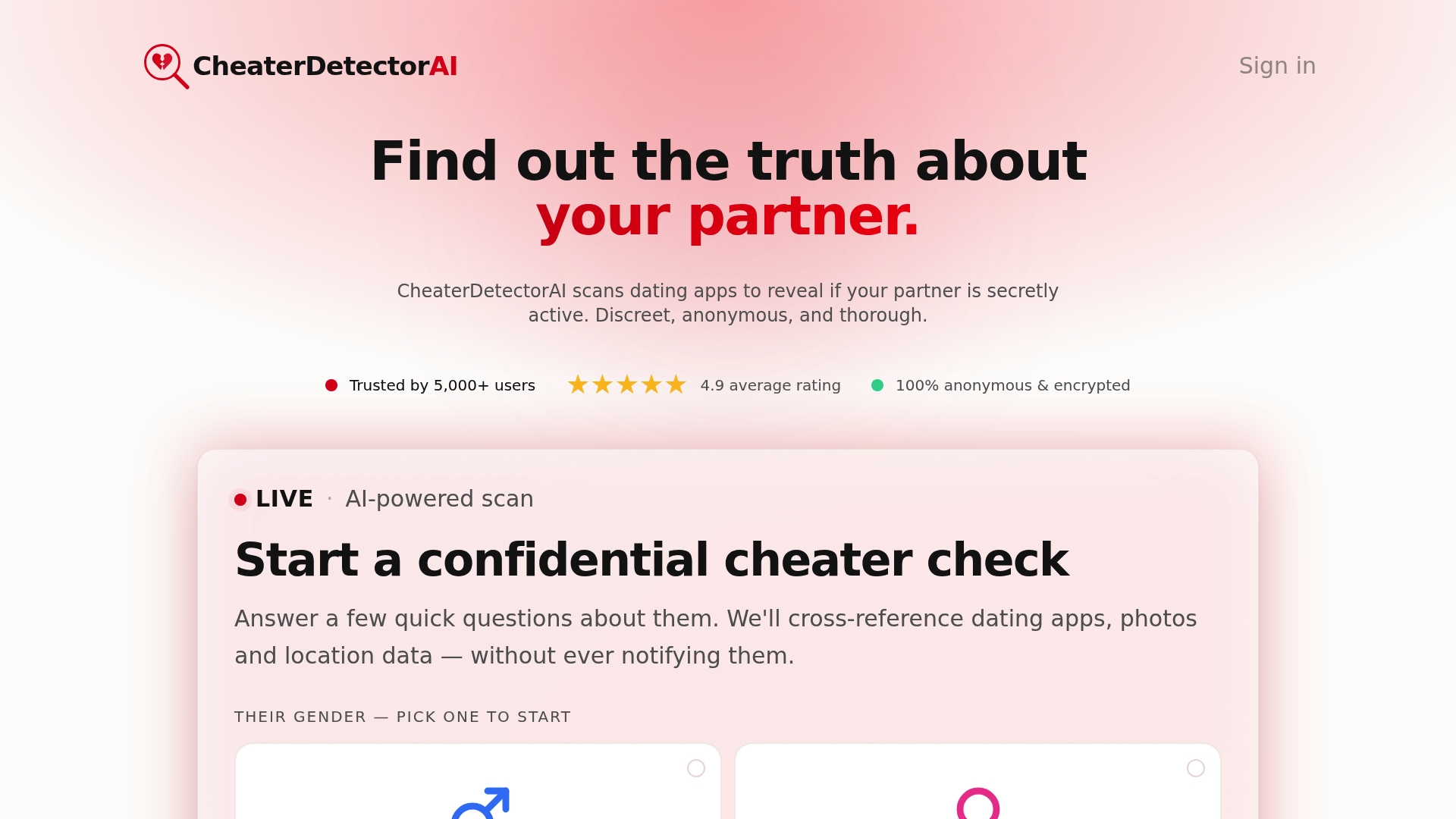
Cheaterdetector uses AI-powered scanning to cross-reference your partner’s information against profiles across major dating platforms. The process is anonymous and encrypted, meaning your partner receives no notification that a search was run. You enter minimal information, and the scan returns a detailed report that includes profile photos and timestamps. Over 5,000 people have used the service, which carries a 4.9 average rating. If you want to verify your partner’s app activity without the hours of manual searching, Cheaterdetector delivers that answer discreetly and securely. You can also run a deep person scan to surface concealed or alias profiles across a broader range of platforms.
FAQ
What is the safest legal way to catch a cheater online?
The safest method is OSINT, which uses only publicly available data such as public profiles, people-search databases, and reverse lookups. Unauthorized access to private accounts or devices violates the Computer Fraud and Abuse Act and can expose you to criminal liability.
Can I catch a cheater online for free?
Yes. Reverse phone lookups, reverse email searches, username enumeration tools, and reverse image searches are all available at no cost. Free methods require more time and manual effort than paid services, but they are effective when used in combination.
How do I find out if my partner is on a dating app?
Search their known email addresses and username variations directly on major dating platforms. You can also use a dating profile search service that scans multiple apps simultaneously without alerting your partner.
Is evidence from social media usable in divorce proceedings?
Most divorce attorneys confirm that social media evidence is regularly used in U.S. legal proceedings, but only when collected from public data sources. Evidence obtained through unauthorized account access is inadmissible and can harm your own legal position.
How many evidence types should I combine before confronting my partner?
Professional investigators recommend cross-referencing at least three to four independent data points before drawing conclusions. A single finding almost always has an innocent explanation. Converging evidence from multiple sources is what produces a credible, accurate picture.