%20scale(1.05)%20translate(-12,-14.25)'%3e%3cpath%20d='M12%2021s-7.5-4.7-7.5-10.2A4.3%204.3%200%200%201%2012%207.5a4.3%204.3%200%200%201%207.5%203.3C19.5%2016.3%2012%2021%2012%2021Z'%20fill='%23F0384A'%3e%3c/path%3e%3c/g%3e%3c/svg%3e)

Figuring out how to see if my girlfriend is on dating apps is something no one wants to do, but many people find themselves needing to. Suspicion without evidence is exhausting. The most effective approach combines reverse search tools, device observation, and email monitoring to confirm or rule out dating app activity without confrontation. Cheaterdetector’s AI-powered scanning is one of the most direct methods available, cross-referencing a partner’s information against profiles on major platforms anonymously. This guide walks through each method clearly, so you can get real answers and decide what to do next.
How to use reverse search methods to detect dating app profiles

Reverse search is the most technically reliable starting point when you want to check if your girlfriend is on dating apps. It works by taking an identifier you already have, such as a phone number, email address, or photo, and scanning it against known dating platform databases.
Step-by-step: reverse phone and email lookup
- Collect the identifier. Use her primary phone number or the email address she uses for personal accounts.
- Run a phone or email lookup. Reverse phone and email lookup tools like Spokeo and Searqle can identify dating app profiles linked to those identifiers. These services scan multiple platforms in one pass, which saves time compared to checking each app manually.
- Search by username. If you know a username she uses across social platforms, enter it into Google with the site search operator (e.g.,
site:tinder.com "username"). Many profiles are publicly indexed. - Run a reverse image search. Uploading a partner’s photo to Google Images or TinEye can reveal if that image appears on dating platforms. This works best with photos that are not widely shared on public social media.
- Review the results carefully. A match does not automatically confirm active use. Check the profile’s last activity date if visible.
Pro Tip: Use a photo she does not post publicly, such as one from a private text conversation, for reverse image searches. Publicly shared photos produce more false positives because they appear on many non-dating sites.
The table below shows which identifier type works best for each method.
| Identifier | Best tool | What it reveals |
|---|---|---|
| Phone number | Spokeo, Searqle | Linked dating accounts |
| Email address | Spokeo, Searqle | App registrations and notifications |
| Profile photo | Google Images, TinEye | Matching images on dating platforms |
| Username | Google site: search | Publicly indexed dating profiles |
One important limitation: apps like Tinder remove inactive profiles from visibility after about a week of inactivity. A missing result does not guarantee she is not registered. It may only mean the profile is currently hidden.
What device signs reveal dating app activity
Physical device observation is a lower-tech approach, but it produces real signals when done respectfully. The goal is to notice patterns, not to invade privacy by reading private messages.
Signs worth watching for include:
- Installed apps. Scroll through the app library on her phone if she leaves it unlocked. Dating apps are often moved to folders or the last page of the home screen.
- Notification behavior. Does she turn her phone face down when you are nearby, or dismiss notifications quickly? Unusual notification habits are a behavioral signal worth noting.
- Browser history. Browser history often reveals visits to major dating websites unless it has been manually cleared. A recently cleared history is itself a signal. Look for Tinder, Bumble, Hinge, Match.com, or OkCupid in the history.
- App storage data. On an iPhone, go to Settings > General > iPhone Storage. On Android, go to Settings > Apps. Dating apps appear in the list even if their icons are hidden from the home screen.
- Disabled notifications. Some users disable app notifications specifically to prevent alerts from showing on the lock screen. Check notification settings for unfamiliar apps.
Pro Tip: If you notice browser history has been cleared recently but the device shows high data usage on an unfamiliar app, that combination is more meaningful than either signal alone.
The legal and ethical line here is clear. Looking at publicly visible app icons or a shared browser on a shared device is generally acceptable. Installing monitoring software without consent crosses into legally questionable territory in most U.S. states. Monitoring apps that track communications without consent can violate the Electronic Communications Privacy Act. Stick to observation, not interception.
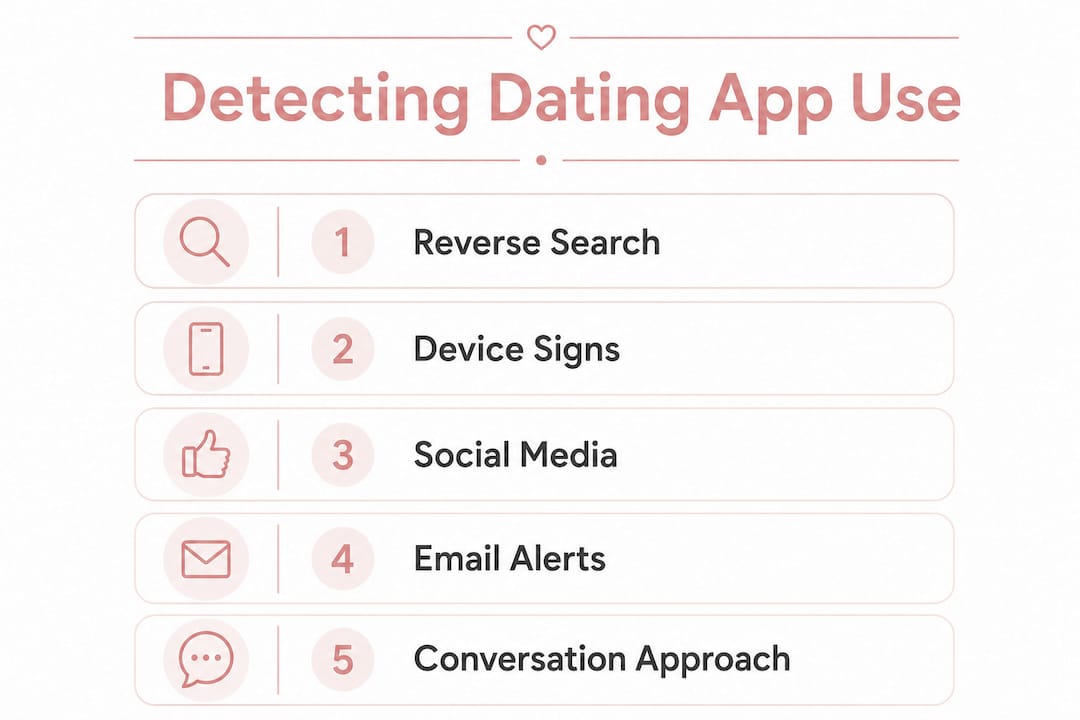
How social media and email alerts can be clues for dating app activity
Social media and linked email accounts often reveal dating app activity before any direct search does. Automated email notifications from dating apps are frequently the earliest sign of activity. Messages like “Someone liked your profile” or “You have a new match” are sent automatically and land in the inbox tied to the account.
If you have access to a shared email account or can observe her inbox briefly, look for:
- Emails from Tinder, Bumble, Hinge, Match.com, OkCupid, or Plenty of Fish
- Password reset emails from dating platforms she did not mention
- “Welcome back” or reactivation emails from apps she may have used before
- Promotional emails from dating apps, which are only sent to registered users
Social media activity can also provide indirect clues. A changed relationship status, new connections with people she has never mentioned, or increased privacy settings on her profiles are all behavioral shifts worth noting. None of these are definitive on their own, but together they build a clearer picture.
One nuance to keep in mind: many people remain subscribed to dating app email lists long after they stop using the apps. A single promotional email is not proof of active use. Look for transactional emails, such as match alerts or message notifications, which only trigger when the account is actually being used.
What to do once you find evidence
Finding evidence changes the situation immediately. The next step is not confrontation. It is documentation and reflection.
Write down what you found, when you found it, and how. Screenshots are more reliable than memory. This is not about building a legal case. It is about making sure you have a clear, accurate record before emotions take over the conversation.
“Technical findings do not resolve the root causes of suspicion. Relationship experts recommend using technology only as a first step, followed by open communication. The goal is not to win an argument. It is to understand what is actually happening in the relationship.”
Approach the conversation from a place of curiosity rather than accusation. “I noticed something and I want to understand it” lands differently than “I caught you.” The first opens a dialogue. The second triggers defensiveness.
Experts caution that investigating a partner through technology is sensitive and should be balanced with openness to restore trust. If the evidence confirms infidelity, a couples therapist can help both of you process what happened. If the evidence turns out to be benign, an honest conversation about why the suspicion arose is still worth having. Unaddressed suspicion damages relationships even when there is nothing to find.
Key Takeaways
The most reliable way to check if your girlfriend is on dating apps combines reverse search tools, device observation, and email monitoring, followed by direct communication about what you find.
| Point | Details |
|---|---|
| Reverse search is the strongest starting point | Use phone number, email, or photo lookups to scan multiple platforms at once. |
| Device observation reveals behavioral patterns | Check app storage and notification settings rather than reading private messages. |
| Email inboxes hold early evidence | Transactional dating app emails appear before any manual search turns up results. |
| Absence of results is not proof of innocence | Inactive profiles are hidden after roughly a week on apps like Tinder. |
| Technology findings require a follow-up conversation | Evidence alone does not resolve trust issues. Open dialogue is the necessary next step. |
Why I think most people go about this the wrong way
When someone asks how to find out if their girlfriend is on Tinder or any other app, the instinct is to go straight for the most invasive method available. I get it. The anxiety is real and the need for certainty feels urgent. But the people I have seen handle this well almost always start with the least invasive method first, then escalate only if needed.
Reverse image search and email lookups are genuinely powerful. They do not require touching her phone, installing anything, or violating her privacy in a way that could blow up the relationship even if you find nothing. Start there. If those methods return nothing, the behavioral signals I described above, such as cleared browser history combined with unusual data usage, are your next layer.
The part that most articles skip is this: even if you confirm she has an active profile, you still do not know the full story. A profile can exist without active use. An active profile does not always mean physical infidelity. I am not saying that to minimize what you are feeling. I am saying it because going into that conversation with “I know everything” when you actually know one data point will make the conversation worse, not better.
Use the deep person scan tools available to you. Get the clearest picture you can. Then talk to her with that picture in hand, not with assumptions layered on top of it.
— Oleg
Cheaterdetector makes the search faster and more private
Doing all of these searches manually takes hours and still leaves gaps. Cheaterdetector was built specifically to close those gaps.
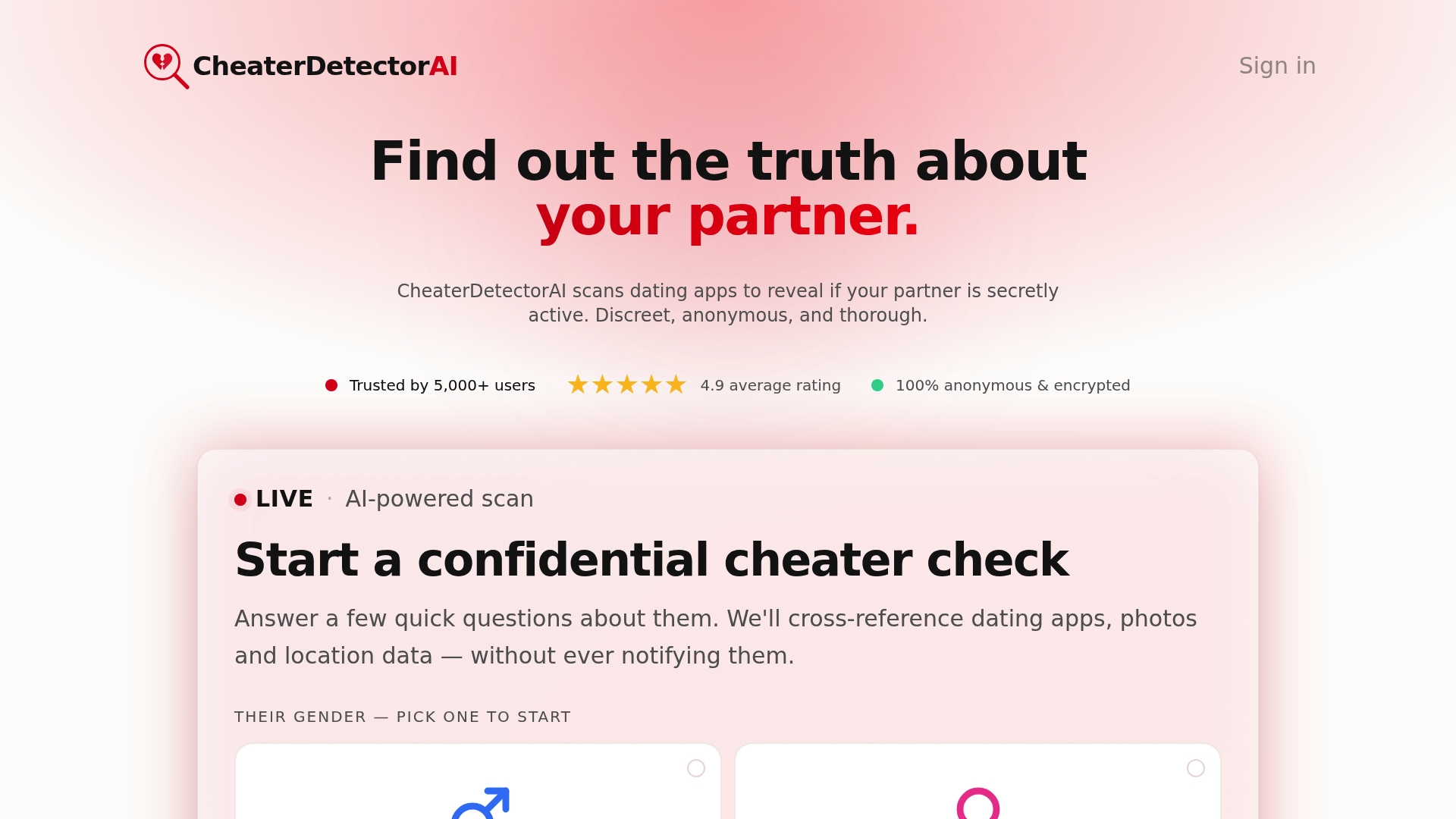
The service lets you enter basic information about your partner and runs an anonymous, encrypted scan across major dating platforms. You get a detailed report that includes profile photos and timestamps, without your girlfriend ever being notified. Over 5,000 people have used Cheaterdetector, and it holds a 4.9 average rating. If you want to check dating app activity without spending hours on manual lookups, Cheaterdetector gives you a clear answer fast. You can also run a full profile search across platforms in one pass.
FAQ
How can I check if my girlfriend is on Tinder without her knowing?
Run a Tinder profile search using her name, photo, or linked email. Cheaterdetector’s anonymous scan returns results without alerting her account.
Does clearing browser history mean she is hiding something?
Cleared browser history is a signal, not proof. It is most meaningful when combined with other indicators like unusual app data usage or unfamiliar email notifications.
Can dating apps be hidden on a phone?
Yes. Apps can be moved to hidden folders, removed from the home screen, or have their notifications disabled. Checking Settings > Apps or iPhone Storage reveals all installed apps regardless of where they appear on the screen.
What if I find a profile but she says she forgot to delete it?
Apps like Tinder hide inactive profiles after about a week of no use. If a profile appears in search results, it is likely because the account has been opened recently.
Is it legal to check my girlfriend’s phone for dating apps?
Looking at visible app icons on an unlocked phone is generally not illegal. Installing tracking or monitoring software without consent can violate federal law under the Electronic Communications Privacy Act. Stick to observation and legitimate search tools.