%20scale(1.05)%20translate(-12,-14.25)'%3e%3cpath%20d='M12%2021s-7.5-4.7-7.5-10.2A4.3%204.3%200%200%201%2012%207.5a4.3%204.3%200%200%201%207.5%203.3C19.5%2016.3%2012%2021%2012%2021Z'%20fill='%23F0384A'%3e%3c/path%3e%3c/g%3e%3c/svg%3e)

Determining whether your partner is on dating apps is possible using discreet, practical methods that require no confrontation and, in most cases, no access to their device. The most common platforms to check are Tinder, Bumble, and Hinge. Tinder reaches 8% of all U.S. adults, Bumble reaches 6%, and Hinge reaches 4%, making these three the statistically most likely places to find an active profile. That concentration matters because it tells you exactly where to focus your search first. This guide walks you through every method, what your findings actually mean, and how to handle what you discover.
Is my partner on dating apps? What to gather before you start
Before you search anything, you need two things: the right inputs and the right mindset. The inputs are practical. The mindset is what keeps you from misreading results or making a premature accusation.
The most useful pieces of information you can have are your partner’s primary email address, their phone number, and a few photos of them that are not widely posted on public social media. Each of these unlocks a different verification method. Without at least one of them, your search options narrow significantly.

| Input | Method it enables | What it can reveal |
|---|---|---|
| Email address | Registration check, reverse email lookup | Existing account on major apps |
| Phone number | Registration check on SMS-based apps | Account tied to that number |
| Photos | Reverse image search | Hidden profiles using those images |
| Age and location | In-app profile browsing | Profiles matching your partner’s description |
Emotional preparation matters just as much as the technical setup. Finding a profile does not automatically confirm active cheating. Not finding one does not confirm loyalty. Go into this process committed to gathering facts, not confirming a fear. That distinction shapes every decision you make afterward.
Step-by-step methods to check if your partner is on dating sites
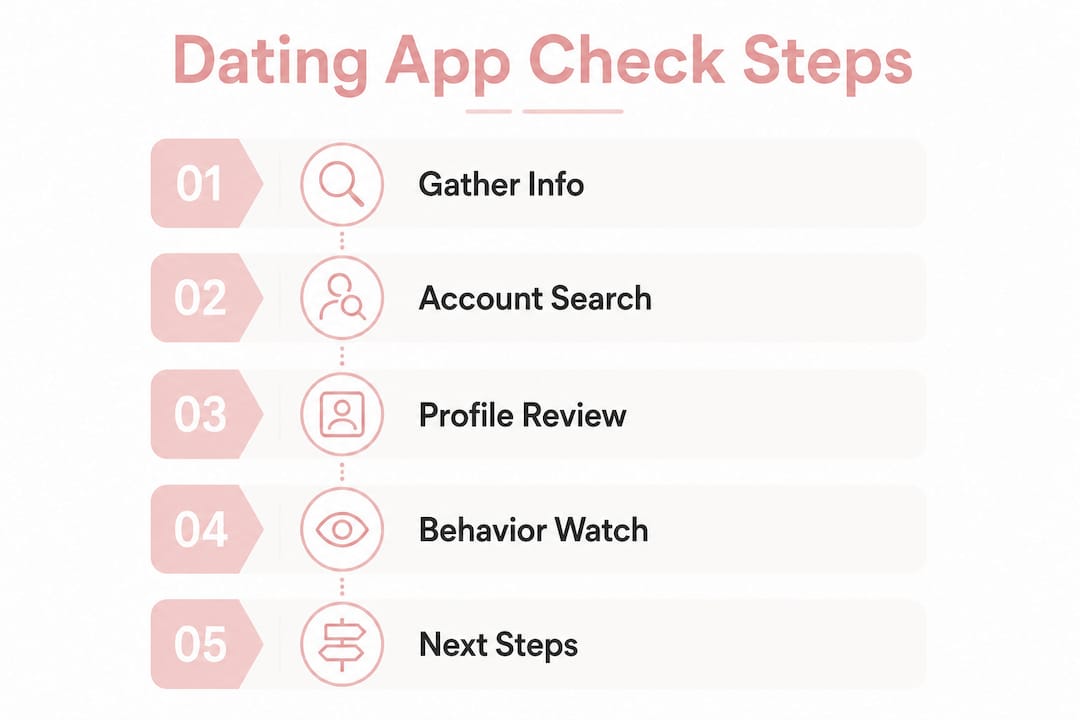
These methods move from the fastest and least invasive to the more thorough. Use them in order.
-
Run the registration check. Go to Tinder, Bumble, or Hinge and attempt to create a new account using your partner’s email address or phone number. If that contact is already registered, the app will display an “account already exists” or “email already in use” message. This check takes under 60 seconds per platform and requires no special tools.
-
Browse profiles directly inside the apps. Most dating apps allow free profile browsing using age and location filters without a paid subscription. Create a neutral account, set the filters to match your partner’s age and your shared location, and scroll through results. This works best when you have a clear photo of your partner for visual comparison.
-
Run a reverse image search. Take a photo your partner uses that is not on their public Instagram or Facebook profile. Upload it to Google Images or a dedicated reverse image search tool. Reverse image search can surface dating profiles that use photos your partner considers “private,” which is exactly why this method catches people who think they are being careful.
-
Check for unfamiliar apps on shared devices. If you share a tablet or your partner occasionally leaves their phone unlocked, look for dating apps in the app library. On an iPhone, swipe left past the last home screen page to open the App Library. On Android, open the full app drawer. Dating apps are often moved off the main home screen but rarely deleted entirely.
-
Use a reverse email lookup service. If you suspect your partner uses a secondary email address you did not know about, a reverse email lookup can identify which platforms that address is registered on. Reverse email lookup adds a verification layer beyond what in-app browsing alone can show.
Pro Tip: When running the registration check, stop at the point where the app confirms or denies the account. Do not proceed to request a password reset. Triggering a reset sends a code directly to your partner’s phone or email, which alerts them immediately.
For a broader look at checking hidden dating profiles, the privacy and ethical considerations involved deserve careful attention before you proceed.
How to interpret what you find on dating apps
A profile found is not automatically proof of active cheating. A profile not found is not automatically proof of fidelity. Both conclusions require more context.
Dating apps hide dormant profiles from search results to keep their active user feeds looking fresh. A profile your partner created two years ago and never deleted may simply be invisible to in-app browsing. This is one of the most misunderstood aspects of dating app searches, and it causes both false positives and false negatives.
When you do find a profile, look for these signals before drawing conclusions:
- Recent photos. Photos that match your partner’s current appearance, haircut, or clothing suggest the profile is actively maintained.
- Updated bio details. A bio that references current interests, a recent job title, or a current city indicates recent editing.
- Active timestamp. Some apps display “active today” or “active within 24 hours” on profiles. That is the clearest signal of current use.
- Match count or engagement signals. On apps that show this data, a high match count on a recently created profile suggests active swiping.
Experts advise that evidence collection should precede any confrontation. Raising concerns based purely on suspicion, without documented findings, tends to produce denial and conflict rather than honest conversation. Gather what you can verify, then decide how to use it.
Behavioral changes around phone privacy often appear before digital evidence does. Sudden screen-turning, new passcodes, or a phone that never leaves their hand are patterns worth noting alongside whatever you find digitally. Neither behavioral cues nor digital evidence alone tells the full story. Together, they build a clearer picture.
What to do when you find no profile
A clean search result does not close the case. Several factors can produce a false negative, and knowing them prevents you from accepting a misleading outcome.
- The profile may be hidden by the app’s algorithm. As noted above, app algorithmic throttling can make real accounts invisible to standard browsing searches.
- Your partner may use a different email or phone number. A secondary contact registered specifically for dating activity will not appear in a check of their primary email.
- The app may not be one of the three major platforms. Plenty of Fish, Match.com, and a range of niche apps serve specific demographics and are worth checking separately.
- Your partner may have deleted the app but not the account. Deleting an app from a phone does not delete the account. The profile remains searchable until the account itself is removed.
- Your search filters may be too narrow. If you set age or location filters too tightly, you may miss a profile that uses a slightly different age or a neighboring city.
When direct searches come up empty, shift to indirect methods. A reverse email lookup on a secondary address, a people lookup service using their name and city, or a deeper scan tool can surface accounts that standard in-app browsing misses entirely.
Regardless of what you find or do not find, the anxiety of suspicion itself signals something worth addressing. If the search produces no evidence but the gut feeling persists, that is a conversation about trust, not about apps. Protecting your own emotional health during this process means setting a clear endpoint for the search and committing to a direct conversation once you reach it.
Key Takeaways
Checking whether your partner is on dating apps requires the right inputs, the right methods, and a careful reading of what the results actually mean.
| Point | Details |
|---|---|
| Start with Tinder, Bumble, and Hinge | These three platforms cover the largest share of U.S. dating app users. |
| Use the registration check first | Testing your partner’s email or phone number takes under 60 seconds per app. |
| A missing profile is not proof of loyalty | App algorithms hide dormant accounts, producing false negatives in standard searches. |
| Combine digital and behavioral evidence | Behavioral cues around phone privacy often appear before digital proof surfaces. |
| Gather evidence before confronting | Raising concerns without documented findings typically produces denial, not honesty. |
What I’ve learned about searching for the truth in relationships
I have spent years watching people approach this question from two opposite extremes. Some act on pure suspicion with no evidence and blow up a relationship that did not deserve it. Others find clear proof and talk themselves out of believing it because confrontation feels harder than doubt.
The registration check method is genuinely underused. Most people assume they need a private investigator or access to their partner’s phone. They do not. A valid email address and five minutes is enough to confirm or rule out accounts on the three biggest platforms. That is a meaningful starting point, not a complete answer, but it is far more than most people realize they already have.
What I find consistently true is that the search itself is rarely the hard part. The hard part is deciding what to do with what you find. People who go into this process with a clear plan, gather verifiable facts, and then have a calm, direct conversation tend to reach resolution faster than those who spiral into extended surveillance without a defined endpoint.
The behavioral signals matter too. A partner who suddenly guards their phone, changes passcodes without explanation, or becomes defensive about their location is showing you something before any app search confirms it. Digital evidence and behavioral evidence work together. Neither one alone is the whole story.
If you are at the point of running these searches, you deserve a clear answer. Get the facts, then use them.
— Oleg
How Cheaterdetector can help you search safely and discreetly
Doing this manually takes time, and the risk of accidentally alerting your partner is real.
Cheaterdetector runs an anonymous, encrypted scan across major dating platforms using just a name, email, or phone number. The scan does not notify your partner. Results include profile photos, timestamps, and activity indicators, giving you the documented evidence you need before any conversation happens. Over 5,000 people have used Cheaterdetector, and it holds a 4.9 average rating. If you want a thorough, private answer without the manual guesswork, run a deep person scan or check anonymously now to get started.
FAQ
Is my partner on dating apps if I can’t find a profile?
Not finding a profile does not confirm they are inactive. Dating apps hide dormant accounts from search results, and a secondary email or phone number can make an account invisible to standard checks.
How do I check if my partner is on Tinder without them knowing?
Attempt to register a new account using their email address or phone number. If Tinder shows “account already exists,” a profile is registered. Stop before requesting a password reset to avoid sending them an alert.
Can I find out if my partner is on dating sites for free?
Yes. The registration check method and in-app profile browsing are both free. Most dating apps allow free browsing by age and location without a paid subscription.
What does it mean if my partner has an old dating profile?
An old profile does not automatically mean current cheating. Check for recent photos, an updated bio, or an active timestamp to determine whether the profile has been maintained recently.
Should I confront my partner as soon as I find a profile?
Experts recommend collecting evidence first before raising concerns. A calm, fact-based conversation produces better outcomes than an accusation built on a single data point.