

Your stomach drops when the phone lights up and gets flipped over. You tell yourself it is nothing. Then it happens again. Now you are here, reading about Tinder at midnight, trying to figure out if your gut is right.
This guide gives you the signs people notice first. It also tells you the hard part: no single sign proves anything. Some are easy to explain away. Some are not. Read on, and you will know which is which, and how to get a real answer instead of another sleepless week.
TL;DR
- The most common signs are a hidden phone, new secrecy, sudden changes in routine, and a partner who gets defensive when you ask simple questions.
- One sign alone is weak. A pattern of three or four is hard to ignore.
- You cannot search for a person inside Tinder. That is why most people never find out the truth on their own.
- Tinder lets people hide their profile and their activity status, so “I checked and saw nothing” proves very little.
- If the doubt will not go away, a quiet scan of the dating apps can give you a clear answer. Search their name now.
The first signs most people notice
Most worried partners do not start with proof. They start with a feeling. Something is off. You cannot name it yet.
Here are the changes people describe most often.
The phone changes
Your partner never used to care about the phone. Now it is face down on the table. It goes into the bathroom. It goes into the pocket the second you walk in.
The screen is locked with a new code. Notifications are turned off. Or the phone is always on silent, even at home.
Ask yourself: when did this start? A phone that was open for two years and is suddenly sealed is worth noticing.
The schedule changes
There is a new gym habit. A new late night at work. A friend you have never met who needs help every Thursday.
None of these is a crime. Plenty of people really do get busier. But when the new schedule comes with vague answers, your mind starts filling in the blanks. That is not you being crazy. That is you paying attention.
The mood changes
Your partner is distant. Or oddly sweet, like someone making up for something. Sex drops off, or changes. Small talk dies. Every question feels like an attack.
Some people get defensive when they feel guilty. Others get defensive because they feel nagged. Both look the same from where you sit. That is why the mood alone cannot settle anything.
The looks and habits change
New clothes. New cologne or perfume. More time on photos. A sudden interest in looking good for no clear reason.
Again, this can be harmless. It can also be someone getting ready to be seen by new people.
Signs that point more directly at Tinder
The signs above fit many problems. These ones fit dating apps in particular.
- A Tinder alert you were not meant to see. A banner on the lock screen. A badge on an icon. An email with the app’s name in it. This is the one people call a major red flag, and it is hard to explain away.
- A folder of odd apps. Dating apps are sometimes tucked into a folder with a boring name, like “Utilities.”
- Old photos showing up in strange places. If your partner suddenly wants new pictures taken, ask why.
- A new habit of deleting texts, search history or app data. A person with nothing to hide rarely wipes everything daily.
- A friend or coworker says, “I think I saw them on there.” Be careful. Mistaken identity is common. But it is a lead.
- Your partner knows a lot about how dating apps work. Casual curiosity is fine. Detailed knowledge about hiding profiles or timing is a different story.
If you want a longer list to compare against, this relationship red flags checklist sorts common warning signs by how serious they are.
Count how many of these fit. Two or three, over several weeks, is a pattern. That is the point where doubt stops being a passing thought.
Why none of these signs are proof
Here is the hard truth. Every sign above has an innocent explanation. A surprise party looks like secrecy. A work crunch looks like a late night. Stress looks like distance.
That is why people spend months going in circles. They see a sign, panic, calm down, then see another one.
The other problem is that the app itself hides things. Tinder lets people turn off Discovery, which hides a profile from new people without deleting the account. People they have already liked may still see the profile and match with them.
So a profile can exist and be hard to find. A person can be on the app and look “gone.”
The flip side matters too. A profile that is still up could be an old one nobody touched in years. Seeing a photo or a screenshot does not tell you when it was last used. Finding it does not tell you what your partner is doing today. It only tells you where to look harder.
That is the real problem. You are not short on suspicion. You are short on facts.
Can you look up someone’s Tinder profile yourself?
Short answer: not really.
Tinder says plainly that you cannot search for a specific person on the app. All you can do is change who you see through your own Discovery settings.
So the usual advice looks like this:
- Make your own account.
- Set the distance and age close to your partner’s.
- Swipe and hope.
That is slow. It is also a gamble. You might swipe for days and never see them. The app shows you a small slice of people at a time. Your partner may have set things so you never would.
And there is a cost nobody mentions. Now your own profile is out there. Your photos, your name, your first name on a dating app. If your partner finds it, the conversation turns around on you.
There is a smarter way to look, and it does not need you to build a profile or swipe on anyone. We cover it below. If you want a walk-through of how it works first, read how to see Tinder without an account.
What “Recently Active” and “Online Now” really tell you
People fixate on the little green dot. Let’s clear it up.
Tinder says its Recently Active status means someone was online in the last 24 hours, shown as a green dot. Its Online Now label means activity in the last two hours.
That sounds like a perfect lie detector. It is not. The same Tinder page says people can turn the Recently Active status off in settings. A careful person hides it. A careless one does not.
So what does a green dot mean for you? If you see one, your partner was likely on the app very recently. That is a big deal. If you see no dot, you learned almost nothing.
Want to go deeper? We wrote about what Tinder’s active now badge really means, and what the “Joined Recently” badge can and cannot tell you. For the bigger picture on dates and times, see our guide to dating profile timestamps.
Tricks people try, and why they backfire
The internet is full of tips. Most of them are bad.
Trying to log in as your partner. You need their phone number or email, and the app may send a code to their phone. That text lands in front of them. Now they know you were digging.
Going through their phone. It might show you something. It also puts a crack in trust, whatever you find. Love is Respect, a US nonprofit on healthy relationships, says that accessing a partner’s phone or computer without permission is unhealthy and a violation of digital privacy. You may not agree with every part of that. But it is how your partner will see it if they catch you.
Making a fake profile to test them. This one gets people hurt. It can look like a trap. It can also turn an uncertain situation into a fight about what you did.
Asking a friend to swipe for you. Now three people know.
The pattern is the same each time. Hard to do, easy to get caught, and still no clear answer.
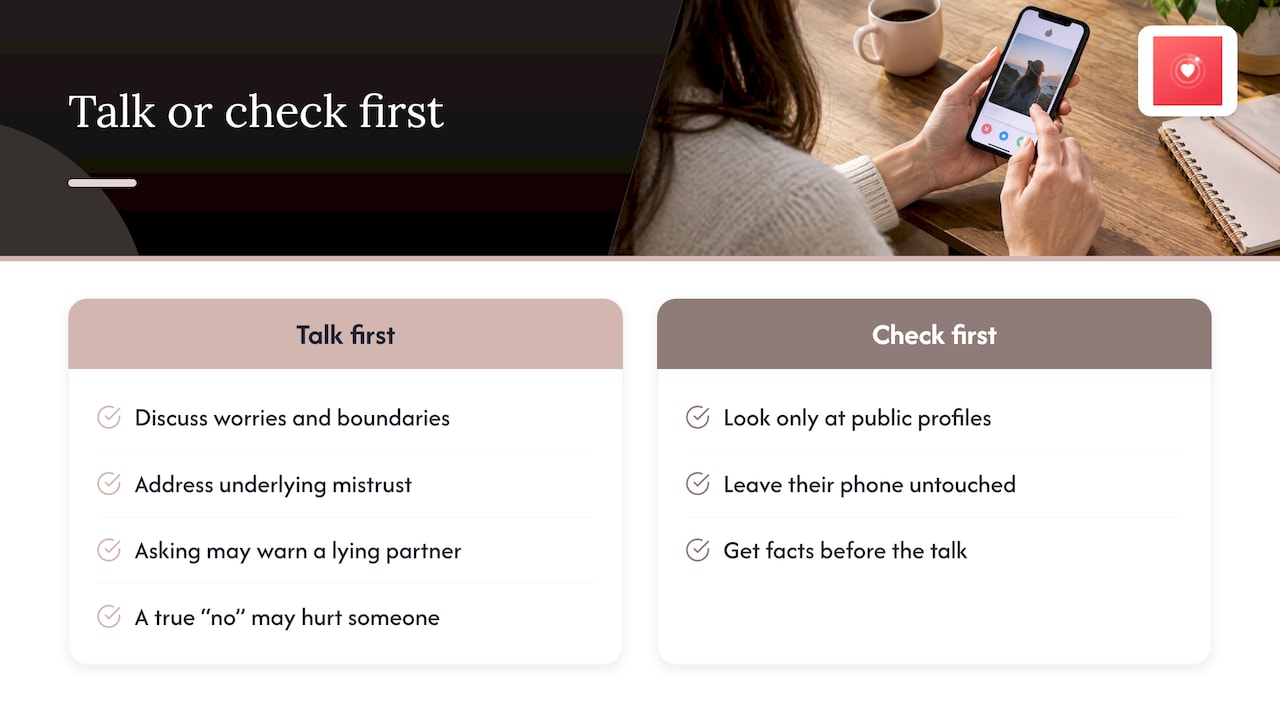
Talk to them, or check first?
This is the real question underneath all of it. Do you ask, or do you find out?
Love is Respect’s advice is to open an honest talk about your worries and the boundaries in your relationship, and to deal with the mistrust underneath rather than gather secret evidence. It is a fair point. A healthy relationship has room for hard questions. If you want help setting those boundaries, we put together a practical guide to dating app boundaries.
But here is what most people tell us. They are afraid to ask without knowing. If you say, “Are you on Tinder?” and the answer is a lie, you have warned the person and learned nothing. If the answer is a true “no,” you may have hurt someone who did nothing wrong.
That is why many people want a quiet fact first. Not to punish. To walk into the talk standing on something solid.
You also have the right to protect your own peace. Respecting privacy on someone’s personal phone and wanting to know if you are being lied to are not the same thing. A check of public dating profiles looks only at what anyone on those apps can see. It does not touch your partner’s phone. If you want to think about privacy more broadly, this piece on confidentiality and privacy in counseling is a thoughtful read on why people need safe spaces.
Our view: why doubt is a signal, not a flaw
We talk to worried partners every day. Here is what we see.
Nobody comes to us because life is great. They come because something nags at them. They have read the same ten articles. They have checked the phone in their head a hundred times. They are tired.
We believe three things.
First, your gut is information. It is not proof, but it is not nothing. When the signs stack up, ignoring them does not make them go away. It makes the waiting longer.
Second, waiting costs you. Every week of “maybe” is a week of bad sleep, short fuses, and checking things you do not want to check. Most people say the doubt hurts more than the answer.
Third, you should not have to wreck your own life to get facts. No fake accounts. No swiping at strangers. No sneaking around. That is why we built a way to check quietly, without telling your partner and without making a profile of your own.
We will say this plainly: we cannot promise you a result you will like. We can promise a clear picture of what is out there.
— Matt
How a quiet check works
Here is the simple version. You give us a little information about your partner, like a name and a photo. We look across the big dating apps for profiles that match, in one search. You do not make an account on those apps. You do not swipe. You do not message anyone.
Your partner is not notified. Your scan is private and encrypted.
You get a report. It shows possible matches, profile photos and timestamps, and a confidence score so you can see how close each match is. You decide what to do with it.
If you are not sure which app to look at first, start with the one most people ask about:
- Tinder Profile Search for the biggest, most common one.
- Bumble Profile Search if you think they use an app where women message first. Our guide to the signs your partner is on Bumble can help you decide.
- Hinge Profile Search, OkCupid Profile Search and Plenty of Fish Search for the others.
Not sure which one? Skip the guesswork. Run the Partner Check and cover them all at once. Check their profile today.
If all you have is a photo you found, try the reverse-image dating search. If you want to dig deeper into one person, the Deep Person Scan goes further.
What to do with what you find
There are really only three outcomes. Plan for each one before you look.
You find a match
Take a breath. Look at the photo. Look at the timestamps and the confidence score. A recent timestamp tells you more than an old one.
Do not text them in anger. Do not post about it. Write down what you saw and when. Then pick a calm time, in private, to talk.
Open with what you found, not with an attack. “I saw a profile with your photo, and I need you to be honest with me.” Then listen. Watch what they do with the silence.
You find nothing
That is real information too, though not a guarantee. People can use apps in other cities, under other photos, or sign up later. If your doubts are still loud, you can set up ongoing monitoring so you hear if something new appears.
And if the check comes back clean, ask yourself what else is going on. Sometimes the worry is about distance, not an app. That is worth a conversation too.
You find something unclear
A low-confidence match is a maybe. Do not act on a maybe. Look at the photo, the age and the location, and see if it is really them. If you are still unsure, run another check. For more on timing and old profiles, read our guide on when a scan actually helps.
A short checklist before you decide
Use this. Be honest with yourself.
- Has this gone on for more than a few weeks?
- Do you see at least three signs from the lists above?
- Have you tried asking, and gotten dodges or anger?
- Is the worry hurting your sleep, work or mood?
- Do you want a fact more than another guess?
If you said yes to three or more, you already know where you stand. The doubt is not going to leave on its own. Run a quiet check now and stop carrying this alone.
Ready to stop guessing?
We built Partner Check for people exactly like you. One private search. No account on any dating app. No notice to your partner. A clear report with photos, timestamps and match scores.
If Tinder is the one that keeps you up at night, start your Tinder profile search. The sooner you look, the sooner you know. For a wider look at the whole topic, see how to find out if your partner is on dating apps.
FAQ
Can you see if someone is on Tinder without signing up?
Tinder itself does not let you search for a person, and it does not show profiles to people without an account. A quiet outside check can look for matching public profiles without you making one. Read how it works, then run your search.
How can I tell if my boyfriend or girlfriend has Tinder?
Look for a pattern: a hidden phone, new secrecy, schedule changes, and alerts you were not meant to see. One sign is a maybe. Several together are worth checking. A private scan of the dating apps can turn that maybe into a yes or no.
Does a green dot mean my partner is cheating?
It means your partner was recently online on the app. Tinder says the dot shows activity in the last 24 hours. It does not tell you what they did there, but it does tell you the profile is not an old one.
What if I find nothing?
Nothing found is not a promise that nothing is there. Profiles can be hidden, set up under other photos, or created later. If the doubt stays, keep monitoring so you are told if something new shows up.
Should I confront my partner first?
Some people do, and some experts say an honest talk about boundaries is the best first step. The risk is a lie that leaves you no wiser. Many people prefer to have a fact in hand before they speak, so the talk can be calm and clear.
Sources
- Can I search for a specific person on Tinder?
- Recently Active, Tinder Help Center
- Online Now, Tinder Help Center
- Hide your Tinder profile
- “I caught my partner on a dating app!”, Love is Respect