%20scale(1.05)%20translate(-12,-14.25)'%3e%3cpath%20d='M12%2021s-7.5-4.7-7.5-10.2A4.3%204.3%200%200%201%2012%207.5a4.3%204.3%200%200%201%207.5%203.3C19.5%2016.3%2012%2021%2012%2021Z'%20fill='%23F0384A'%3e%3c/path%3e%3c/g%3e%3c/svg%3e)

Yes, you can legally check if your partner is active on dating apps, but only if you stick to public information. Spying with tracking apps, reading private texts, or hacking into their phone is illegal, even if you’re married. A legal, anonymous scan of public dating profiles gives you real answers without the legal risk. If you’re ready to stop guessing, search their name now.
TL;DR:
- A legal online profile scan only reveals public dating profiles, photos, timestamps, and profile links, and never accesses private messages, locations, or device data.
- Installing tracking or spyware on a partner’s phone without consent is illegal and can lead to criminal charges and inadmissible evidence in legal cases.
- Clear, mutual boundaries around dating app use are essential, and verified evidence from public profiles helps confirm or disprove boundary violations without distrust.
- Gathering safe identifiers and screenshots beforehand protects privacy and prevents turning suspicions into legal risks during the search process.
- CheaterDetectorAI offers anonymous, law-compliant scans that verify online profiles without notifying the targeted person or risking legal consequences.
Setting Relationship Boundaries on Dating Apps: What’s Legal vs. What’s Not
Your gut is telling you something is wrong. Maybe he’s guarding his phone. Maybe she’s suddenly private about texts. That fear eats at you, and it’s tempting to grab his phone while he’s asleep or download an app that reads every message she sends. Don’t. That step turns you from a worried partner into someone who could face criminal charges.
Spyware and stalkerware are apps built to secretly track someone’s phone. They read messages, log calls, and sometimes even turn on the microphone. The Federal Trade Commission has banned companies that sold this kind of software and ordered them to delete every bit of data they collected illegally.
Here’s what most people don’t realize:
- There is no “marital exception” to privacy law. Being married gives you zero legal right to intercept your spouse’s private messages.
- Installing tracking software on someone else’s phone without consent can lead to federal and state criminal charges.
- Civil lawsuits are also possible. Your partner could sue you for invasion of privacy.
- Evidence collected illegally usually can’t be used in a divorce or custody case anyway.
A legal scan works completely differently. It only looks at what’s already public, things anyone could find by searching. No phone access. No hacking. No private accounts.
Pro Tip: If you’ve already installed a tracking app out of panic, stop using it and remove it. Then use a legal scan instead. It’s the only version of “checking” that can’t be used against you.
What a Legal Dating App Scan Can Actually Show You
A legal scan won’t hand you a transcript of his private texts. It works within the same rules search engines follow: only public information is visible. Here’s what that means for you.
What you can realistically expect to see:
- Profile photos matching your partner’s face across dating platforms
- Direct links to any public profiles found
- Timestamps showing when a profile was created or last active
- Bios, usernames, and other details visible to any app user
What a legal scan will never show you:
- Private messages or conversations
- Real-time phone location
- Anything stored only on the device itself
- Hidden data that was never shared publicly
The most useful piece of evidence is usually the photo match. Reverse-image technology compares a photo of your partner against millions of public dating profiles. A strong match with a recent timestamp is meaningful. A blurry, years-old photo with a partial match is not.
That distinction matters when you’re staring at a report at midnight. A match is a signal, not a confession. Someone can share a face-swapped photo, keep an old profile alive without opening the app, or get flagged by a look-alike. Treat a scan report as the start of a conversation, not the end of one.
Pro Tip: Before you assume the worst, check the timestamp. An active profile updated last week tells a very different story than one that’s been dormant since before you started dating.
This is also exactly why reverse-image dating searches exist as their own product. Sometimes the photo is the only lead you have, and running it against public dating profiles is completely legal.
How to Prepare Before You Run a Scan
Panic makes people do things they regret, like grabbing a phone, guessing a password, or confronting a partner with no proof at all. Slow down. Here’s how to protect yourself and get better results.
- Gather safe identifiers first. Write down your partner’s full name, any nicknames, and cities they’ve lived in. Save a few clear, recent photos you already have.
- Never touch their phone or accounts. Don’t guess passwords. Don’t open their apps while they’re asleep. That single act can turn your suspicion into your legal problem.
- Screenshot anything public you find on your own. If you spot something during your own casual browsing, take a dated screenshot and note where you found it. Don’t edit or crop the original.
- Keep records organized. Store screenshots and notes somewhere your partner can’t access, separate from shared devices or cloud accounts.
- Build a safety plan if you feel unsafe. If confronting your partner could put you at risk, contact The Hotline before doing anything else. Digital control is a recognized form of abuse, and advocates can help you plan safely.
- Run the legal scan. Once you have safe identifiers, a scan does the searching for you across every major platform at once.
Pro Tip: Don’t tell your partner you’re planning to check. If they’re active on dating apps, a heads-up gives them time to delete profiles before your scan runs.
For more on gathering leads safely, this guide on how to check if someone is on a dating app walks through it step by step.
How CheaterDetectorAI Works and Why It’s the Legal Option
You give CheaterDetectorAI a name, a photo, or both. That’s it. No login to their phone. No account passwords. No installing anything on a device you don’t own.
Here’s the process in plain terms:
- You submit basic details anonymously; your partner is never notified.
- The system cross-checks that information against public profiles on major dating apps.
- Matches get compiled into an encrypted report you can access privately.
The report itself includes photo-verified matches, the dates a profile was created or last active, and direct links to any public profiles found. You can also add ongoing monitoring, so you get an alert if a new profile pops up later instead of running fresh searches every week.
Every part of this avoids the legal exposure that comes with spyware. There’s no device access, no intercepted messages, and nothing that requires your partner’s password. That’s the same distinction privacy researchers point to when they warn that phone-based snooping creates an evidence trail that can be used against the person doing the snooping.
CheaterDetectorAI has built this process around one simple rule: check what’s public, skip what isn’t. The service has been used by a number of people and received positive user feedback. For a deeper breakdown of how the privacy side works, read are dating app scans anonymous?
Why Relationship Boundaries Around Dating Apps Matter So Much
A boundary is simply a rule you and your partner agree to about what’s off-limits, whether that’s staying off dating apps entirely once you’re exclusive, or being upfront if either of you keeps a profile active for any reason. Without a clear agreement, two people can walk around with completely different assumptions about what’s acceptable.
That gap is where most suspicion starts. One partner assumes dating apps got deleted the moment the relationship turned serious. The other partner never actually agreed to that, or agreed out loud but never followed through. Neither one is technically lying, but the mismatch still feels like betrayal when it surfaces.
Clear boundaries matter because they turn a vague feeling (“something’s off”) into a specific, checkable agreement (“we said no active profiles”). That specificity is what makes it possible to know, rather than guess, whether a line got crossed.
It also protects the relationship even when nothing is wrong. Couples who talk openly about dating apps, old accounts, and what “exclusive” actually means tend to avoid the slow build of resentment that comes from unspoken expectations. The conversation itself, even when uncomfortable, does more for trust than silence ever does.
If you’re at the point where you suspect the boundary already got broken, the goal isn’t to relitigate what you should have agreed on months ago. It’s to find out, legally and quietly, whether it happened.

Common Boundaries Couples Set Around Dating Apps
Most disagreements about dating apps come down to a handful of recurring flashpoints. Naming them specifically makes it much easier to spot when one gets crossed.
- Active profiles. Some couples agree that any dating app account gets deleted, not just deactivated, once the relationship becomes exclusive.
- Communication frequency with matches. Even before exclusivity, some couples set limits on how many people they’re actively messaging at once.
- Sharing personal information. Boundaries around what gets shared with matches, like home address, workplace, or a phone number, protect both physical safety and emotional exclusivity.
- Meeting in person. Agreements about whether meeting a new match in person is even on the table once a relationship has started.
- Keeping old matches around. Some couples are fine with staying friendly with past matches; others consider that a gray area worth naming out loud.
- Notification and honesty rules. A boundary as simple as “tell me if you get recognized on an app” prevents an awkward surprise from becoming a bigger issue.
None of these boundaries are universal. What matters is that both partners actually said them out loud and agreed, rather than assuming the other person shares the same unspoken standard. Vague boundaries (“just don’t do anything weird”) tend to fail exactly when they’re tested, because nobody agreed on what “weird” means.
Talking About and Enforcing Boundaries With Matches
Boundaries only work if they get said clearly, early, and without ambiguity. That applies to the people you’re matching with, not just your existing partner.
If you’re setting a boundary with a match (like “I’m not comfortable sharing my address yet” or “let’s video call before we meet”), say it plainly and matter-of-factly. You don’t need to justify it or soften it with excessive apology. A simple, direct statement works better than a long explanation, because it signals you’re not negotiating.
Enforcement matters just as much as the statement. If a match pushes past a stated boundary, pressuring you to share more, meet sooner, or ignore a “no,” that’s information. Someone who respects a boundary the first time you state it is showing you something important about how they’ll treat you later. Someone who argues, guilt-trips, or tries again a different way is doing the same.
With an existing partner, the same principle applies but with higher stakes. If you’ve agreed that dating apps are off-limits and you find evidence otherwise, the conversation works best when it’s direct and specific: name what you found, ask for an explanation, and watch whether the response is honesty or deflection.
One practical note: before that conversation happens, you want your facts straight. Confronting a partner with a vague suspicion invites denial. Confronting them with a specific, dated, verifiable match is much harder to talk around.
The Emotional Upside and the Real Challenges of Setting Limits
Setting a clear boundary on a dating app, or in a relationship where dating apps are involved, tends to lower anxiety almost immediately. Once you know exactly what’s off-limits and what isn’t, you stop running mental calculations every time your partner is on their phone. That certainty is worth more than people expect going into it.
The challenge is that boundaries only reduce anxiety if you trust they’re being followed. A boundary you can’t verify starts to feel less like protection and more like a hope. That’s the gap that pushes so many people toward checking, whether that’s glancing at a phone screen or, worse, installing something that crosses a legal line.
There’s also a harder emotional challenge: enforcing a boundary sometimes means confirming your worst fear instead of your best hope. Many people delay checking because part of them would rather stay uncertain than get a confirmed answer. That’s a normal reaction, but it usually prolongs the anxiety rather than resolving it.
The healthiest version of boundary setting treats verification as neutral, not accusatory. Checking whether an agreed boundary held isn’t the same as assuming guilt. It’s closing a loop. Whether the answer is reassuring or painful, having it is almost always better than living inside the guesswork.
Spotting Boundary Violations and Red Flags on Dating Apps
Some warning signs are obvious. Others are quiet enough that you talk yourself out of noticing them for weeks.
Watch for these patterns:
- Sudden phone secrecy. A partner who was casual about their phone and suddenly guards it, flips it over, or changes their passcode.
- New app downloads that get deleted fast. Some people install a dating app, use it briefly, then delete it before anyone notices.
- Vague answers about where they’ve been or who they’re talking to. Evasiveness, especially about specifics that used to be easy to answer.
- Defensiveness when the topic comes up. Getting angry or dismissive when you simply mention dating apps, rather than answering plainly.
- A match who won’t respect stated boundaries. If you notice your partner engaging with someone who keeps pushing past limits you know were set, that’s worth naming.
None of these signs alone proves infidelity. Taken together, and combined with a gut feeling that’s been nagging at you for a while, they’re worth investigating properly. The right response isn’t to install spyware or demand their passcode. It’s to gather what public information you legally can and let a proper scan confirm or rule out what you’re seeing.
Protecting Your Privacy and Theirs While You Look for Answers
Checking on a suspected boundary violation doesn’t mean abandoning every rule of privacy yourself. A few habits keep you safe and keep the process fair.
Keep your own search process private. Don’t announce that you’re looking, don’t ask mutual friends to snoop, and don’t post about your suspicions anywhere your partner or their contacts might see it. The moment word gets back, evidence disappears.
Stick to information that’s already public. A legal scan works because it only touches what anyone could already find; it doesn’t require you to invade a private space to get an answer. That protects you from legal exposure, and it also means you’re not violating anyone’s actual privacy, just checking what’s already visible to the world.

Protect your own emotional safety, too. Set a limit on how much time you spend refreshing search results or scrolling for clues yourself. Constant checking without a clear plan tends to feed anxiety rather than resolve it. Decide in advance what you’ll do with the answer, whichever way it comes out, so you’re not left holding proof with no next step.
And if the person you’re worried about is not a partner but someone monitoring you, the safety rules flip. If you suspect your own devices are compromised, get a free device safety check from a trusted source before doing anything else, and loop in an advocate if leaving the relationship could be dangerous.
Run a Legal Scan Now: Which CheaterDetectorAI Tool Fits You
You don’t need to guess anymore, and you don’t need to risk a felony charge to get an answer. CheaterDetectorAI gives you a legal, anonymous way to check public dating profiles across every major platform, no phone access, no passwords, no installing anything on a device that isn’t yours.
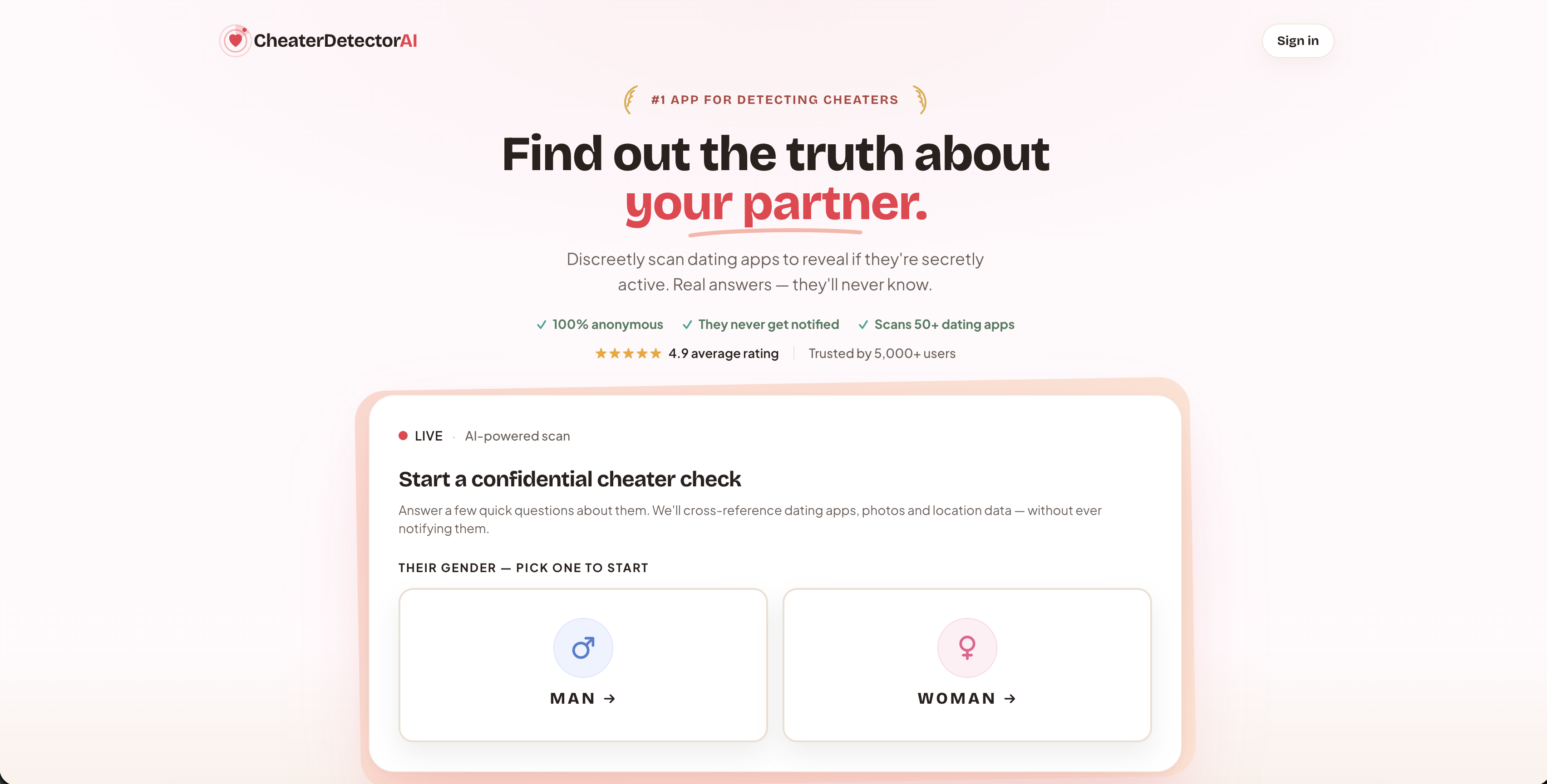
If you’re not sure where to start, match your situation to the right tool:
- Suspicious but not sure where to look? Start with a Deep Person Scan to search a name across all major dating apps at once.
- Just need a fast yes or no? The Partner Check is built for exactly that question.
- Only have a photo to go on? Run a reverse-image dating search to find matching profile pictures.
- Suspect a specific app? Use the dedicated Tinder, Bumble, Hinge, OkCupid, or Plenty of Fish search pages.
Every scan runs anonymously. Your partner is never notified, and your report arrives encrypted, with photo-verified matches, timestamps, and direct profile links laid out clearly. If the results confuse you, you can revisit the report as many times as you need before deciding what to do next.
Why Doing This the Legal Way Actually Matters
Most people don’t set out to break the law. They’re scared, they’re up at 2 a.m., and a spyware ad promises answers in five minutes. That’s exactly how good people end up with criminal exposure they never saw coming.
Here’s what the conventional wisdom gets wrong: it treats “catching them” as the whole goal, when the real goal is having proof you can actually act on. Illegally obtained evidence often can’t be used in a divorce filing or custody dispute, and it can expose you to the very consequences you were trying to uncover in your partner. A legal scan doesn’t just protect you from prosecution. It protects the credibility of whatever you find.
If you’re scared, get safe first. Contact The Hotline or local law enforcement if you feel threatened in any way. Then use a public-profile scan, not spyware, to look for answers. We’ve built our own blog resources, including guides on blocking someone on dating apps legally, because we’d rather you have real information than a false sense of control from a tracking app that could land you in court.
— Oleg
Where to Get Real Legal and Safety Help
If you need to verify what’s legal or find support fast, these sources are worth bookmarking. The FTC’s stalkerware enforcement history and its consumer guidance on spyware explain the legal risk plainly. The Hotline offers safety planning for tech-facilitated abuse, and Pew Research tracks how common dating app use actually is.
This article is general information, not a substitute for advice from a qualified lawyer. Consult a qualified legal professional about your own circumstances before acting on anything here.
Sources
- Stalkerware: What to know | Consumer Advice (FTC)
- The Hotline — Technology-facilitated abuse resources
- Pew Research Center — Online dating in the U.S.
FAQ
Is It Legal to Scan for Dating Profiles Without Consent?
Yes, checking public dating profiles without your partner’s knowledge is legal because you’re only viewing information already visible to anyone. What’s illegal is accessing private accounts, messages, or devices without permission, which is why CheaterDetectorAI only searches public profile data.
What’s the Difference Between a Legal Scan and Spyware?
A legal scan searches only public dating profiles using details like a name or photo, while spyware secretly accesses a phone’s private messages, location, and calls. The FTC has banned companies selling spyware because it violates federal privacy law.
Can My Partner Find Out I Ran a Scan?
No, a legal scan through CheaterDetectorAI runs anonymously and never notifies the person being searched. There’s no login required from their side and no alert sent to their account.
What Should I Do if I Find a Boundary Violation?
Stay calm, document what you found with dated screenshots, and avoid confronting your partner until you have clear, specific evidence. If you feel unsafe having that conversation, contact The Hotline for a safety plan before you say anything.
How Much Does a CheaterDetectorAI Scan Cost?
Current pricing for each scan type is listed directly on the CheaterDetectorAI site, since prices vary by product like the Deep Person Scan or a single-app search. Check the specific product page for the exact cost before you start.