%20scale(1.05)%20translate(-12,-14.25)'%3e%3cpath%20d='M12%2021s-7.5-4.7-7.5-10.2A4.3%204.3%200%200%201%2012%207.5a4.3%204.3%200%200%201%207.5%203.3C19.5%2016.3%2012%2021%2012%2021Z'%20fill='%23F0384A'%3e%3c/path%3e%3c/g%3e%3c/svg%3e)

The clearest signs of online cheating aren’t one big red flag. They’re a pattern: secrecy around a device, plus emotional energy going somewhere else. If your partner suddenly guards his phone, stays up late “working,” and gets defensive when you ask a normal question, that combination matters more than any single clue. Below is a full checklist, how to read it without jumping to conclusions, the legal line you can’t cross, and a lawful way to get real answers fast.
TL;DR:
- Multiple behaviors like new passcodes, hidden apps, and secret profiles combined over weeks increase the likelihood of online cheating, especially when they escalate in frequency.
- Public social media timestamps and profile searches can legally verify suspicious activity without touching private devices or messages, provided they only access publicly available information.
- Installing spyware or secretly tracking a partner’s device is illegal and can result in criminal prosecution, making lawful online checks vital for avoiding legal issues.
- Emotional distancing and defensiveness often precede digital proof, which may take weeks to reveal a pattern, emphasizing the importance of observing behavior clusters over time.
- Legal online profile scans, such as those offered by CheaterDetectorAI, enable discreet verification of hidden dating profiles without privacy violations or legal risk.
Signs of Online Cheating: The Full Checklist
Online infidelity thrives on secrecy. Researchers describe it as the creation of hidden intimacy, a private world your partner builds on purpose, and often through a channel that deliberately cuts you out of the loop, according to a peer-reviewed look at internet infidelity. That’s the thread running through every sign below. None of these alone proves anything. Together, especially if several show up at once, they tell a different story.
-
Late-night device use that’s new. Your partner used to put the phone down early. Now they stay up late scrolling, angling the screen away from you.
-
A sudden new passcode, or a passcode that changed and he won’t tell you why. Devices that used to sit unlocked on the counter now lock the second you walk in.
-
A cleared browser history or private/incognito tabs where there weren’t any before. This isn’t proof. It’s a change in behavior, and behavior changes are what matter.
-
Hidden or “vault” apps disguised as calculators, games, or file managers. These exist specifically to hide messages and photos from anyone who picks up the phone.
-
Messages that disappear on their own, through apps with vanish or auto-delete settings newly turned on.
-
New or duplicate social and dating profiles you didn’t know existed, often under a slightly altered name or a different profile photo.
-
Defensiveness that’s out of proportion to the question. You ask who texted, and you get anger instead of an answer. That reaction alone is data, according to clinical guidance on cyber affair behavior.
-
A noticeable emotional pullback. He’s physically present but checked out, distracted, or short with you in a way that feels new.
-
A change in intimacy or sexual behavior, either a sudden drop in interest or, sometimes, an unexplained increase.
-
Sudden grooming or appearance changes with no obvious reason: new clothes, a new gym habit, more attention to how he looks before he “runs an errand.”
-
A second phone, a new SIM card, or unfamiliar numbers showing up on a shared bill. A hidden or secondary communication channel is one of the most reliable signals on this entire list, because it almost always exists for one reason: to talk to someone without you seeing it, according to an analysis of digital cheating signals.
-
Subscription charges or app purchases you can’t explain, including recurring charges tied to a service you’ve never heard him mention.
-
Timestamps that don’t add up. He says he was stuck in a meeting until 8, but a public post or Story shows him somewhere else, active online, at that exact time.
-
Obsessive attention to one particular account or contact, checking it constantly, reacting emotionally to what it posts.
A single item on this list might mean nothing. Stress, a new hobby, a private personality, all of these explain isolated behavior. What changes the calculation is clustering: three or four of these appearing together, escalating over weeks rather than a one time slip. Concealment tools like vanishing messages and vault apps exist specifically to make sure you never see the pattern build.
How to Read the Pattern Without Jumping to Conclusions
Timing tells you more than any single fact. Look at whether the behavior is escalating (more frequent, more secretive, lasting longer) instead of judging one bad night. A pattern that’s been building for six weeks carries far more weight than a single defensive moment after a hard day.
Public timestamps can back up or contradict a story, but they have real limits.
- A Story posted at 9 p.m. shows he was somewhere, but not necessarily what he was doing there.
- A tagged photo confirms a location, not intent.
- Silence on social media proves nothing either way.
You can lawfully check public information without touching his phone. Reverse image searches on a suspicious profile photo, people lookups on an unfamiliar number, and scans for secondary public profiles all use records anyone can already see, according to guidance on tracing a digital trail without device access. These checks confirm whether something exists. They can’t read minds or prove what was said in a private message.
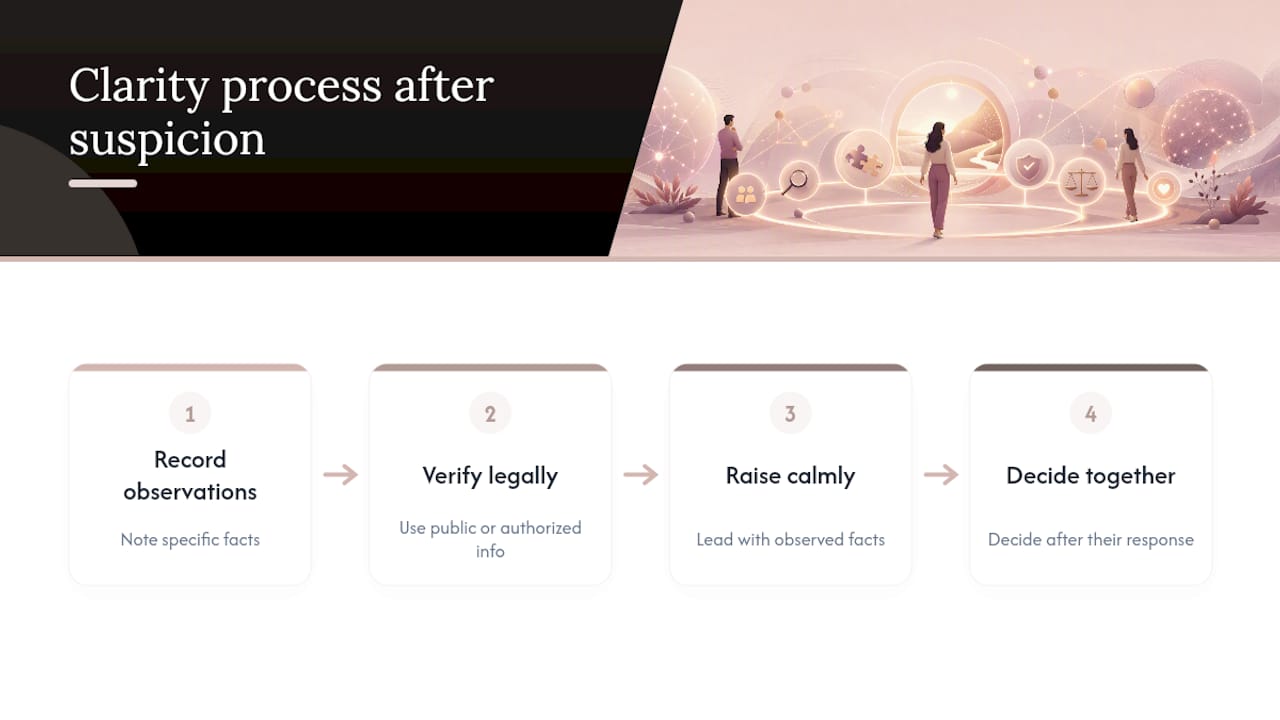
Pro Tip: Write down dates and specific contradictions as they happen, not from memory a week later. “Said he was at the gym Tuesday 7pm, but posted a Story from downtown at 7:15” is something you can calmly bring up. A vague feeling isn’t.
When you’re ready to talk, keep it about facts, not accusations: “I noticed you’ve been up a lot later than usual, and I wanted to check in.” That opens a conversation instead of a fight.
What Not to Do: The Legal Line You Cannot Cross
Here’s what nobody tells you upfront: installing spyware, secretly tracking his location, or reading her private messages without permission isn’t just a bad idea. It’s illegal in most circumstances, and it can get you criminally prosecuted, not him. Unauthorized access to someone’s device or accounts can trigger computer fraud and wiretapping laws, even between spouses.
That fear of “getting caught snooping” keeps a lot of people stuck, unable to look for real answers. You don’t need to break the law to get clarity.
- Check public profiles and public posts, information anyone could already see.
- Use a third-party anonymous scan that checks public dating-app listings instead of a private device.
- Screenshot public evidence with visible timestamps, and save it somewhere he can’t delete it.
- Talk to a therapist or, if things escalate, a lawyer before you act on anything you find.
Pro Tip: If you screenshot a public post or profile as evidence, save the original link and date alongside it. A screenshot with no context is easy to dismiss later.
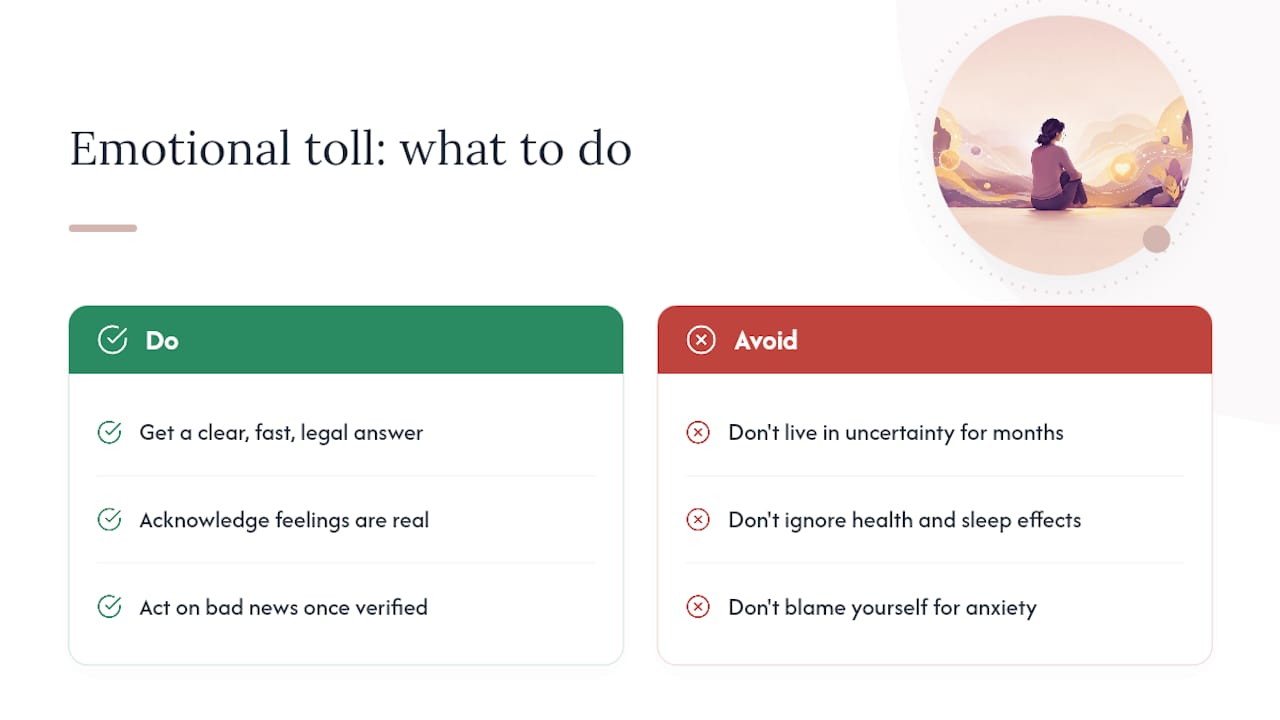
The Toll It Takes on You Before You Even Know the Truth
Suspecting something is wrong is its own kind of exhausting. You start checking his phone screen out of the corner of your eye. You replay conversations, looking for cracks in the story. You feel foolish for noticing, then foolish for ignoring it.
That reaction isn’t overreacting. Feelings of betrayal from an emotional online affair are just as real and just as damaging as betrayal from a physical one, according to clinical commentary on infidelity. Your body treats suspicion like a threat, because in a real sense, it is one. Anxiety spikes. Sleep gets worse. You might catch yourself rehearsing arguments in the shower or checking his location “just this once.”
Paranoia and anxiety in this situation aren’t a character flaw. They’re what happens when your gut is picking up something before your evidence catches up. The problem is that living in that state for months, without answers, does real damage, to your health and to the relationship, whether or not anything is actually happening. That’s exactly why getting a clear, fast, legal answer matters so much. Uncertainty is often worse than bad news, because at least bad news gives you something to act on.
Online Cheating Looks Different From an Affair in Person
Offline cheating usually leaves physical clues: unexplained absences, receipts, a change of scent, lipstick on a collar. Online cheating leaves almost none of that. He can be sitting on the couch next to you and still be emotionally somewhere else entirely.
That’s what makes digital infidelity harder to catch and, in some ways, easier to deny. There’s no missing block of time to explain, no hotel receipt. The “affair” might happen in fifteen-minute bursts scattered across a normal day: a message on a lunch break, a late-night chat after you’ve gone to bed. Near-universal smartphone ownership means devices are with people constantly, which is exactly why so much of this now plays out on a screen instead of in a hotel room, based on data from Pew Research on smartphone use.
The emotional signs often show up before any digital proof does. Distance, secrecy, and defensiveness tend to arrive first; the second account or the burner number shows up later, once the emotional line has already been crossed. That’s a key reason the checklist above weighs behavior changes as heavily as any single digital discovery.
What Happens to a Relationship After You Suspect Something
Suspicion changes a relationship even before you know the truth. Trust doesn’t wait for proof to erode. It erodes the moment you start double checking a story or feeling relief when he’s out of the room.
If it turns out something is happening, the relationship faces a real decision point: whether it can rebuild, and whether both people actually want to do that work. If it turns out nothing is happening, you still have a communication problem to solve, because whatever created that gap of secrecy and distance in the first place needs an honest conversation regardless of the outcome.
Either way, the move is the same: get clarity before you decide anything permanent. Once you have real information, whether that’s public evidence or simply a clearer read on the pattern, bring it up calmly. Lead with what you observed, not what you assume: “I’ve noticed you’re a lot more private with your phone lately, and it’s been bothering me.” Give him room to respond before you decide what it means. A conversation grounded in specific, verifiable facts goes somewhere. An accusation built on gut feeling alone usually just triggers a fight.
A Note on Getting Through This
Feeling anxious over a partner’s changed behavior is not paranoia. It is a reasonable response to a real pattern, and it deserves a real answer, not months of guessing.
The good news is you never have to break the law to get one. Public, legal verification exists precisely so you’re not stuck between staying silent and doing something you could be prosecuted for. What comes next is a lawful way to check the one thing spyware and phone snooping can’t legally touch: public dating profiles.
— Oleg
How CheaterDetectorAI Checks Public Profiles Legally
CheaterDetectorAI scans public dating app profiles for you, so you never have to touch his phone or install anything sketchy to get a real answer. You give minimal details, a name, a photo, basic identifiers, and the system cross-references major dating platforms to see if he has an active profile hiding in plain sight.

This is 100% legal because it only checks information that’s already public: profile photos, bios, and activity timestamps that anyone on that platform could see. No phone access, no installed tracker, no notifications sent to him, ever. The entire scan is encrypted and anonymous, so there’s zero risk of tipping him off while you wait for answers.
If you already suspect a specific app, start with a Tinder Profile Search or a Bumble Profile Search. If you’re not sure where to look, run a Partner Check across all major platforms at once. Stop guessing based on late-night screen glow and defensive one-word answers. Search his name now and get a real report, fast, without breaking a single law to do it.
Sources
- PMC2802380
- Signs Your Spouse Is Having an Online Affair - Verywell Mind
- How to Catch a Cheater: Find the Digital Trail Without Touching Their Phone - ClarityCheck
- Is My Partner Cheating? 15 Digital Signs in 2026 · StoryCheck
FAQ
How Do You Know if Someone Is Cheating Online?
You look for a pattern, not one clue: secrecy around a device, late-night activity, defensiveness when asked simple questions, and a possible second communication channel. One sign alone rarely means much, but three or four appearing together over several weeks is worth taking seriously.
What Does Online Cheating Look Like?
It usually looks like emotional energy going somewhere else through a hidden channel, a secret app, a duplicate account, a messaging thread you’re not part of, according to research on internet infidelity. It often has no physical evidence at all, which is why it’s harder to spot than a traditional affair.
What Are Examples of Unfaithful Acts That Happen Online?
Common examples include maintaining a secret dating profile, sexting or flirting through a hidden app, and having a sustained emotional connection with someone outside the relationship over messaging. A detailed breakdown of digital signs treats a persistent secondary account as one of the strongest indicators.
How Do Cheaters Hide Texts?
The most common methods are auto-deleting or vanish-mode messages, calculator-style vault apps, and cleared conversation threads right after they’re read. If you notice messages disappearing that never used to, that’s a real behavior change worth paying attention to, and a legal profile scan through CheaterDetectorAI can tell you if a secret account is behind it, without you touching his phone.
Is a Legal Scan Really Better Than Checking His Phone Myself?
Yes. Checking a phone without permission can expose you to prosecution under privacy and computer access laws, no matter how justified it feels in the moment. A public profile scan service stays entirely within the law by only checking public listings. Check his profile today and get answers without any legal risk to you.