%20scale(1.05)%20translate(-12,-14.25)'%3e%3cpath%20d='M12%2021s-7.5-4.7-7.5-10.2A4.3%204.3%200%200%201%2012%207.5a4.3%204.3%200%200%201%207.5%203.3C19.5%2016.3%2012%2021%2012%2021Z'%20fill='%23F0384A'%3e%3c/path%3e%3c/g%3e%3c/svg%3e)

Don’t install spyware, and don’t read their messages on a phone you grabbed while they slept. That’s how you collect digital evidence the right way: legal, device-free checks on public dating profiles, careful screenshots with timestamps, and a privacy-first scan like CheaterDetectorAI. Skip the illegal shortcuts. Check their profile today instead of risking a crime.
TL;DR:
- Searching public dating profiles using your own account or a reverse-image search is legal, while hacking private accounts or using spyware is a serious criminal offense.
- Properly documenting evidence requires capturing full screenshots with visible URLs and timestamps, avoiding edits, and backing up copies to establish credibility in court.
- Unauthorized access to private messages or recordings can lead to criminal charges and court dismissals, making legal channels essential for gathering admissible proof.
- Conducting device-free scans across multiple dating apps anonymously is safer and more effective than guessing or risking illegal shortcuts like spyware or hacking.
- Consulting a licensed private investigator or attorney is necessary when obtaining phone records, deleted messages, or comprehensive device analysis beyond public profile checks.
What Makes Digital Evidence Collection Illegal?
You’re scared. You’re up at 2 a.m. wondering if he’s swiping through Tinder in the next room, or if she’s messaging someone from a group chat you weren’t invited into. That fear is real, and it’s exhausting. But here’s what nobody tells worried partners fast enough: the panic that makes you want to grab their phone is the exact thing that can turn you into the one facing charges.
Secretly installing tracking software, reading private messages, or breaking into someone’s accounts without permission is often a crime under federal law, not just a bad idea. The Wire and Oral Communications chapter of federal law makes unauthorized interception of someone’s private communications illegal, and being married to someone does not give you a pass. Some state laws carry penalties in the multi-year prison range, plus fines up to $10,000, for illegal electronic surveillance.
It gets worse if you ever need this “proof” in a divorce or custody case. Courts and legal guides are consistent on this: evidence grabbed through unauthorized access is usually thrown out, and the person who collected it can face their own legal trouble on top of it. Judges don’t reward snooping, even when the suspicion turns out to be right.
Here’s what actually puts you at risk:
- Installing any tracking or spyware app on their phone without consent
- Logging into their email, social media, or messaging apps using a password you found or guessed
- Reading texts or DMs on a device you accessed while they weren’t looking
- Recording private phone calls without the other person’s knowledge, depending on your state’s consent rules
The risk isn’t abstract. A Reporters Committee legal overview notes that illegally obtained communications are frequently excluded from court entirely, meaning all that risk bought you nothing.
How Do You Legally Gather Proof They’re Cheating?
You have more legal options than you think, and none of them require touching their phone. Here’s the order to work through them.
- Search public dating profiles yourself. If a profile is public, looking at it isn’t spying. Search their name, or run a reverse-image search using a photo you already have, on the major apps: Tinder, Bumble, Hinge, OkCupid, Plenty of Fish. Public posts are treated very differently under the law than private messages. Copying what’s publicly visible is generally lawful; anything obtained by breaking into a private account is not.
- Save your own conversations. If they’ve messaged you, or you share a family account, that’s yours to keep. You don’t need permission to preserve your own inbox.
- Write down what you find, immediately. Note the date, the platform, and the profile URL the moment you see something.
- Escalate through a professional when you hit a wall. If you need phone records, deleted messages, or a full device exam, that has to go through an attorney requesting records through proper legal channels, or a licensed private investigator. Licensed investigators can lawfully document public conduct, which gives you admissible material without anyone breaking a law.
Pro Tip: Before you spend hours manually searching five different dating apps, run a single scan that checks all of them at once. It saves you the guesswork of which platform to search first, and it keeps your search anonymous.
Trying to get carrier records or a forensic phone exam on your own almost never works. Those routes generally require a subpoena or a court order, which is exactly why an attorney matters once you’re building a real case rather than just confirming a fear.
How Do You Document Evidence So It Holds Up?
A screenshot that looks convincing to you might look worthless to a lawyer if it’s missing basic details. Credibility comes down to a few unglamorous habits.
Capture the full page, not just the juicy part. That means the profile URL should be visible, along with a timestamp, whenever the platform shows one. A cropped screenshot that only shows a suspicious photo, with no context around it, is easy for anyone to dismiss as fake or out of context.

Never edit a screenshot. No cropping out inconvenient details, no zooming that distorts the image. Investigators building family court cases lean on multiple corroborating pieces, not one dramatic photo, because a pattern of matching timestamps, profile URLs, and screenshots is much harder to argue against than a single image.
Back everything up somewhere you control. Email copies to yourself immediately after you capture them. Keep the originals untouched on your device, and keep a simple written log alongside them: date, time, platform, what you found.
| Do this | Why it matters |
|---|---|
| Screenshot the full page with URL and timestamp visible | Removes doubt about where and when it came from |
| Email copies to an independent account right away | Creates an independent time record |
| Keep a written log with date, time, and platform | Builds a pattern, not just one photo |
| Leave originals unedited | Cropped or altered images lose credibility fast |
| Hand your log and files to an attorney before acting | They’ll tell you what actually holds up |
If you eventually talk to a lawyer, hand over your log and your unedited files together. That’s what turns a folder of screenshots into something a court will actually consider.
What Should You Never Do to Get Proof?
Some methods feel tempting when you’re desperate for answers, and every one of them can backfire on you specifically, not just on the relationship.
- Never install a stalkerware or tracking app on their phone, even one marketed as a “parental-control” tool
- Never log into their accounts using a password you found, guessed, or saved from an old shared device
- Never ask a friend or hire someone off the internet to hack into an account for you
- Never record a private phone call without checking your state’s consent laws first
Beyond the legal exposure, these apps are a security disaster. Reporting on the stalkerware industry has documented repeated data breaches at spyware vendors, exposing victims’ private messages, photos, and even location history to strangers, not just the person who installed the app. You’d be handing your own private data, and theirs, to companies with a track record of losing control of it.
That’s the trap. You install something to protect yourself, and you end up more exposed than when you started. Even if it never gets discovered, and even if it never leaks, you’re still risking criminal charges over information a legal scan could have surfaced anyway.
Why Device-Free Checks Beat Guesswork Every Time
Most people think proving infidelity means catching a smoking gun text message. It rarely works that way, and chasing that one message is what pushes worried partners toward illegal shortcuts they wouldn’t otherwise consider.
A service takes a different approach. It scans public profiles across the major dating apps using minimal information you already have, and it never touches their phone. The report comes back encrypted and anonymous, so nobody gets a notification that you looked. That’s the entire point: you get clarity without gambling your own legal standing to get it.
If you want a deeper look at how evidence actually holds up in a legal proceeding, the CheaterDetectorAI blog covers this in more detail in How to Prove Infidelity Online and Screenshot Evidence of Cheating. And if you think this is heading toward divorce court, talk to a lawyer before you act on anything you find. A five minute conversation now can save a case later.
— Oleg
Get Your Answer Without Touching Their Phone
CheaterDetectorAI is the alternative to guessing, snooping, or hiring someone shady off the internet: one anonymous scan checks public profiles across every major dating app at once, with no phone access, no notifications sent to your partner, and no risk of the legal trouble that comes with spyware.
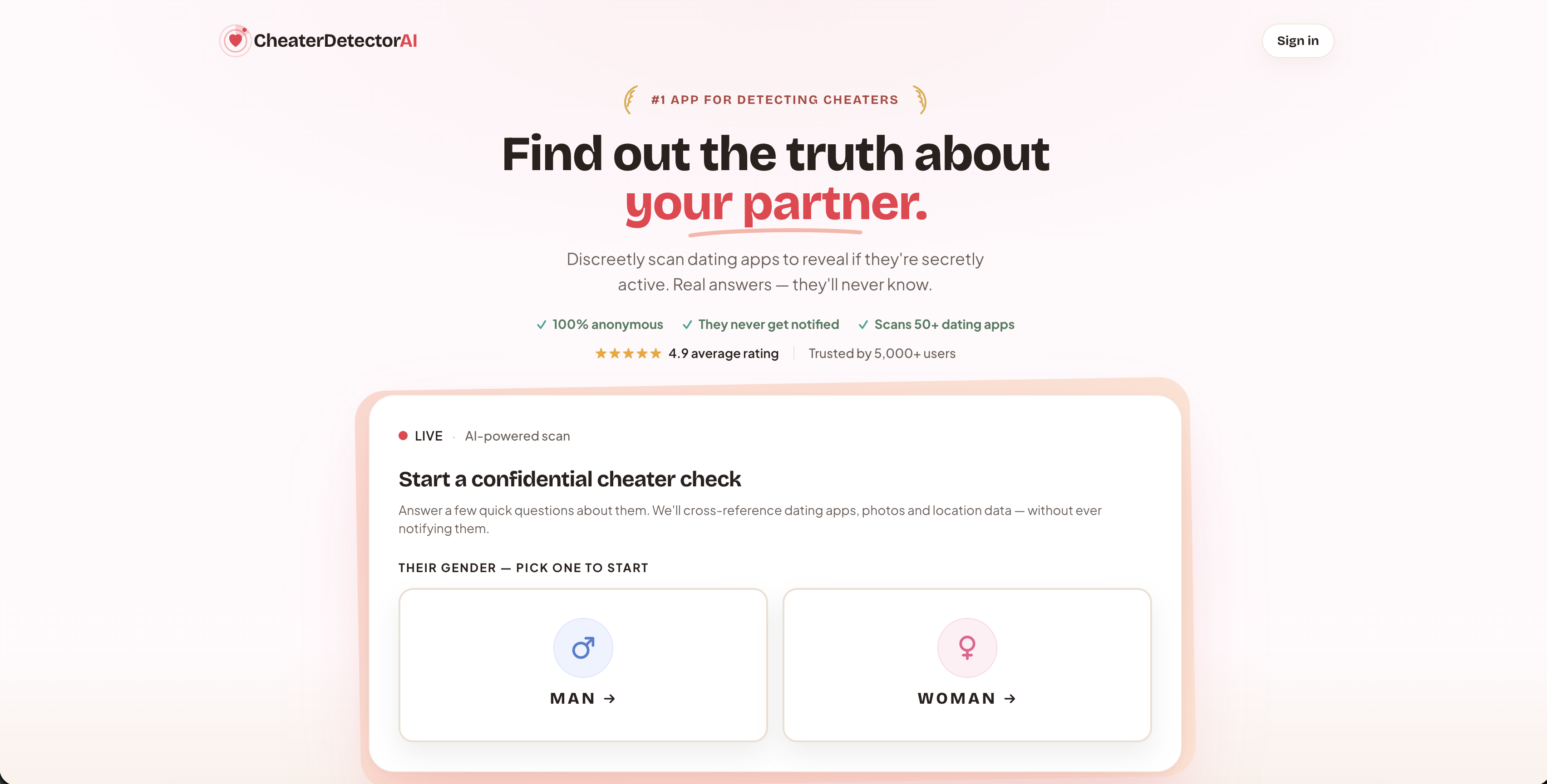
If you already have a name and a rough idea of the apps they might use, start with the Partner Check for a fast read on whether they show up at all. Want the full picture, including photo matches and activity timestamps? Run a Deep Person Scan instead. Only have a photo and no name? The reverse-image dating search can still find a match. If you already suspect a specific photo he’s used elsewhere, a tool like AI-generated image comparison shows how far photo matching technology has come.
Every scan stays private. Your partner never finds out you looked, and you never have to touch their phone. Search their name now and stop guessing about something you deserve a real answer to.
This article is general information, not a substitute for advice from a qualified lawyer. Consult a qualified legal professional about your own circumstances before acting on anything here.
Sources
- 18 U.S.C. — Part I — Chapter 119 (Wire and Oral Communications) — Cornell Law School
- Reporters Committee: Recording guide and legal overview (example jurisdiction)
- Hacked, leaked, exposed: Why you should never use stalkerware apps | TechCrunch
- Journal of the American Academy of Matrimonial Lawyers — admissibility and preservation guidance
FAQ
Is it illegal to look at my partner’s public dating profile?
No. Viewing or screenshotting a public profile isn’t the same as breaking into a private account, so it’s generally lawful. The moment you’d need a password or private access you don’t have, you’ve crossed into illegal territory.
Can screenshots really be used as evidence in court?
Yes, when they’re captured properly. Screenshots that show the full page, the profile URL, and a visible timestamp, and that were never edited, carry far more weight than a cropped image with no context, according to family-law preservation guidance.
What happens if I get caught using spyware on their phone?
You could face criminal charges under federal wiretap law, plus state penalties that in some cases include prison time and fines up to $10,000 for illegal surveillance, per federal wiretap statutes. Any evidence gathered that way is also likely to get thrown out of court.
How much does a CheaterDetectorAI scan cost?
Pricing for the Partner Check, Deep Person Scan, and reverse-image search is listed directly on each product page at CheaterDetectorAI, since costs vary by scan type. Check the site for current rates before you run a search.
When should I hire a private investigator instead of doing this myself?
Bring in a licensed investigator once you need phone records, deleted messages, or anything requiring a subpoena, since only licensed professionals can lawfully pursue those records. For public profile activity, a scan or your own documentation is usually enough to start.