%20scale(1.05)%20translate(-12,-14.25)'%3e%3cpath%20d='M12%2021s-7.5-4.7-7.5-10.2A4.3%204.3%200%200%201%2012%207.5a4.3%204.3%200%200%201%207.5%203.3C19.5%2016.3%2012%2021%2012%2021Z'%20fill='%23F0384A'%3e%3c/path%3e%3c/g%3e%3c/svg%3e)
Worried your partner is hiding a dating profile? Here’s the short answer: dating app scans are rarely fully anonymous. Most leave some kind of trace, whether it’s a server log, a payment record, or leaked data sitting in a place it shouldn’t be.
Here’s why. Many scanning tools ask for access to your phone, camera, or photos. Once that data leaves your device, it’s stored on someone else’s server, and you have no control over what happens next. Even “private” apps have been caught exposing user location and personal data through unsecured systems. If you use a real credit card or your personal email, you leave a paper trail too.
Not knowing is expensive. It costs you sleep, trust, and time you can’t get back. But you don’t need to snoop to get answers.
- Search their name now on public profile databases
- Check their profile today across major dating apps
- Request a discreet scan that only checks public data
Pro Tip: Never install anything on your partner’s phone. If a “scan” asks for phone access, it’s not a scan. It’s spyware.
Key Takeaways
Dating app scans are almost never fully anonymous, but public-only checks like CheaterDetectorAI keep you safe, while spyware and phone access can backfire badly.
| Point | Details |
|---|---|
| Anonymity is a spectrum | Scans range from pseudonymous to fully identifiable; true anonymity is rare because someone always processes the data. |
| Server-side scans leave traces | Logs, IP addresses, and payment records can connect a search back to you even without your name attached. |
| Spyware backfires | Installing trackers or reading a partner’s messages without consent can lead to criminal charges against you. |
| Preserve evidence safely | Screenshot profiles with dates and URLs; never access your partner’s device directly. |
| CheaterDetectorAI offers a safer path | It checks public profiles only, skips phone access entirely, and delivers encrypted reports to over 5,000 users. |
This article is general information, not advice for your specific situation.
What People Mean by a “Dating App Scan”
Not all scans work the same way, and the differences matter a lot for your privacy and theirs.
Some scans work like Tinder’s Photo Insights feature, which digs through your camera roll to suggest better profile photos. Others work on the server side, meaning a company’s computers search through massive lists of dating profiles to find a match. There are also API leaks, which happen when an app’s own systems accidentally expose data to anyone who knows where to look. That’s exactly what happened with the Raw dating app, where a security flaw let outsiders see users’ exact locations and profile details.
Then there’s the simplest kind: a public-profile or reverse-image search. This just checks what’s already visible to anyone, no permissions needed.
Here’s the breakdown:
- Camera-roll scans: access your photos directly (risky, invasive)
- Server-side searches: cross-reference public profile data (safer, if done right)
- API leaks: accidental exposure of private data (out of your control)
- Reverse-image or public search: checks only what’s already public (safest option)
Apps often request far more device access than they need. One analysis of 100 dating apps found many request “dangerous” permissions like camera access, precise location, and file storage.
Pro Tip: Before you trust any “scan” feature, ask yourself: does it need my camera roll to work? If yes, walk away.
How Anonymous Is a Dating App Scan, Really?
Think of anonymity as a sliding scale, not a yes-or-no switch. On one end you have true anonymity, where nobody, not even the company running the scan, can trace the search back to you. That’s rare. In the middle sits pseudonymity, where your identity is hidden behind an account number or code, but a company could still connect it back to you if pressed. On the far end is fully identifiable data, where your name, email, or payment method is tied directly to every search you make.
Server-side processing is where things get risky. When a scan happens on someone else’s computer instead of your phone, it leaves records: login times, IP addresses, payment info. USENIX researchers found that several location-based dating apps leak data through their own systems, letting outsiders pinpoint a user’s exact location.
Camera-roll uploads and biometric face scans are especially risky since some of that data can stick around long after you think it’s gone. Mozilla’s research found that many of the dating apps studied may share or sell personal data.
Before trusting any “anonymous” scan claim, check for:
- Clear encryption statements you can actually read
- Confirmation that data never leaves your device unnecessarily
- No link between your payment and your search history
- A stated data-retention policy (how long they keep your info)
Does Spying on Your Partner’s Phone Put You at Risk?
Yes. Installing spyware, tracking apps, or reading someone’s private messages without permission is illegal in most places.
People panic and try things like phone-spying apps, hidden trackers, or intercepting texts. These aren’t gray areas. They’re crimes that can lead to criminal charges against you, even if your partner actually was cheating. Courts don’t care about your motive; they care about what you did.
Watch for these red flags, whether you’re being asked to do something risky or someone’s trying to pull the same move on you:
- Requests to install an unfamiliar app on someone’s phone
- Anyone asking for a partner’s passcode or biometric login
- Payment processed through the suspect’s own card or account
- Any tool that claims it needs “just a few minutes” with the phone
If it requires touching your partner’s phone, unlocking it, or installing something on it, it’s not a scan. It’s surveillance.
If you feel unsafe or threatened, contact a domestic violence hotline before doing anything else. Your safety comes first, always.
Safe Ways to Check if Your Partner Is on Dating Apps
You don’t need to snoop to get real answers. The safest options only look at what’s already public.
- Try a basic public search first. Search their name, check social media, and try a reverse image search using any photo you have.
- Run a username or email lookup. These tools check if an email is tied to dating profiles without touching anyone’s device.
- Use a vetted anonymous scanner. CheaterDetectorAI checks public profiles across major dating platforms using minimal details you already have, no phone access required.
Pro Tip: Start with a free public search before paying for anything. If that turns up nothing, a deeper scan is worth the money.
What to Do if the Scan Finds a Match
Finding a matching profile hurts. Before you do anything else, pause. Don’t confront anyone in the heat of the moment.
Preserve what you found the right way:
- Screenshot the profile, including the URL and date visible on screen
- Note the exact time and date you found it
- Never attempt to unlock or access your partner’s phone
- Think through your safety first, especially around location details on the profile
- Talk to a friend or a counselor before deciding your next move
If you feel unsafe confronting your partner alone, bring a friend or talk to a professional first. A calm, documented approach protects you far better than an angry confrontation ever will. If the scan hasn’t given you clarity yet, check their profile today and request an encrypted report before you say anything.
Protect Your Own Privacy While You Search
While you’re checking on someone else, don’t forget your own phone is leaking data too.
A few fast fixes make a real difference:
- Turn off camera-roll and location permissions for apps that don’t need them
- Disable precise location tracking and contact-list access
- Skip logging in with Facebook or Google; use a separate email instead
- Use fresh photos instead of ones pulled from your social media accounts
Pro Tip: Photos carry hidden metadata called EXIF data, which can include the exact location and time a photo was taken. Strip it before uploading anything, or use a screenshot instead of the original file.
For a full walkthrough on running your own dating profile search safely, check the linked guide above.
How We Checked These Facts
This article leans on public investigations, not guesswork. News outlets, privacy researchers, and academic teams all contributed pieces of the picture, and no competitor tools were named or endorsed anywhere in this piece.
- TechCrunch: documented the Raw app’s location and data exposure
- Mozilla Foundation: analyzed data practices across 22 dating apps
- USENIX: ran a technical audit of location leaks in 15 dating apps
- Comparitech: reviewed permission requests across 100 dating apps
The Anonymity Spectrum, Explained Simply
Picture a dial, not a switch. On the far left sits full anonymity: nobody, not even the company, could ever connect a search back to you. This almost never happens in practice, because someone has to process your request somewhere.
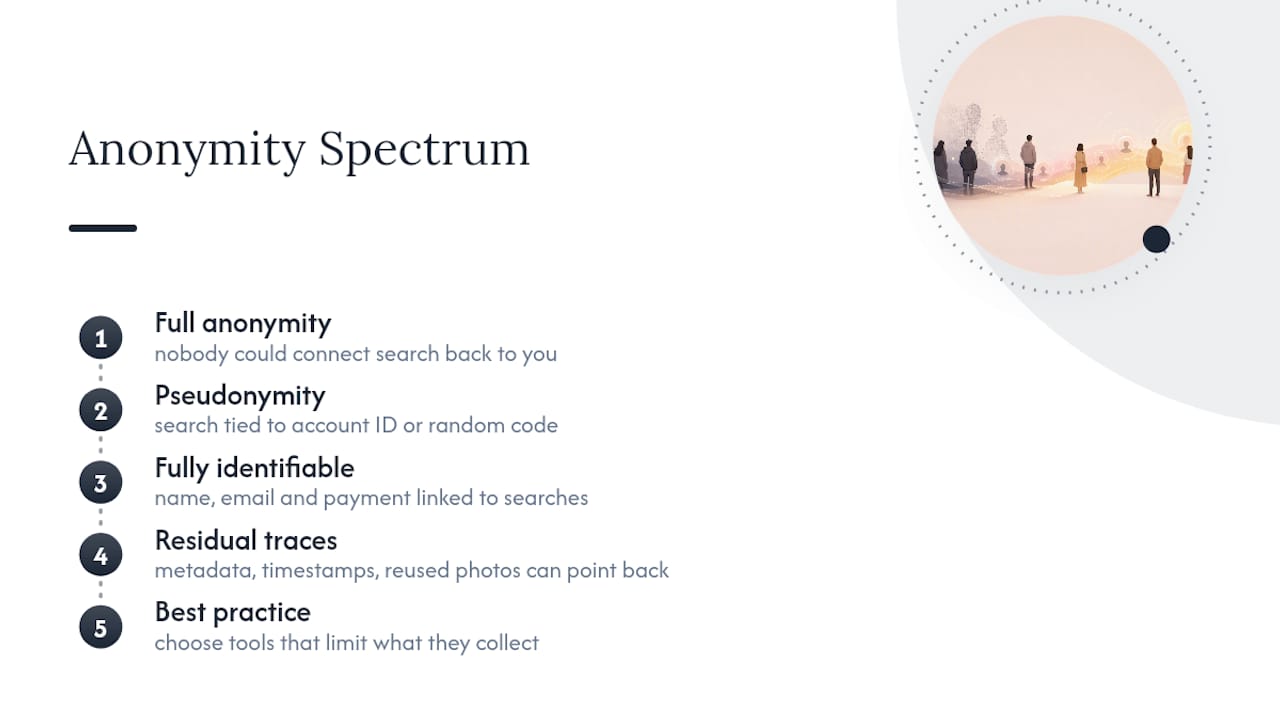
Move the dial slightly right and you land on pseudonymity. Your search is tied to an account ID or a random code instead of your real name. The company could still figure out who you are if they wanted to, by cross-referencing your IP address or payment details, but on the surface, your search looks disconnected from your identity.
Keep moving right and you reach fully identifiable handling. This is where your name, email, and payment method are all linked directly to your search history. Many free “dating scan” tools land here, especially the ones that ask for your full name and card number upfront.
Removing your name from a screenshot doesn’t erase the trail either. Metadata, timestamps, and reused photos can all point right back to you, even without your name attached. That’s why the smartest move is picking a tool that limits what it collects from the start, rather than trying to scrub your tracks after the fact.
Do Privacy Laws Like GDPR and CCPA Protect You?
Data protection laws give you real rights, but they work differently depending on where you live.
Under the European Union’s GDPR, companies need a legal basis to process your personal data, and you have the right to know what’s collected, request deletion, and object to certain uses. In the United States, the California Consumer Privacy Act (CCPA) gives California residents the right to know what personal data a business collects and to request that it be deleted or not sold. These laws mostly apply to how companies handle your own data, though, not to whether you can search public information about someone else.
That distinction matters here. Searching a public dating profile isn’t the same as a company mishandling your data. But it does mean any scanning tool you use should be transparent about what it collects and how long it keeps it. If a service won’t tell you its retention policy in plain language, that’s a warning sign, regardless of which rules technically apply where you live.
What Should a Dating App Tell You Before Scanning Your Data?
A dating app that respects you will tell you clearly, before you agree to anything, exactly what it plans to check and why.
That means plain language, not buried fine print. It means telling you upfront if a feature accesses your camera roll, your contacts, or your location, and letting you say no without losing access to the core app. It also means being honest about whether your data gets shared with advertisers or third parties, something Mozilla’s research found many apps fail to do clearly.
If you’re the one running a scan on someone else’s public information, the same principle of transparency should guide your choice of tool. Pick a service that tells you plainly what it checks (public profiles) and what it doesn’t touch (someone’s phone). That’s the whole difference between a check and spying.
Why We Push Public Profile Scans Over Spyware
Too many people reach for spyware out of desperation, not malice. They don’t realize they’re putting themselves at risk while trying to protect their relationship.
Privacy-first scanning exists because you shouldn’t have to choose between getting answers and staying out of trouble. Public-profile checks give you real information without crossing a line you can’t uncross. If you’re ready to stop guessing, search their name now and get an encrypted scan today.
Get a Discreet Answer Today
CheaterDetectorAI checks only what’s already public, so you get answers without ever touching your partner’s phone. That’s the real difference: no spyware, no access to anything private, nothing that can come back on you.
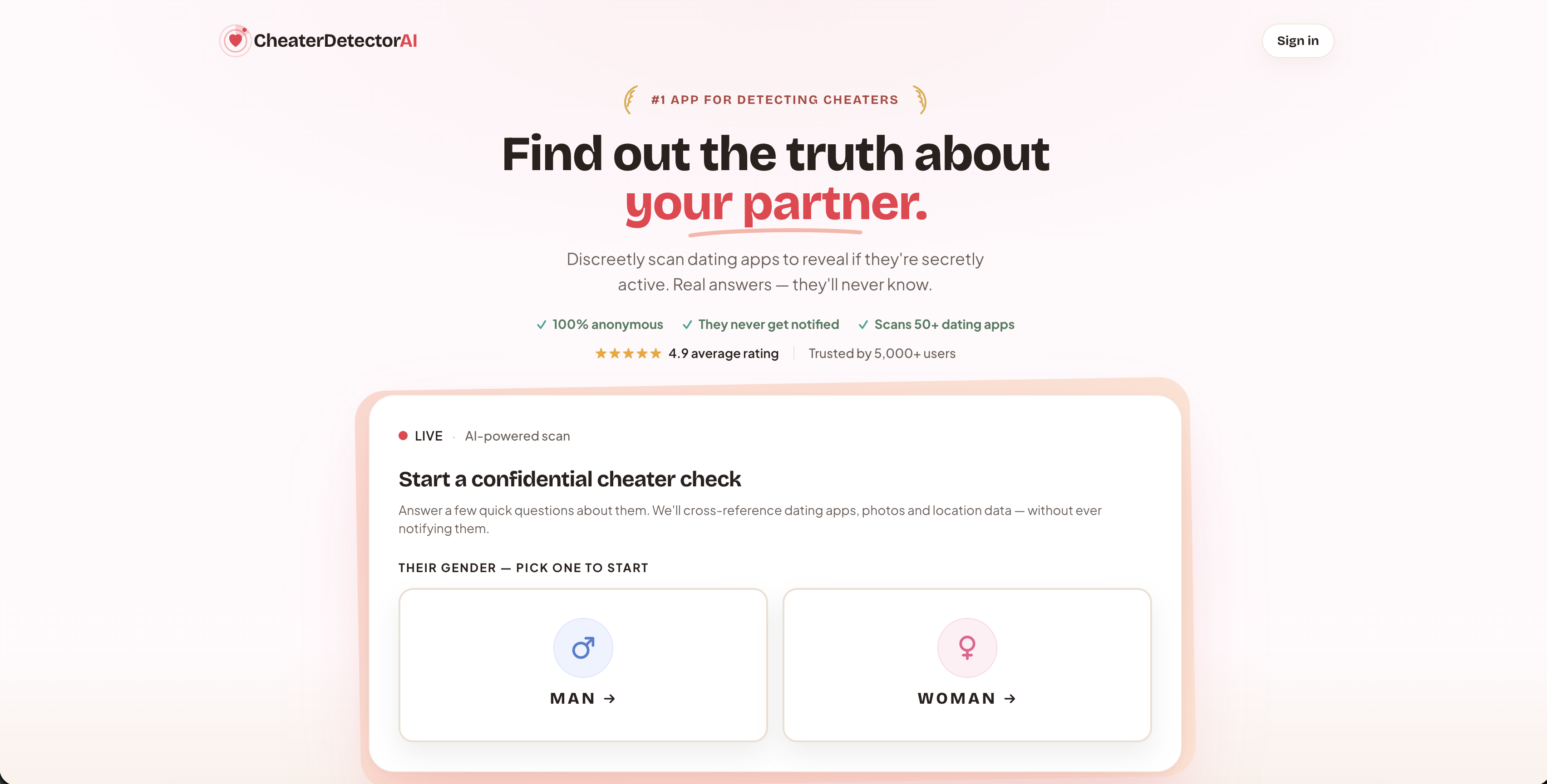
Here’s what you get: public-only profile checks across major dating platforms, encrypted reports so your search stays private, and results that come back fast, not days later. You provide minimal details, like a name or photo, and the report includes profile matches, photos, and activity timestamps. Over 5,000 people have already used CheaterDetectorAI, rating the service 4.9 on average.
You don’t need to install anything, unlock anyone’s phone, or risk prosecution. Start with a deep person scan and get your encrypted report now. Order a discreet scan today, and stop wondering.
Sources
- Dating app Raw exposed users’ location data and personal information
- Everything But Your Mother’s Maiden Name: Mozilla Research Finds Majority of Dating Apps More Data-hungry and Invasive than Ever
- Swipe Left for Identity Theft: An Analysis of User Data Privacy Risks on Location-based Dating Apps
- The privacy costs of dating on your phone — 100 dating apps analyzed
FAQ
Are Dating App Scans Truly Anonymous?
No, most dating app scans leave some kind of trace, whether it’s a server log, payment record, or IP address, unless the tool checks only public data without collecting your personal details.
Can I Get in Trouble for Spying on My Partner’s Phone?
Yes, installing spyware or reading someone’s private messages without consent is illegal and can lead to criminal charges against you, even if your partner is cheating.
What’s the Safest Way to Check if My Partner Is on Dating Apps?
Public-profile searches and vetted services like CheaterDetectorAI that only check publicly available data, without accessing your partner’s phone, are the safest option.
Does CheaterDetectorAI Notify My Partner?
No, CheaterDetectorAI checks public profiles only and does not contact or alert the person being searched.
What Should I Do if I Find a Matching Profile?
Screenshot the profile with the date and URL visible, avoid confronting your partner alone, and consider talking to a counselor or someone you trust before your next move.