%20scale(1.05)%20translate(-12,-14.25)'%3e%3cpath%20d='M12%2021s-7.5-4.7-7.5-10.2A4.3%204.3%200%200%201%2012%207.5a4.3%204.3%200%200%201%207.5%203.3C19.5%2016.3%2012%2021%2012%2021Z'%20fill='%23F0384A'%3e%3c/path%3e%3c/g%3e%3c/svg%3e)

Yes, you can find out if your partner is secretly active on dating apps, and no, you don’t need to touch their phone to do it. Snooping through private messages or installing spyware is illegal in most states and can turn you from a worried partner into a defendant. The safe path is a public, anonymous profile scan. Check their profile today with a legal search instead of risking a crime you can’t undo.
TL;DR:
- Searching for a public dating profile using a partner’s name, photo, or phone number is legal and avoids privacy violations associated with private message snooping.
- Installing spyware, guessing passwords, or setting up auto-forwarding breaches federal and state laws and can result in felony charges or civil damages.
- Recognized signs of active cheating include changes in phone security or unexplained late nights, but evidence should be limited to public profiles with timestamps for legal reliability.
- A verified public profile match and proper screenshot evidence protect you legally and are more credible than data obtained through secret surveillance.
- Conducting an anonymous, encrypted search with a professional tool like CheaterDetectorAI is the safest and fastest way to find out if your partner is active on dating apps without risking legal or relationship damage.
Is DM Cheating Even the Right Question to Ask?
The real worry isn’t whether a flirty message crossed a line. It is whether your partner has an active dating profile they never told you about. That’s a much bigger red flag than any message, and it’s also the one thing you can actually verify without breaking any law.
Here’s the distinction that matters: reading someone’s private conversations requires access you don’t legally have. Checking whether their name or photo shows up on a public dating profile does not. One is snooping. The other is a search anyone could technically do, just without the manual grind of checking six apps by hand.
If you’re asking “is DM cheating,” you’re probably really asking “is my partner using dating apps behind my back?” That’s answerable. And it’s answerable legally.
What U.S. Law Says About Checking a Partner’s Phone
Marriage does not give you a legal pass to go through your partner’s phone. Federal statutes like the Electronic Communications Privacy Act and the Stored Communications Act can apply even to spouses, and state laws often go further. If you install spyware, set up message forwarding, or guess your partner’s password to get into their accounts, you’re not gathering evidence. You’re breaking federal law.
Courts have awarded real civil damages against spouses who installed hidden monitoring apps, and some states charge this kind of digital snooping as a felony. Here’s what crosses the line:
- Installing spyware or a hidden tracking app on your partner’s phone
- Guessing a password or bypassing a fingerprint or face lock
- Setting up auto-forwarding so their texts or emails land in your inbox
- Planting a GPS tracker on their car or belongings
Do not read your partner’s private messages, and do not install any monitoring software. Even if you know the password because they told you once, using it now without permission can still violate wiretap and stored-communication laws. Implied consent is a narrow, fact-specific defense, not a blanket shield, and it evaporates the moment your partner changes their passcode. Some states treat these actions as felonies with real prosecution risk, not just a slap on the wrist.
Which Signs and Evidence Actually Hold Up?
Not every red flag means cheating, and not every piece of “evidence” will hold up if things go legal. Some signs are worth watching. Others are traps that get you in trouble instead of answers.
Behavioral signs worth noticing include a sudden password change on a phone that used to sit open on the counter, new secrecy about notifications, or unexplained late nights that don’t match the story you’re told. None of these prove anything alone, but a pattern is worth paying attention to.
What actually helps if you ever need real proof:
- A public dating profile with your partner’s photo, name, or matching details
- Screenshots of that public profile, with the date and time visible
- Public timestamps showing recent activity on the account
What you should avoid leaning on entirely: anything pulled from spyware, a hacked account, or a device you accessed without permission. Courts have found that evidence gathered through lawful methods, like public screenshots or subpoenaed records, holds up far better than data pulled through secret surveillance.
Pro Tip: When you screenshot a public profile, capture the full screen, including the date and time in your phone’s status bar. A cropped photo with no timestamp is easy to dismiss later; a dated screenshot is not. Our guide to legally capturing screenshot evidence walks through this in more detail.
How Do You Check Legally, Step by Step?
You don’t need a private investigator on day one, and you definitely don’t need to touch their phone. Work through this in order, and stop the moment you have what you need.
- Start with what’s already visible. Check any shared accounts, tagged photos, or public social media your partner already knows you can see. Nothing hidden, nothing sneaky.
- Search public signals yourself. Try their name, common usernames, or a reverse image search on a favorite photo. This surfaces public profiles without touching anything private.
- Run an anonymous profile scan. A service built to search public dating profiles across major platforms can do in minutes what would take you hours of manual checking app by app. It never asks for access to their phone.
- Preserve what you find. Save the profile URL, capture the photo, and note any visible timestamp. Keep this on a device your partner doesn’t use. Recording the date and using a fresh device or account when you talk to counsel protects the evidence and protects you.
A few things to keep in mind as you go:
- If you find a genuine match, don’t confront your partner immediately. Talk to a lawyer first if you think divorce or custody could be involved.
- If you’re tempted to guess a password “just this once,” stop. That single move can undo everything you’ve done right so far.
- If the situation involves threats, controlling behavior, or you feel unsafe, contact an attorney or domestic violence resource before doing anything else.
What Discovering a Hidden Profile Does to You Emotionally
Finding out your partner might be active on a dating app doesn’t feel like a discovery. It feels like the floor tilting. Your brain runs through the whole relationship again, looking for moments that suddenly read differently.
This reaction is normal, and it doesn’t mean you’re overreacting. Betrayal, even suspected betrayal, triggers the same stress response as a physical threat. Sleep gets worse. You check your phone constantly. You replay conversations looking for cracks you missed.
Waiting to find out is often worse than knowing. Uncertainty keeps your nervous system stuck in alert mode indefinitely, while an answer, even a painful one, lets you actually start dealing with what’s real. That’s part of why a fast, legal way to check matters so much: not because speed fixes the pain, but because not knowing has its own cost, one that compounds every week you sit with it.
Give yourself permission to feel shaken before you try to be logical about next steps. You’re allowed to be upset and still make a smart decision.
Could You Be Misreading an Innocent Message?
Not every late reply or vague text is a cheating in DMs situation. Context changes everything, and it’s easy to build a case out of details that mean nothing on their own.
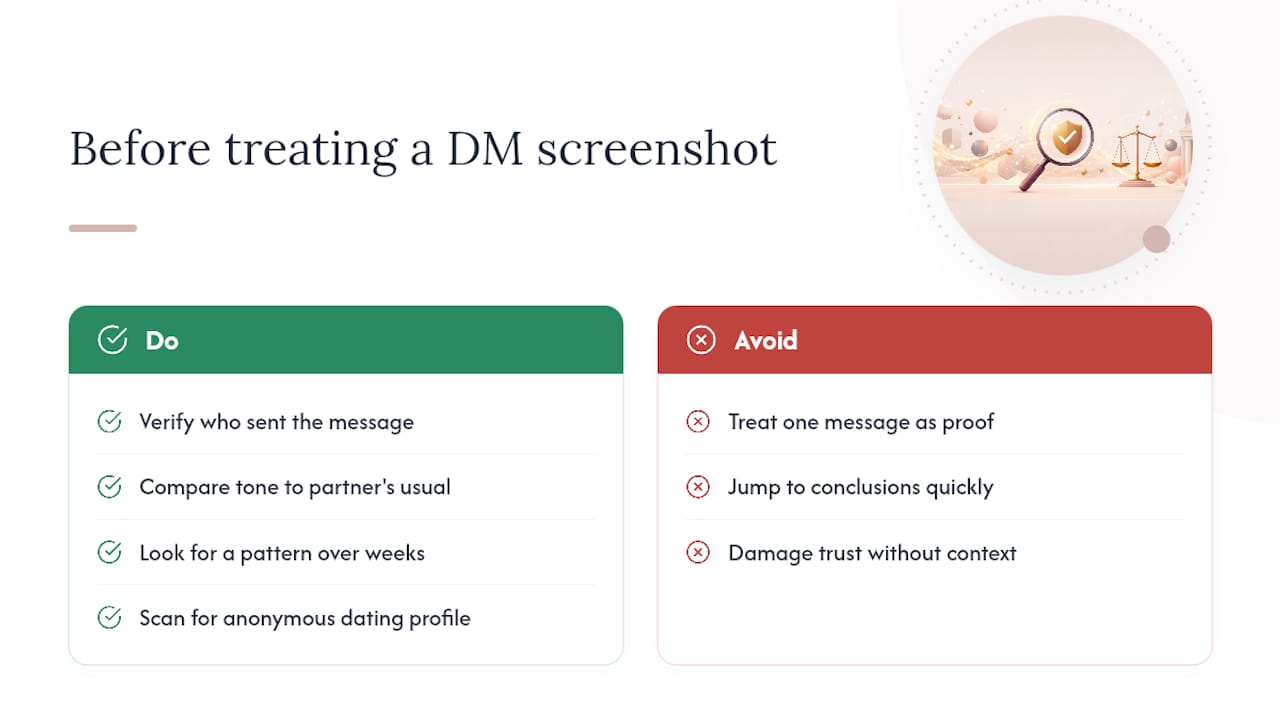
Before you treat a screenshot as proof, ask a few questions. Is this message from someone you already know is a coworker, old friend, or family member? Does the tone match how your partner talks to everyone, or is it noticeably different? Is the “evidence” a single message, or a pattern across weeks?
A single ambiguous message rarely tells you anything solid. A pattern, paired with a public dating profile that shouldn’t exist, tells you a lot more. That’s the real value of an anonymous profile scan: it gives you something concrete to weigh the ambiguous stuff against, instead of guessing from a screenshot with no context.
If you’re not sure whether what you’re seeing counts as emotional cheating or just an ordinary friendship, it helps to read up on where that line typically sits before you act. Our breakdown of when online interactions cross into emotional cheating covers this in plain terms.
Jumping to conclusions from one out-of-context text can damage trust that took years to build, sometimes over something that turns out to be completely innocent.
Where Is the Line Between Checking and Invading Privacy?
Wanting the truth doesn’t erase your partner’s right to privacy, and holding both of those at once is uncomfortable but necessary. The goal is verification, not surveillance.
That distinction shows up in the method you choose. Checking a public dating profile respects the boundary that your partner’s private messages, photos, and device data are still theirs. Installing spyware or reading their texts erases that boundary entirely, and it doesn’t matter how justified you feel in the moment.
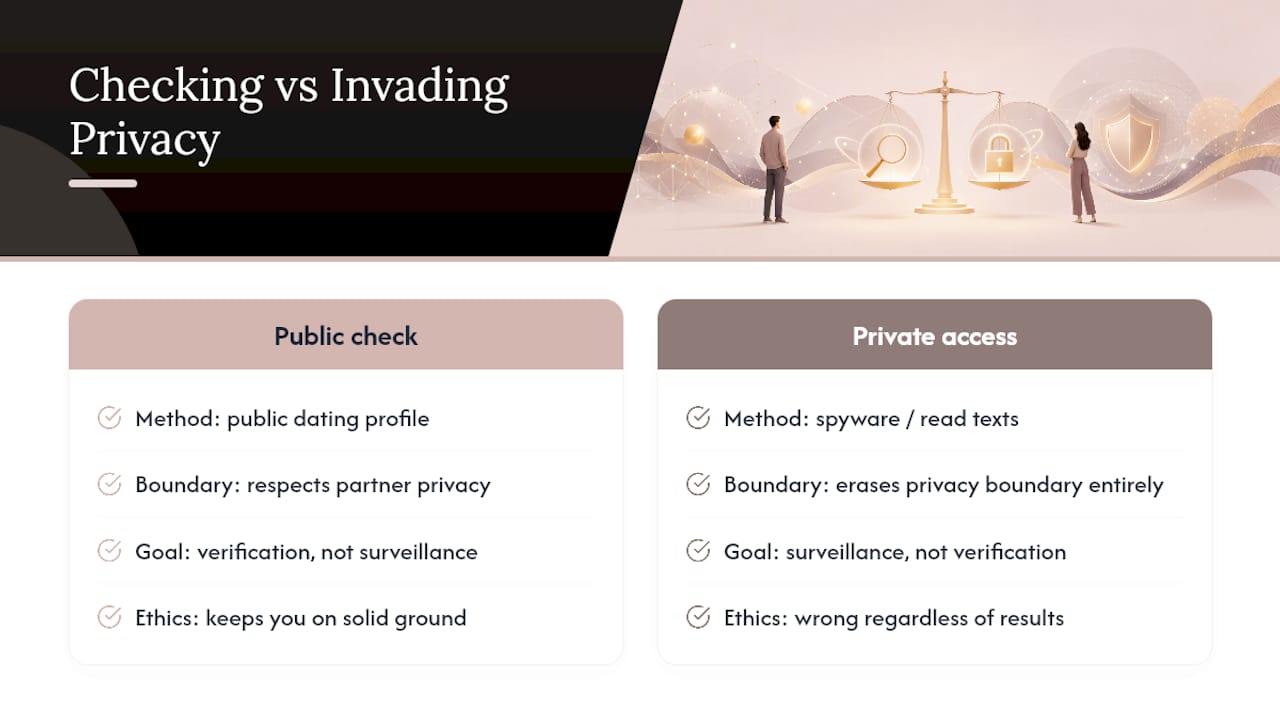
If you’re in a relationship built on any kind of mutual respect, the way you look for answers matters almost as much as the answers themselves. A search limited to public information keeps you on solid ethical ground even if what you find is painful. A search that crosses into their private world puts you in the wrong regardless of what it turns up.
What Happens If You Accuse Your Partner and You’re Wrong?
A false accusation doesn’t just embarrass you. It can genuinely break something in the relationship that’s hard to repair, even after you apologize.
Trust runs both directions. If you confront your partner with a screenshot that turns out to be a work conversation or an old friend catching up, you’ve told them, without meaning to, that you were already looking for reasons to doubt them. That message lands hard, even when your intentions were to protect the relationship, not damage it.
There’s a practical cost too. If the accusation escalates into a legal dispute, like a divorce or custody case, a pattern of unfounded accusations can undercut your credibility later, even when a real issue eventually surfaces. That’s one more reason to have something concrete, like a verified public profile match, before you say anything out loud.
Slow down before you speak. Get your facts straight first, hold the conversation until you actually have something solid, and lead with a question instead of a statement when you do talk.
How CheaterDetectorAI Gives You Answers Without the Risk
CheaterDetectorAI runs an anonymous scan across major dating platforms and checks for a matching public profile using only the details you already know, like a name, photo, or phone number. You get an encrypted report back with any profile match it finds, including photos and activity timestamps.
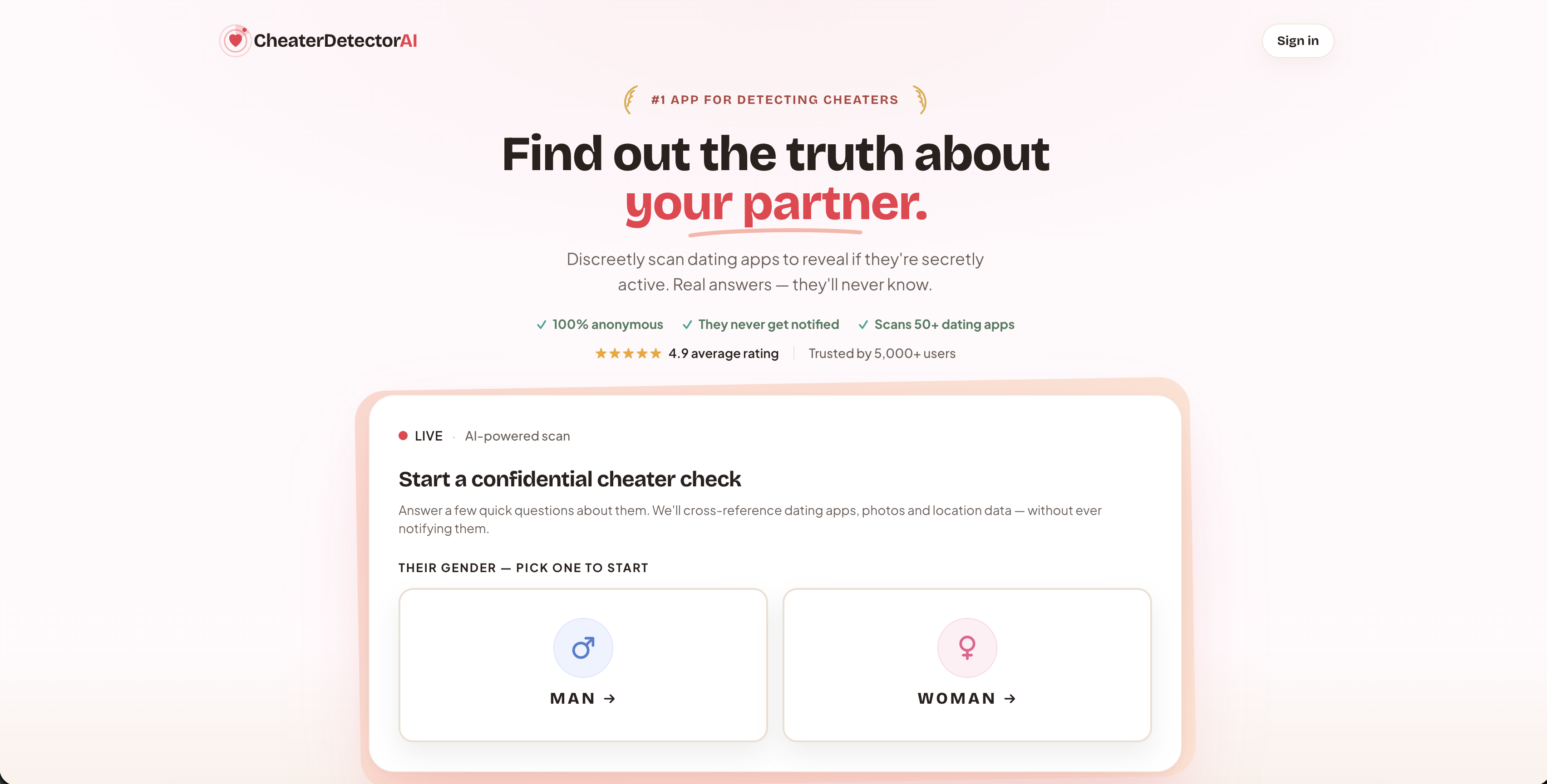
Here’s what it does not do, and this matters: no spyware, no access to your partner’s phone, and no reading of private messages. Everything it checks is public. That’s what makes it legal.
Reports typically come back fast, no waiting days for an answer while your mind spins. Pricing details are available on the website, so you can get a straight answer without a long-term commitment.
Search their name now with a deep person scan and see what turns up. Still unsure if this is the right move? Find out anonymously whether your partner is on dating apps before you say a word to anyone. Check their profile today instead of spending another week guessing.
Oleg’s Take: Get the Facts Before You Get Loud
Every version of this story I’ve seen ends the same way when someone reaches for spyware: worse. Worse legally, worse emotionally, worse for the relationship even if the suspicion turns out to be true. The anonymous, encrypted approach isn’t a compromise. It’s the only version of this search where you’re not risking a lawsuit to get an answer.
Anonymity matters because it protects you while you’re still uncertain. You shouldn’t have to tip your hand or explain yourself before you even know what you’re dealing with. Encryption matters because this is sensitive information, and it should stay between you and the report, not sit exposed somewhere.
If you get a match, don’t lead with anger. Document it, sit with it for a day, then talk. If things get complicated, read a bit on emotional honesty in relationships before that conversation, and consider a lawyer if custody or divorce is on the table.
— Oleg
This article is general information, not a substitute for advice from a qualified lawyer. Consult a qualified legal professional about your own circumstances before acting on anything here.
Sources
- Is It Illegal to Go Through Spouse Phone in 2026?
- Digital espionage in matrimonial cases: drawing the line
FAQ
Is checking dating apps for my partner’s profile illegal?
No. Searching public dating profiles is legal because you’re only viewing information your partner made publicly visible, unlike reading private messages or installing spyware, which can violate federal wiretap law.
Can I get in trouble for looking through my partner’s phone?
Yes. Marriage does not exempt you from federal and state privacy laws, and accessing a partner’s phone without permission can carry criminal and civil penalties even if you’re married.
What does an anonymous dating app scan actually check?
Services like CheaterDetectorAI search public dating profiles across major platforms using a name, photo, or phone number, then return an encrypted report with any matches, profile photos, and timestamps.
Is one flirty message in a DM enough to prove cheating?
No. A single ambiguous message rarely proves anything on its own; a pattern of secretive behavior combined with a hidden dating profile is far more telling than one out-of-context text.
How long does a legal profile scan take?
Anonymous public-profile scans are built for speed, typically returning results in minutes rather than the days a private investigator or manual search would require.