%20scale(1.05)%20translate(-12,-14.25)'%3e%3cpath%20d='M12%2021s-7.5-4.7-7.5-10.2A4.3%204.3%200%200%201%2012%207.5a4.3%204.3%200%200%201%207.5%203.3C19.5%2016.3%2012%2021%2012%2021Z'%20fill='%23F0384A'%3e%3c/path%3e%3c/g%3e%3c/svg%3e)
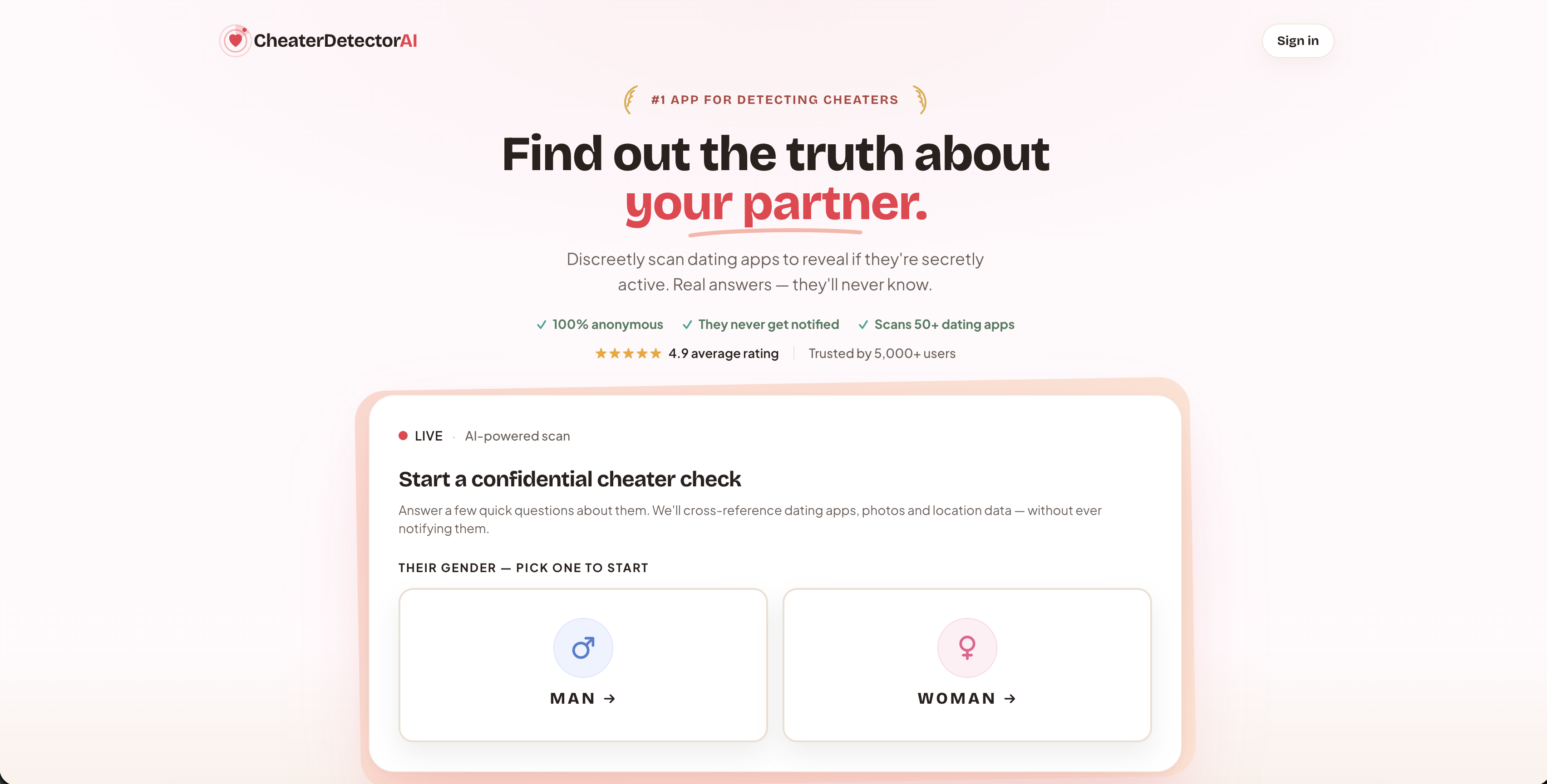
Yes, you can anonymously check whether your partner has an active dating profile — without touching their phone. If you suspect your partner is secretly using dating apps, a public-profile scan is the clean way to find out.
Here’s what a public-profile scan does and does not do:
- What it does: Searches publicly visible dating profiles using basic information you provide (name, photo, location). No device access. No message interception. Fully encrypted and anonymous.
- What it does not do: Read private messages, access locked accounts, or install anything on your partner’s phone.
CheaterDetectorAI runs exactly this kind of scan. The process is anonymous, encrypted, and based entirely on public information. Search their name now at CheaterDetectorAI and get your answer fast.
Key Takeaways
Anonymous public-profile scans are the safest way to check if a partner is active on dating apps without snooping or hurting your own case later.
| Point | Details |
|---|---|
| Skip the spyware | Installing tracking apps or intercepting messages can result in federal charges, civil suits, and excluded evidence. |
| Scans use public data only | A public-profile scan checks publicly visible profiles — no phone access, no message interception, fully anonymous. |
| Report items that matter | Profile link + matching photo + recent timestamp = stronger evidence; a name-only match alone is inconclusive. |
| Preserve evidence safely | Screenshot and secure your report before you decide on next steps or bring in a licensed investigator. |
| CheaterDetectorAI | Anonymous, encrypted, no phone access required — trusted by 5,000+ users with a 4.9 average rating. |
Why spyware and secret phone access backfire
Installing spyware, using a stalker app, or reading your partner’s messages without their consent can be a federal crime. This is not a gray area.
The Electronic Communications Privacy Act (ECPA) prohibits intercepting electronic communications without consent. Courts have consistently rejected the idea that marriage creates a blanket exception. Being married does not give you the right to read your spouse’s texts or emails.
The AAML analysis is direct: federal and state statutes generally prohibit interception of electronic communications without consent, and no blanket spousal exemption exists under the ECPA. Courts have largely abandoned the marital exception theory.
State rules add another layer of risk. Texas law and similar statutes make clear that marital status or shared device ownership does not automatically create consent to intercept communications. One-party consent is widely misunderstood — it applies to your own conversations, not to secretly monitoring someone else’s.
The practical fallout is serious:
- Criminal charges. Installing spyware can result in federal wiretapping charges or state criminal prosecution.
- Civil liability. Your partner can sue you for damages.
- Evidence thrown out. A judge can exclude secretly gathered evidence, leaving you worse off than before.
- Backfire in family court. NPR reports that attorneys have seen partners who installed spyware end up needing criminal-defense counsel. In no-fault divorce states, how you gathered evidence can matter as much as what it shows.
There is also a data security problem. TechCrunch documents repeated cases where stalkerware vendors exposed captured data in breaches. Your partner’s private information — and yours — can end up on insecure third-party servers.
If you find spyware on your own device: change passwords, create new accounts, and consider a professional forensics exam rather than trying to remove it yourself.
How an anonymous public-profile scan actually works
A public-profile scan searches only what dating sites make visible to anyone on the internet. It does not require your partner’s phone, password, or any private access.
You provide a few basic inputs. The scan cross-references those inputs against publicly visible profiles across major dating platforms and returns matches with confidence levels.
Typical inputs used:
- Full name or common alias
- A recent photo
- General location (city or state)
- Email address (if publicly associated with a profile)
| Search input | What it can reveal | What it cannot reveal |
|---|---|---|
| Full name | Public profile link, username | Private messages, hidden profiles |
| Recent photo | Matching profile photos, timestamps | Private photos, locked galleries |
| Email alias | Associated public accounts | Account passwords, login history |
| Location | Profiles active in that area | Exact address or real-time location |
Pro Tip: Use a recent, clear photo of your partner’s face for the best match accuracy. A name alone in a large city produces more false positives than a name paired with a photo.
Accuracy has real limits. A common name without a photo will generate more noise. Private or deleted profiles will not appear. If your partner used a fake name and a photo you have never seen, the scan may return no match — that is a limitation of any public-profile search, not a flaw specific to any one service. For a deeper look at how to find hidden profiles, the search inputs you choose matter more than most people realize.
What your report shows and how to read it
A CheaterDetectorAI report contains only public information. No private messages. No account credentials. What you actually receive:
- Profile link. A direct URL to the public dating profile if one is found.
- Public photos. Images visible to any visitor on that platform.
- Timestamps. When the profile was last active, if the platform makes that public.
- Confidence note. A rating indicating how closely the match aligns with your inputs.
On evidence weight: a direct profile link paired with a matching photo and a recent timestamp is strong, documentable evidence. A low-confidence name match with no photo is inconclusive and should not be treated as proof.
What matters is the combination of elements. A profile link alone, without a recognizable photo, is weaker than a link plus a photo that clearly matches your partner. Timestamps showing recent activity strengthen the case further.
Ambiguous results happen. A similar photo, a partial name match, or a profile flagged as “possible” rather than “confirmed” means the scan found something worth noting but not something to act on alone. Treat those as a reason to run a follow-up scan with better inputs, not as confirmation of cheating.

What to do after you get your results
Preserve evidence first. Do not install spyware to dig deeper. That step crosses the line described above, and it can destroy your case.
If the scan finds a match
- Screenshot the report and save it to a secure, private location (not a shared device or cloud account your partner can access).
- Note the date and time you received the results.
- Do not confront your partner using the report as leverage before you’ve had time to think it through.
- Consult a family-law attorney before taking any further action if you’re married or heading for divorce.
- If you need more documentation, consider hiring a licensed private investigator — a court-recognized option.
If the scan finds no match
- Do not assume your partner is innocent based on one scan alone. Private profiles and fake names can evade public searches.
- Consider a monitored follow-up scan that alerts you to new activity over time.
- Avoid jumping to confrontation. One inconclusive result is not the full picture.
Pro Tip: If you are in a situation where you fear for your safety, contact the National Domestic Violence Hotline at 1-800-799-7233 before confronting a partner. Evidence gathering is secondary to your safety.
For a full walkthrough of next steps, the practical guide to catching a cheater online covers both outcomes in detail.
Why CheaterDetectorAI is the right tool for this
CheaterDetectorAI runs public-profile-only, anonymous scans. No device access. No message interception. No notification to your partner.
What you get:
- Anonymous and encrypted scanning. Your search is private. Your partner is never notified.
- No phone access required. You never need to touch their device.
- Detailed report. Profile photos, timestamps, profile links, and a confidence rating.
- Trusted by 5,000+ users with an average rating of 4.9.
- Fast results. Most scans return findings quickly, not days later.
- Subscription monitoring option. Get alerts if a new profile appears over time.
CheaterDetectorAI checks only publicly available profiles across all major dating platforms. You get real answers without snooping.
Check their profile today with the anonymous dating app scan. Or run a deep person scan if you want the most thorough public-profile search available.
A note from Oleg
Suspecting a partner is one of the worst feelings there is. You are not paranoid for wanting to know the truth. You deserve clarity — and you deserve to get it without putting yourself at risk.
Do not install spyware. Do not read their messages. Those paths can turn you into the person facing charges.
The clean path exists. Use it. Search their name now at CheaterDetectorAI and find out what is actually happening.
CheaterDetectorAI: the answer you came here for
You came here because something feels wrong. That feeling deserves a real answer, not a new mess.
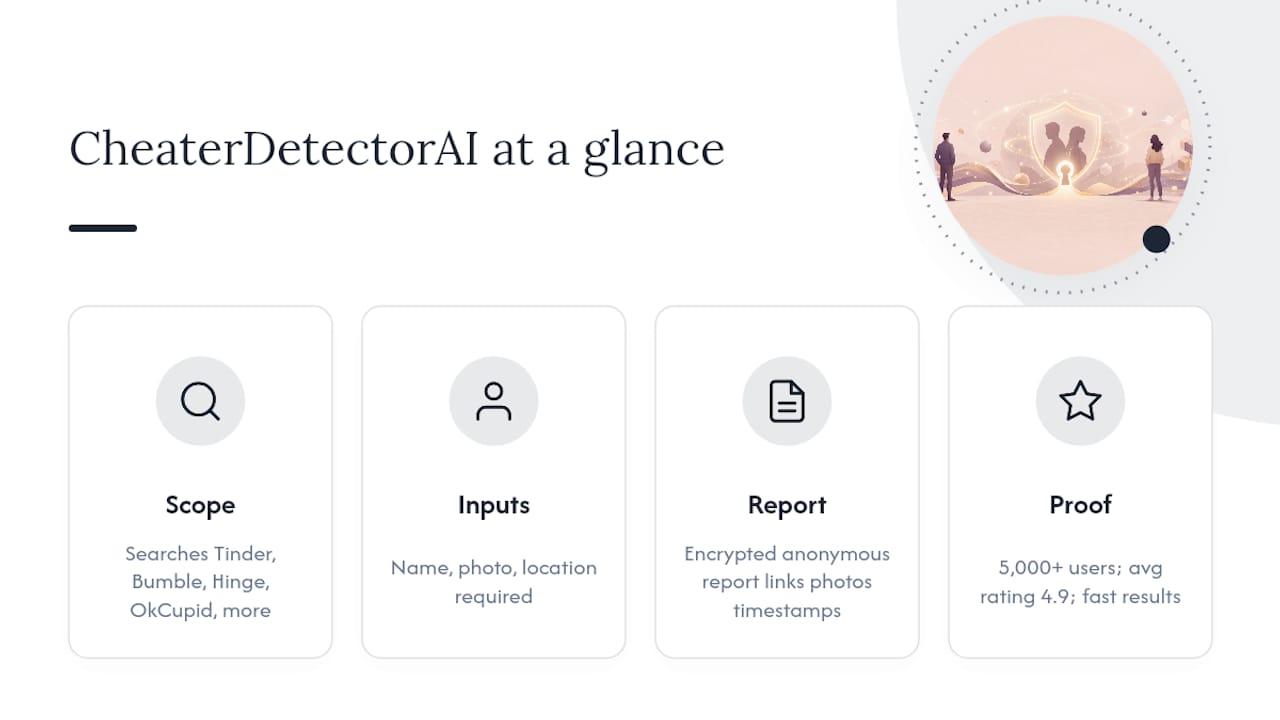
CheaterDetectorAI gives you that answer the right way. Enter your partner’s name, a photo, and their location. The scan searches publicly visible profiles across all major dating platforms — Tinder, Bumble, Hinge, OkCupid, and more. You get an encrypted, anonymous report with profile links, photos, and timestamps. No phone access. No spyware. No risk to you.
Over 5,000 people have used CheaterDetectorAI to find the truth. The average rating is 4.9. Results come fast.
Start your anonymous scan now and find out what your partner is actually doing online.
This article is general information, not a substitute for professional advice. If you’re dealing with a separation or divorce, get advice for your own situation before acting on anything here.
Sources
Trusted U.S. sources on surveillance, stalkerware risks, and safer alternatives:
- What To Do If Spyware Comes Up In Your Relationship : All Tech Considered : NPR
- Hacked, leaked, exposed: Why you should never use stalkerware apps | TechCrunch
- Spyware & Stalkerware Charges | L&L Law Group
- Can I Spy on My Spouse if I Suspect They Are Cheating? What You Can Do Legally
FAQ
Is it OK to scan my partner’s dating profiles without telling them?
Yes, scanning publicly visible dating profiles is legal in the United States. Public-profile scans do not intercept private communications and do not require device access, so they fall outside the ECPA and state wiretap rules.
Can I use spyware on my spouse’s phone if I’m married?
No. The ECPA and most state rules do not provide a spousal exception for intercepting electronic communications. Installing spyware on a spouse’s phone can result in criminal charges and civil liability regardless of marital status.
What does a CheaterDetectorAI report include?
A report includes publicly available profile links, profile photos, activity timestamps (when the platform makes them public), and a confidence rating indicating how closely the match aligns with your inputs.
What should I do if the scan finds a match?
Screenshot and secure the report, note the date, and take time to decide your next step before taking any further action. Do not install spyware or confront your partner in the heat of the moment.
What if the scan finds nothing?
A no-match result does not guarantee your partner is not on dating apps. Private profiles and fake names can evade public searches. Consider a monitored follow-up scan that alerts you to new profile activity over time.