%20scale(1.05)%20translate(-12,-14.25)'%3e%3cpath%20d='M12%2021s-7.5-4.7-7.5-10.2A4.3%204.3%200%200%201%2012%207.5a4.3%204.3%200%200%201%207.5%203.3C19.5%2016.3%2012%2021%2012%2021Z'%20fill='%23F0384A'%3e%3c/path%3e%3c/g%3e%3c/svg%3e)

No. CheaterBuster-style searches do not notify the person you search. The scan runs quietly in the background, and your partner never receives an alert, a message, or any sign that someone looked them up. That’s the short answer.

The one caveat: the search itself is anonymous, but how you handle the results can still expose you. More on that below.
Here’s what you need to know right now:
- The searched person is not notified. No in-app alert, no email, no message.
- You don’t need to log in to any dating app to run the search.
- The scan only checks publicly visible profiles — no phone access, no hacking.
- Spyware and tracking apps are illegal. A legal, anonymous scan is the safe path.
Ready to check right now? Search their profile anonymously before reading another word.
Does CheaterBuster tell the person you search?
No — and that’s the whole point. Multiple 2026 reviews confirm that searches on CheaterBuster-style services are anonymous and the target receives zero notification. Your partner won’t know you searched. There’s no ping on their phone, no “someone viewed your profile” alert, nothing.
What makes this possible is simple: these tools only look at profiles that are already visible to the public. They’re not logging into your partner’s account or sending any kind of request that the app would flag. The search happens entirely on your end.
That said, you can accidentally tip your hand. If you screenshot the results and leave them on a shared device, or if you confront your partner and show them the report, the anonymity is gone. The tool protects your search. It can’t protect your reaction.
Pro Tip: Use a private browser window and a separate email address when you sign up for any scan service. That one step keeps your search completely off shared devices and out of autofill.
How these scans find dating profiles without touching your partner’s phone
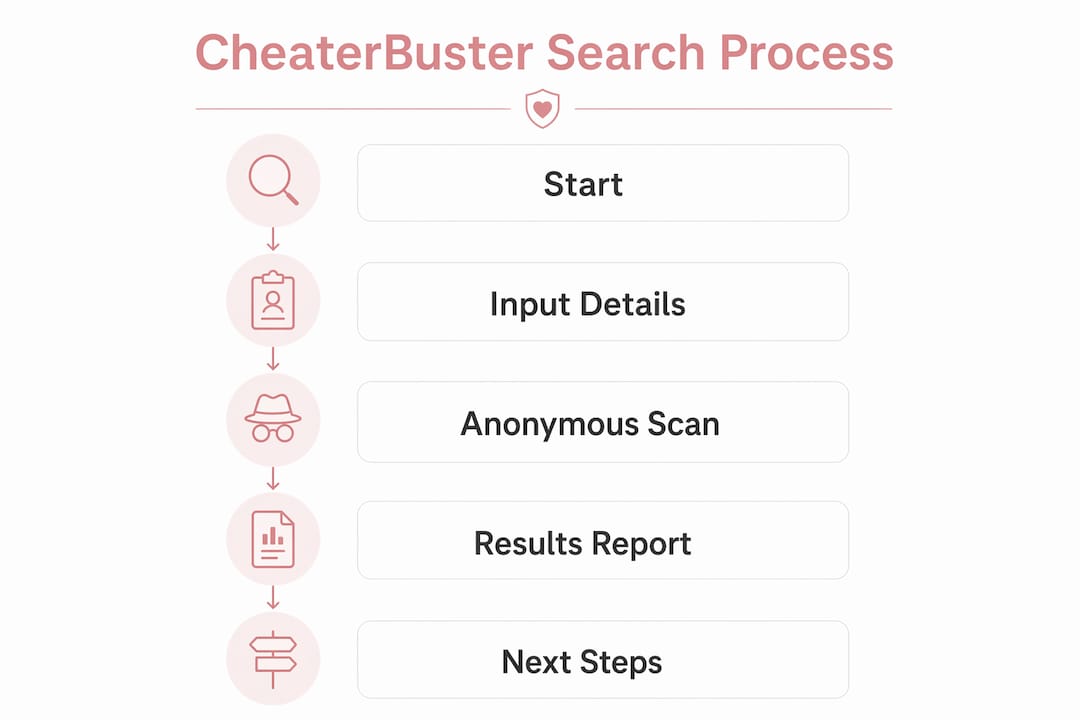
You enter a few basic details: your partner’s first name, approximate age, and location. Some services also accept a photo. That’s it. The service then searches public-facing dating app profiles and returns any matches it finds — no account on the dating app required, no phone access, no passwords.
Here’s the basic flow:
- You enter info (name, age, location, or photo)
- The tool searches public profiles on supported dating apps
- Matches are returned with photos, bio text, and activity indicators
- You get a report — your partner gets nothing
What these tools never do:
- Access your partner’s phone or device
- Read private messages or match lists
- Require you to create a dating app account
- Send any signal to the app that a search occurred
The scan only sees what the app already shows publicly. If your partner’s profile is set to private, paused, or deleted, the tool can’t find it. That’s an accuracy limit, not a flaw in the privacy design. Facial-recognition and public-profile tools can only detect what the app exposes — nothing more.
Pro Tip: A photo-based search tends to be more accurate than a name-only search, especially if your partner has a common name. If you have a recent, clear photo, use it.
What a CheaterBuster-style report actually shows you
When a match exists, hands-on tests show that these reports typically return:
- Profile photos from the dating app
- Bio text (what they wrote about themselves)
- Approximate last-active time or activity indicators
- Location clues (city or distance range shown on the profile)
- Subscription status flags (e.g., Tinder Gold or Plus, when visible)
- Profile links where the app makes them accessible
Some items are sometimes missing. Photos can be blurred if the app restricts them. If the account was recently deleted or paused, the report may come back empty even when the person was active recently. A partial match — same name, slightly different photo — doesn’t automatically mean it’s your partner.
One photo match is a lead, not proof. Two or three data points lining up (photo, bio details, location) is a much stronger signal. Treat the report as evidence to weigh, not a verdict.
Pro Tip: Compare the profile photo in the report against photos you already have. Lighting, angle, and filters can make the same person look different. Look for background details or clothing you recognize.
Want to see what a report looks like? Check their profile today with a private, anonymous scan.
Privacy and traceability: what “anonymous” really means here
The search is anonymous in a specific, meaningful way. The platform runs encrypted searches without linking your identity to any dating app account. No message is sent to your partner. No in-app alert fires. The dating app itself has no record that someone searched for that profile from outside the platform.
What “anonymous” does not cover:
- Payment traces. If you use a credit card your partner has access to, the charge could show up on a shared statement.
- Shared devices. Browser history, autofill, and saved passwords can all expose your search.
- Screenshots. Once you save or share a report, you control the paper trail.
- Confrontation. Showing your partner the report removes all anonymity instantly.
- Social-engineering loops. If you ask mutual friends questions based on what you found, word can get back.
The single biggest risk isn’t the search itself — it’s what you do after. Use a private browser, pay with a method your partner can’t see, and store any report somewhere only you can access.
And one absolute rule: do not install spyware, keyloggers, or tracking apps on your partner’s phone. Reading someone’s private messages without their consent is illegal under federal wiretapping law and state computer-fraud statutes across the U.S. It can get you prosecuted — even if your partner is cheating. A legal, anonymous scan keeps you protected.
Accuracy limits: false positives, false negatives, and what they mean
No scan is perfect. Independent reviews consistently note that common names, privacy settings, and deleted accounts are the main reasons a real profile gets missed.
False negatives (the tool misses an active profile) happen when:
- Your partner uses a nickname or a different name on the app
- Their profile is set to private or hidden from discovery
- The account was recently deleted or paused
- You entered the wrong age range or location
False positives (the tool returns a match that isn’t your partner) happen when:
- The name is common and multiple people match
- A profile photo looks similar but belongs to someone else
- Stale data from a deleted account still appears in results
A search for “Mike Johnson, 34, Chicago” will return more noise than a search for a unique name paired with a clear photo. Accuracy depends heavily on input quality — the more specific your inputs, the cleaner the results.
The bottom line: treat one scan as a starting point, not a final answer. Cross-reference what you find with other details before you act on it.
Which dating apps these tools actually search
Tinder is the most commonly supported platform, but coverage varies by service. Here’s a general picture of what’s typically available:
| Dating App | Typical Coverage | What Results Usually Include |
|---|---|---|
| Tinder | Strong | Photos, bio, last-active indicator |
| Hinge | Moderate | Photos, bio text |
| OkCupid | Moderate | Photos, profile text |
| Bumble | Limited | Photos (when public) |
| Other apps | Varies | Depends on public data available |
Coverage depends entirely on what each app exposes publicly. Apps with stricter privacy defaults are harder to scan. These tools bundle photo matching and cross-platform profile scans into a single subscription, so you’re not running five separate searches manually.
Before you pay, check whether the service covers the specific app you’re most concerned about. CheaterDetectorAI offers dedicated searches for Hinge profiles and OkCupid profiles alongside Tinder.
Legal and safety limits: what’s illegal and what protects you
One line, clearly: installing spyware, using tracking apps, or reading someone’s private messages without their consent is illegal in most U.S. jurisdictions. It doesn’t matter if you’re married. It doesn’t matter if you’re right about the cheating. You can be prosecuted under the federal Electronic Communications Privacy Act and state computer-fraud laws. The cheating doesn’t become your legal defense.
What is legal: searching publicly available dating profiles and paying for an anonymous scan that requires no phone access.
Steps to protect yourself during a legal search:
- Use a private or incognito browser window
- Pay with a method your partner can’t see (a separate card or a privacy-focused payment option)
- Use an email address your partner doesn’t know about
- Don’t save results to shared cloud storage (Google Photos, iCloud shared albums)
- Don’t discuss the search with mutual friends before you’re ready to act
The legal path is also the smarter path. Evidence gathered through illegal means is often inadmissible and can turn a situation where you’re the wronged party into one where you’re facing charges.
If you find a match: responsible next steps
Finding a match is a shock. Here’s a clear sequence to follow before you do anything else.
- Save the report securely. Download it to a device only you access, or email it to a private account your partner doesn’t know about.
- Don’t confront immediately. A single match, even a strong one, benefits from a second look. Give yourself 24 hours.
- Look for corroborating details. Does the bio mention something specific — a hobby, a neighborhood, a phrase your partner uses? Does the photo match recent pictures?
- Consider timing and safety. If you have any concern about your physical safety during a confrontation, involve a trusted friend or a professional counselor before you say anything.
- Decide what you need. Some people need more evidence before they’re ready to talk. Others need to talk to a therapist first. Neither is wrong.
- When you’re ready to talk, be specific. “I found your profile on [app]” is more productive than a general accusation. Have the report accessible but don’t lead with it — lead with the conversation.
Pro Tip: If you’re considering legal action (divorce, custody), speak with a family law attorney before confronting your partner. How you gathered the evidence and what you say first can matter in court.
Free or DIY checks to try before paying for a scan
Before spending money, a few free checks can either confirm your suspicion or put it to rest.
- Reverse image search. Save a recent photo of your partner and run it through Google Images or TinEye. If their dating profile is public and indexed, it may surface.
- Manual app search. If you have your own account on Tinder, Hinge, or another app, you can search by name or browse by location. This works only if their profile is set to discoverable.
- Social profile scan. Search their name, username, or email on Google. Some dating profiles are indexed publicly.
- Mutual connections. Check whether any mutual friends appear in their social media followers or connections — sometimes a dating profile links to a public Instagram.
These methods work best when your partner has a unique name and public profiles. Reverse image and manual searches hit a wall fast with private accounts or common names.
Pro Tip: If your partner has a common name, DIY searches will return too much noise to be useful. A photo-based scan through a dedicated service cuts through that noise far faster.
For a full walkthrough of manual checks, see how to find out if your partner is on dating apps — it covers each step in plain language.
Key Takeaways
CheaterBuster-style searches do not notify the person you search — the scan is anonymous, but how you handle the results determines whether your investigation stays private.
| Point | Details |
|---|---|
| No notification sent | The searched person receives no alert, message, or in-app signal of any kind. |
| Anonymity has limits | Payment traces, shared devices, and screenshots can expose your search after the fact. |
| Accuracy varies | Common names, deleted accounts, and private settings cause misses; use multiple data points before acting. |
| Spyware is illegal | Installing tracking apps or reading private messages without consent can get you prosecuted in the U.S. |
| CheaterDetectorAI | Offers anonymous, encrypted scans across major dating apps with no phone access required. |
Why a private, legal scan is the only path worth taking
The silence is the worst part. You’re not sure. You keep replaying small things. You want to ask, but you don’t want to be wrong — and you don’t want to tip them off if you’re right.
I’ve seen people go down the wrong road here: grabbing a partner’s phone, installing a tracking app, reading through messages. Every one of those options is illegal, and every one of them puts you at legal risk regardless of what you find. The evidence is tainted. You’re exposed. And you still don’t have a clean answer.
A discreet, legal scan is different. It checks publicly available profiles across major dating apps, returns a real report with photos and timestamps, and leaves your partner completely unaware. That’s not a workaround. That’s the right tool for the job. CheaterDetectorAI runs exactly that kind of scan — anonymous, encrypted, no phone access, results fast. If there’s a profile out there, it finds it. If there isn’t, you get that answer too, and that matters just as much.
CheaterDetectorAI: the anonymous, legal scan built for this exact situation
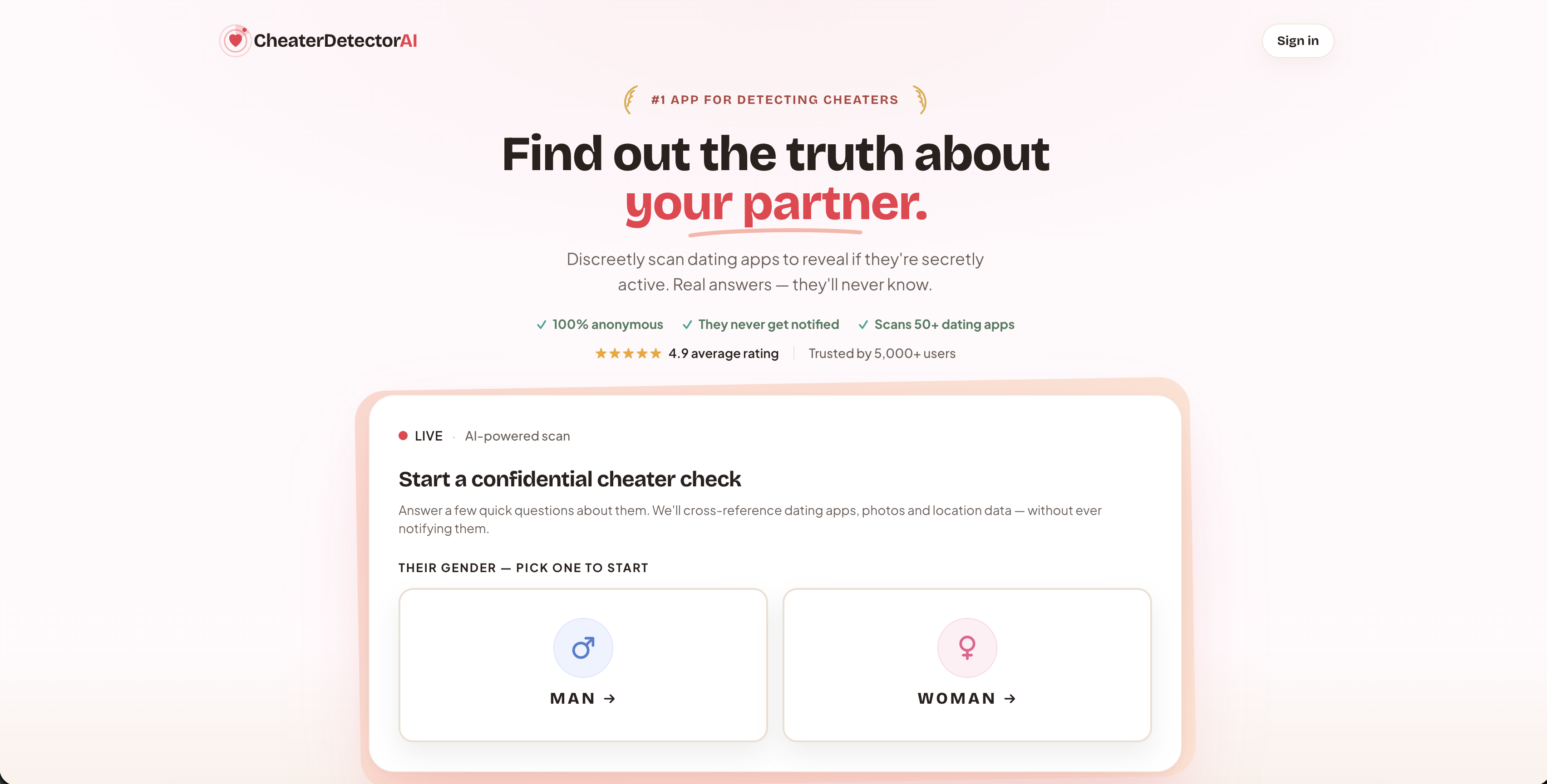
You’ve been sitting with this long enough. CheaterDetectorAI scans major dating apps anonymously — no phone access, no account linking, no notification to your partner. You enter a name, age, and location (or a photo), and the service does the rest.
What you get:
- Anonymous, encrypted search — your partner never knows
- Profile photos and bio text from matching profiles
- Activity timestamps when available
- Multi-app coverage including Tinder, Hinge, and OkCupid
- Ongoing monitoring with alerts if a new profile appears
Results come back fast. No waiting days. No guessing. Trusted by over 5,000 users with a 4.9 average rating.
Search their name now at CheaterDetectorAI and get a clear answer today. If you want the deepest scan available, go straight to the Deep Person Scan — it’s the most thorough option on the platform.
This article is general information, not legal advice. For your specific situation, consult a qualified attorney or check your state’s laws directly.
Useful sources
These are the sources used in this article. Each one covers a specific angle of how CheaterBuster-style services work, their accuracy, and their privacy implications.
- Cheaterbuster AI Review 2026 — Merlion Technologies — Covers how the service works, what inputs it uses, and anonymity claims. Used for the “how it works” and privacy sections.
- Cheaterbuster AI Review 2026 — TechTip Blog — Multiple reviewer confirmations that searches are anonymous and the target is not notified.
- Cheaterbuster Review 2026 — ScribeHow — Details on bundled features including photo matching and cross-platform monitoring subscriptions.
- Cheaterbuster AI: Features, Accuracy, Pricing — GoseBoze — Independent accuracy analysis including false positives and false negatives from common-name searches.
- Facial Recognition Turns Dating Apps into a Surveillance Front — Biometric Update — Industry analysis of what public-profile scanning can and cannot access; used for accuracy and privacy limits.
- We Tested Cheater Buster AI — Technori — Hands-on test results showing what a real report contains when a match exists.
- Catch-a-Cheater Apps vs. Anti-Facial-Recognition Tech — The Hustle — Expert perspective on treating scan results as a starting point rather than definitive proof.
Check your platform’s own privacy policy before running any search, and use only legal, public-data methods.
FAQ
Does CheaterBuster notify the person you search?
No. Searches are anonymous and the searched person receives no notification, message, or in-app alert of any kind.
What does CheaterBuster actually show you?
When a match is found, a report typically includes profile photos, bio text, approximate last-active time, location clues, and subscription status flags where visible.
How trustworthy are CheaterBuster results?
Results are reliable when inputs are specific, but common names, private settings, and deleted accounts cause misses. Treat any single match as a lead to investigate further, not a final verdict.
Does CheaterBuster only search Tinder?
Tinder is the most commonly supported app, but many services also cover Hinge, OkCupid, and others. Coverage varies by platform and depends on what each app exposes publicly. CheaterDetectorAI offers dedicated searches across multiple apps.
What are the risks of using a cheater-detection service?
The search itself is low-risk and legal. The risks come from how you handle results: payment traces on shared accounts, screenshots on shared devices, and confronting your partner before you’re ready can all expose your investigation.