%20scale(1.05)%20translate(-12,-14.25)'%3e%3cpath%20d='M12%2021s-7.5-4.7-7.5-10.2A4.3%204.3%200%200%201%2012%207.5a4.3%204.3%200%200%201%207.5%203.3C19.5%2016.3%2012%2021%2012%2021Z'%20fill='%23F0384A'%3e%3c/path%3e%3c/g%3e%3c/svg%3e)
Short answer: no, you can’t legally read your partner’s private messages or install spyware on his or her phone. But searching for a public dating profile using a name or photo? That’s legal. Running a background check? Also fine. Spyware, keyloggers, or guessing a password to get into someone’s account can get you arrested, not just your partner exposed. If you want answers without that risk, CheaterDetectorAI checks public dating profiles only, and you can search their name now.
TL;DR:
- Accessing private messages or installing spyware on a partner’s device without explicit consent violates federal laws and can lead to criminal charges and civil damages.
- Searching for a partner’s public dating profiles by name, phone number, or reverse image search is legal and widely used to gather information.
- State laws may impose stricter penalties than federal regulations, especially regarding unauthorized device access, recording, and spyware installation, varying significantly by jurisdiction.
- Installing monitoring apps, using keyloggers, guessing passwords, or reading unlocked devices without permission can result in arrest, fines, and exclusion of evidence in court.
- Conducting public profile searches and background checks remains the safest way to verify a partner’s online activity.
Is It Legal to Check Partner’s Dating Apps Under Federal Law?
Here’s the part that catches people off guard: being married or living together does not give you permission to open your partner’s phone and read private messages. Federal law doesn’t care about your relationship status. It cares about consent.
Two federal laws do the heavy lifting here, and both are older than smartphones but still very much enforced today.
The Stored Communications Act, found at 18 U.S.C. § 2701, makes it a crime to access stored electronic communications without authorization. Text messages sitting on a server, saved chat logs, dating app messages already delivered and read. If it’s stored somewhere and password protected, opening it without permission is unauthorized access under federal law. It doesn’t matter if you’re the one paying the phone bill.
The Wiretap Act covers a different moment: the interception of a communication as it happens, not after it’s stored. Think of it as the difference between reading someone’s old letters in a drawer versus opening their mail before they ever see it. Both are violations, but they trigger different sections of the law. If you install something that captures messages in real time as they’re sent and received, you’re potentially looking at wiretap violations on top of stored-communications violations.
Pro Tip: If you’re ever unsure whether something counts as “access,” ask yourself one question: did I need a password, PIN, or fingerprint that wasn’t mine to get in? If yes, stop. That’s the line.
A few things people assume, wrongly, about how this plays out in real life:
- Being married does not create an automatic legal right to your spouse’s phone or accounts.
- “He left his phone unlocked” is not the same as “he gave me permission to read his messages.”
- Knowing the password because you set up the phone together doesn’t mean ongoing consent to use it.
- Consent has to be clear and current, not implied from years ago or from a shared Wi-Fi password.
- Courts look at the facts of each situation, and legal guides on federal case records consistently show that implied consent is a defense argued case by case, not a blanket rule.
Federal court records show that consent disputes in these cases get evaluated individually, meaning your specific situation, not a general marriage exemption, decides the outcome. That’s not comforting if you’re desperate for answers, but it’s the reality.
What actually counts as “access” or “interception” in plain terms? Opening a dating app that requires a login you weren’t given. Reading a text thread after unlocking a phone with a passcode you weren’t supposed to have. Installing an app that forwards copies of messages to your own phone. All three can trigger federal liability, and the penalties aren’t symbolic. Convictions under the Stored Communications Act can carry both criminal fines and the possibility of jail time, plus civil damages your partner could sue you for separately.
How Do State Laws Differ on Checking a Partner’s Apps?

Federal law sets the floor, not the ceiling. States pile their own rules on top, and some are a lot stricter than people expect.
California, for example, has specific computer-access statutes that criminalize unauthorized access to someone else’s device or accounts, separate from federal charges. California prosecutors have used these laws in domestic situations where one partner installed monitoring software on the other’s phone. Texas has its own unauthorized-computer-access statute that can apply to spyware installed on a partner’s device without permission, and it’s been charged as a state crime independent of any federal case. Illinois has specific anti-spyware and eavesdropping provisions that make installing hidden tracking or recording software on someone else’s device its own separate offense, on top of whatever federal charges might apply.
That’s the pattern across the country: a state statute layered on top of federal law, meaning you could face charges in two different courts for the same act.
Recording laws add another wrinkle, and this trips people up constantly. States split into “one-party consent” and “two-party consent” (sometimes called all-party consent) for recording conversations. In a one-party state, you can legally record a conversation you’re part of without telling the other person. In a two-party state, everyone being recorded has to agree first. This matters if you’re thinking about recording a confrontation or a phone call as evidence. Do it in a two-party state without consent, and you’ve just committed a separate crime while trying to gather proof of a different one.
A few things worth checking before you do anything:
- Look up whether your state has a standalone computer-access or anti-spyware statute beyond federal law.
- Confirm whether your state requires one-party or two-party consent for recordings.
- Check if your state’s domestic relations laws treat spousal monitoring differently in divorce or custody proceedings.
- When in doubt, check before you act, not after.
Penalties vary widely by state too. Some treat unauthorized computer access as a misdemeanor with modest fines. Others classify it as a felony, especially if it’s tied to stalking or harassment patterns. Because the range is so wide, and because reading it wrong can mean the difference between a warning and a felony record, check your own state’s rules rather than guessing based on what you read online.
What Actions Cross the Line Into Illegal Monitoring?
Let’s be blunt about the specific things that get people arrested, because vague warnings don’t help anyone.
- Installing spyware or a “monitoring app.” These are apps designed to secretly copy someone’s texts, calls, and app activity to your phone without their knowledge. Even if you bought it from a legitimate-looking website, installing it on someone else’s phone without consent is illegal in nearly every state and can violate federal wiretap law too.
- Using a keylogger. A keylogger secretly records every keystroke someone types, capturing passwords and private messages as they’re typed. Legal analysis on federal wiretap regulation shows this has been treated as both a wiretap violation and a stored-communications violation, depending on how it captures data.
- Guessing or bypassing a password. Trying old passwords, using facial recognition while your partner sleeps, or resetting a password without permission all count as unauthorized access, even without any special software involved.
- Reading messages on an unlocked phone you weren’t invited to look at. This one surprises people the most. Even without installing anything, opening an app and reading conversations you weren’t given permission to see can be unauthorized access under state and federal law.
- Logging into a partner’s dating account with credentials you found or guessed. Same rule applies here as with email or texts. If you weren’t given the password for that purpose, using it is unauthorized access.
The consequences aren’t hypothetical. People have faced arrest, felony computer-access charges, fines running into the thousands of dollars, and civil lawsuits filed by the very partner they were trying to catch. And here’s the part that stings the most for someone hoping to use what they found: evidence gathered illegally is often thrown out of court entirely. So even if you find real proof of cheating through spyware, a judge in a divorce or custody case can rule it inadmissible, and you’re the one facing charges instead.
Do not do this:
- Do not install any app, hidden or otherwise, on a phone that isn’t yours.
- Do not use a password you weren’t given permission to use.
- Do not open messages on someone else’s locked device.
- Do not record a private conversation in a two-party consent state without telling the other person.
- Do not hire a “hacker” or third-party service that claims it can break into someone’s accounts.
What Are Legal Ways to Check if Your Partner Is on Dating Apps?
There’s a real difference between snooping and sleuthing. Snooping means accessing private, password-protected information you weren’t given permission to see. Sleuthing means looking at what’s already public, no passwords, no hacking, no hidden apps.
Here’s what falls squarely on the safe side of that line:
- Searching by name. Typing your partner’s name into a dating app’s search function or a general search engine to see if a profile surfaces.
- Reverse image search. Taking a photo you already have (say, from social media) and running it through an image search tool to see if it matches a dating profile photo. CheaterDetectorAI’s reverse image dating search does exactly this kind of matching without needing access to any device.
- Searching by phone number or username. Many dating platforms let you search or match against a phone number, which can surface a public profile without touching a private account.
- Background checks. Services that compile public records can show past addresses, court records, and sometimes flagged online accounts. A background check for dating safety works from public and licensed data sources, not stolen credentials.
- Reporting suspicious accounts directly to the platform. If you find a profile that looks like it belongs to your partner, most apps let you report or flag it, which can prompt a review without you doing anything invasive.
Pew Research has documented just how mainstream online dating has become across age groups in the U.S., which is exactly why public-profile searching has become such a common first move for anyone with suspicions. You’re not doing anything unusual by looking. You’re just doing it the safe way.
If you’re not sure where to start, a name and a photo are usually enough. CheaterDetectorAI’s guide on finding hidden profiles walks through exactly how to search across platforms using only public information, the same approach we automate for you. And if you’re specifically wondering whether snooping itself crosses a line, our breakdown of what counts as illegal snooping covers the gray areas in more depth.
What Should You Do if You Find a Profile?
Finding the profile is only step one. What you do next determines whether you protect yourself or accidentally hurt your own case.
- Screenshot everything, with the URL and timestamp visible. A cropped photo with no context is weak evidence. A full screenshot showing the web address, the date, and the platform name holds up far better if you ever need it for a conversation, a mediator, or a divorce case.
- Save copies in more than one place. Email the screenshots to yourself, or save them to cloud storage. Phones get lost, broken, or reset, and you don’t want your only proof to vanish with it.
- Do not confront in the moment you find it. Give yourself a day. A calm conversation gets you further than one fueled by adrenaline and hurt.
- Decide who needs to see this. A screenshot of a public profile is usually not police-report material by itself. It becomes relevant if it supports a divorce filing, a custody argument, or a pattern of deception you’re documenting for yourself.
- If you feel unsafe, prioritize that first. Evidence can wait. Your physical safety cannot.
Pro Tip: Keep a simple folder, digital or physical, labeled with dates only. If this ever becomes part of a court case, a clean timeline matters more than a pile of unsorted screenshots.
If what you find points to something beyond infidelity, stalking behavior, threats, or coercive control, that’s a different situation entirely. Contact your local police department or a domestic violence hotline before making any big moves. If money, custody, or property is involved, a family attorney can tell you how this kind of evidence typically gets used and what protects you going forward.
Does Snooping on a Partner Actually Hurt the Relationship?
Here’s the uncomfortable truth: finding proof rarely feels like the relief people expect. And the search itself often does damage whether or not you find anything.
Research on relationship dynamics has linked phone-checking behavior to higher conflict and increased breakup risk, even in relationships where nothing was actually wrong. Peer-reviewed research on relationship dynamics points to a pattern where the checking itself, not just what’s found, erodes trust on both sides. You start hiding the fact that you’re looking, which adds a second layer of secrecy on top of whatever you’re worried about.
There are better first moves, even when your gut says otherwise:
- Say what you’re feeling directly. “I’ve been feeling anxious about us lately” opens a door that snooping never will.
- Suggest couples counseling before you suggest surveillance. A neutral third party often surfaces the real issue faster than digging ever could.
- Set clear boundaries together about what “checking in” looks like, rather than assuming or guessing.
- If your faith plays a role in how you approach trust and commitment, resources like these Bible verses on marriage offer a different lens on working through doubt without surveillance.
Watch for signs that go beyond ordinary jealousy, though. If you’re not just worried but genuinely controlled, monitored, isolated from friends and family, or afraid of your partner’s reaction to normal questions, that’s coercive control, and it’s a different problem than infidelity. That situation calls for a domestic violence advocate, not a dating app search.
Where Should You Get Legal Help if Monitoring Crosses a Line?
Knowing when to call a lawyer versus when to call the police saves you time and protects you.
Call the police if you discover actual stalking, threats, harassment, or evidence someone installed spyware on your phone without your consent. That’s a criminal matter, and law enforcement can open an investigation. The FBI’s internet crime reporting resources explain when online harm rises to the level of a federal case, particularly for harassment or fraud that started online and escalated.
Consult a civil attorney if you’re dealing with divorce, custody, or a potential lawsuit, either one you want to file or one you’re worried about facing. In civil cases, attorneys can use subpoenas and formal discovery requests to obtain records, phone logs, or account data through the court system, rather than through unauthorized access. That’s the proper version of what people try to do on their own: get the records, just through a process a judge actually approves.
A few resources worth bookmarking:
- Your state Attorney General’s office, for consumer protection and cybercrime complaints.
- The FBI’s internet crime reporting page, for harassment, stalking, or fraud that started online.
- The National Sex Offender Public Website, a free way to check registry status if safety is a real concern.
- A licensed family law attorney in your state, for anything involving custody, divorce, or civil claims.
Get Answers Without Touching a Single Phone
You don’t need to snoop to get the truth. That’s the whole point of CheaterDetectorAI. We scan public dating profiles across all the popular platforms, matching names, photos, and details you already know, and we never touch a phone, install anything, or ask you to access an account that isn’t yours. No spyware. No hacking. No risk to you.
Here’s what you get with a scan:
- Matching profile results across major dating apps
- Profile photos so you can confirm it’s really your partner
- Activity timestamps showing when the profile was active
- An encrypted, private report delivered fast, so you’re not stuck waiting and wondering
| What people want | What CheaterDetectorAI delivers |
|---|---|
| Fast answers | Reports typically ready in minutes, not days |
| Total privacy | Encrypted results only you can see |
| No snooping | Public profile data only, no device or account access |
| No confrontation yet | Discreet scan your partner never knows about |
Check their profile today and stop guessing. Search their name now using just a name and a photo, nothing else required. If you already suspect a specific platform, start your search here and get a straight answer instead of another sleepless night spent refreshing his or her social media.
How Does Privacy Law Change Depending on Where You Live?
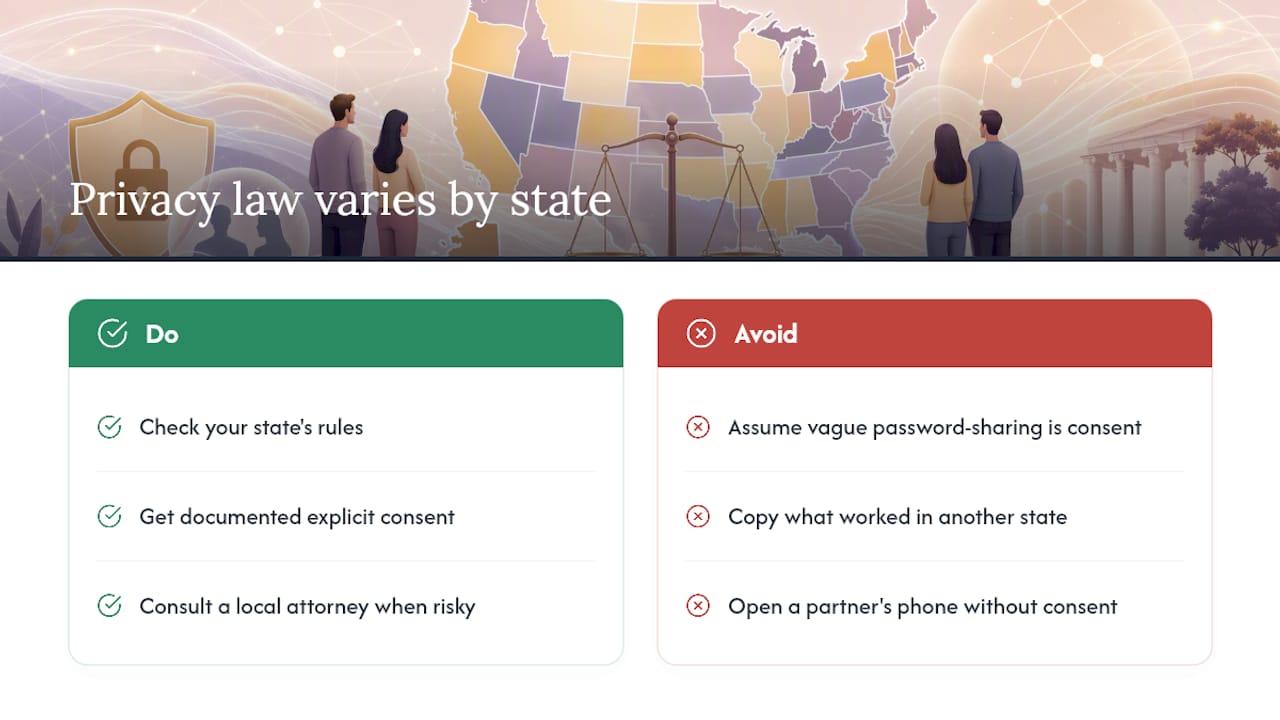
Privacy expectations shift depending on which state you’re in, and that affects how much room you actually have. Some states, like California, have layered extra privacy protections on top of federal law through statutes that specifically address unauthorized computer and device access between private individuals. Others rely almost entirely on federal law with fewer state-specific add-ons, meaning your exposure for the exact same action, opening a partner’s phone without permission, isn’t identical everywhere.
Courts generally recognize that a person has a reasonable expectation of privacy in their password-protected phone and accounts, even inside a marriage or long-term relationship. That expectation doesn’t disappear because you live together, share a lease, or split the phone bill. What can change the analysis is documented, explicit consent. If you and your partner have an actual agreement, written or clearly and mutually stated, about sharing device access for a specific purpose, that shifts the legal picture. Vague assumptions (“we’ve always known each other’s passwords”) don’t carry the same weight in an actual legal dispute.
The takeaway: don’t assume your state treats this the same way a friend’s state does, and don’t assume living together erases privacy rights. When the stakes are high, check your own state’s rules instead of relying on what worked for someone else.
What Happens Legally With Shared Devices and Accounts?
A lot of couples share a tablet, a streaming account, or even a phone plan, and that shared access creates real confusion about what’s legally allowed. Sharing a device is not the same as consenting to have every app on it read by the other person.
Say you both use a shared iPad, but your partner has a personal email or dating app logged in under their own account with a separate password. Your access to the shared device does not extend to that password-protected account. Courts have generally drawn this line clearly: implied consent to use a device for its shared purpose (watching shows, browsing the web together) doesn’t imply consent to open every private account on it.
Where it gets murkier is genuinely shared accounts, a joint email used by both of you for household bills, for example. If you both actively use it and know the other checks it, that mutual pattern can support an implied-consent argument. But a single dating app account tied to one person’s identity almost never falls into that shared category, even if it happens to be logged in on a device you both use.
The safest rule: if the account or app is clearly tied to one person’s identity and requires their own login, treat it as private, regardless of what device it lives on.
Are the Rules Different for Apps Versus Browser Versions of Dating Sites?
Some people assume that checking a dating website through a browser is somehow safer, legally, than opening the app itself. It isn’t. The Stored Communications Act and Wiretap Act apply to the communications and data themselves, not the format you use to access them.
Whether your partner uses the Match app or logs into match.com through a browser, private messages sent through either version are stored electronic communications under federal law. Accessing them without authorization carries the same exposure either way. The delivery method doesn’t change what kind of data it is.
Where the browser-versus-app distinction actually matters is on the legal side of searching. A public profile is public whether you view it through an app or a website, which is why searching services like CheaterDetectorAI’s Match profile search or POF profile search work the same regardless of which version your partner prefers. The legality hinges on whether the information is public-facing, not on which screen it appears on.
Can You Be Sued for Snooping, Even Without Criminal Charges?
Criminal charges aren’t the only risk. Even if a prosecutor never files anything, your partner can sue you civilly, and that possibility surprises a lot of people who assume “nothing happened” if police weren’t involved.
Common civil claims in these situations include invasion of privacy, intentional infliction of emotional distress, and, in some states, statutory civil damages built directly into computer-access or wiretap laws. Several federal and state statutes that criminalize unauthorized access also include a private right of action, meaning the person whose messages you read can sue you directly for damages, separate from any criminal case.
These lawsuits can get expensive fast: attorney’s fees, statutory damages, and in some cases punitive damages if a court finds the conduct particularly reckless. And if you’re in the middle of a divorce, evidence that you obtained illegally can backfire twice, first by getting excluded from your own case, and second by becoming grounds for your partner’s separate claim against you.
The bottom line: even a “victimless” snoop, one where you never confront your partner and nothing seems to happen right away, can resurface later in a divorce filing or a civil suit you didn’t see coming.
Why Starting With Public Information Works Better
Most advice about “catching a cheater” skips straight to tactics and treats the legal risk as a footnote. That’s backwards. The single biggest mistake I see in this space is people treating spyware and phone snooping as a shortcut when it’s actually the slowest, most expensive path available: it can cost you a criminal record, a civil judgment, and your evidence getting thrown out of the exact proceeding you needed it for.
The conventional wisdom, “just check his phone while he’s asleep,” ignores that courts have consistently rejected the idea that marriage or cohabitation erases someone’s privacy rights. What the research and the law actually support is narrower and less dramatic than people want: search what’s public, run a background check, and have the hard conversation. It’s less satisfying than a dramatic phone reveal, but it’s the version that doesn’t blow up in your face six months later during a divorce.
If you’re going to prioritize one thing, prioritize doing this the right way first and staying emotionally grounded second. The answers matter less if getting them backfires on you.
— Oleg
This article is general information, not legal advice for your specific situation.
Sources
You don’t have to take any of this on faith. Here’s where to read the actual laws and government guidance behind everything covered above.
- 18 U.S.C. § 2701 — Unlawful access to stored communications (Cornell Law School LII)
- Federal and state wiretap act regulation of keyloggers (Harvard JOLT digest)
- Key findings about online dating in the U.S. (Pew Research Center)
- FBI internet crime reports (FBI)
None of this replaces a conversation with a licensed attorney in your own state, especially if you’re already facing a specific legal question tied to divorce, custody, or a criminal complaint. Federal statutes set the baseline, but your state’s specific rules can change the outcome.
FAQ
How can I find out if my spouse is on dating sites?
Search by name, phone number, or a reverse image search using a photo you already have. Services like CheaterDetectorAI check public profiles across major dating platforms without needing any access to your spouse’s phone.
What is the 333 rule in dating apps?
There’s no established dating-industry standard called the “333 rule.” If you’ve seen it referenced elsewhere, treat it as informal advice, not a verified framework, since it doesn’t come from any recognized platform source.
How do I check dating apps for cheaters legally?
Stick to public information: search by name or photo, use a reverse image search, or run a background check. Never log into an account with a password you weren’t given, and never install monitoring software on a device that isn’t yours.
How do I know if my husband has hidden apps on his phone?
You can’t legally check his phone directly without his permission, since that would count as unauthorized access under federal law. Instead, search for his name and photo across dating platforms publicly, which is exactly what a service like CheaterDetectorAI does using only public profile data.