%20scale(1.05)%20translate(-12,-14.25)'%3e%3cpath%20d='M12%2021s-7.5-4.7-7.5-10.2A4.3%204.3%200%200%201%2012%207.5a4.3%204.3%200%200%201%207.5%203.3C19.5%2016.3%2012%2021%2012%2021Z'%20fill='%23F0384A'%3e%3c/path%3e%3c/g%3e%3c/svg%3e)
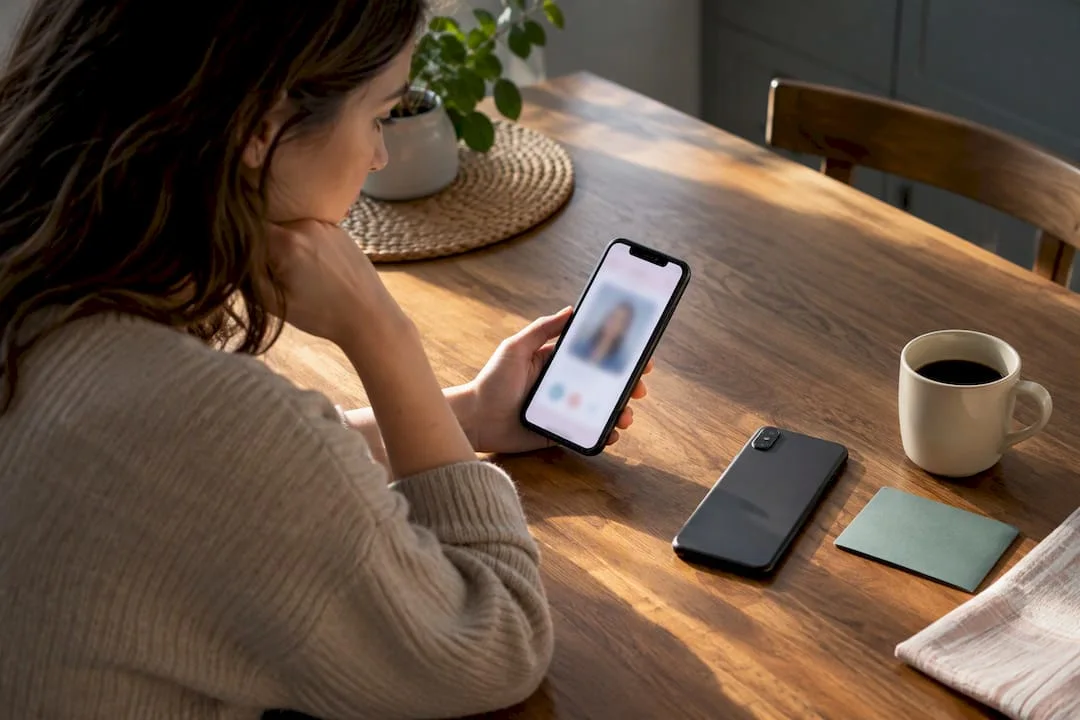
Online cheating is any secret romantic, sexual, or emotional connection your partner builds through a screen. It does not need a physical touch to count. What separates a harmless chat from a betrayal is secrecy, deception, and whether it crosses a line the two of you agreed on, a standard that Tavistock Relationships uses in its clinical work, backed by research showing online affairs can hurt just as much as in-person ones.
TL;DR:
- Online cheating involves hidden romantic or sexual connections, often marked by secrecy, deception, and breaching agreed-upon boundaries.
- Key signs include secret messages, deleted conversations, increased online activity, and emotional or sexual exchanges outside the relationship.
- Trust is damaged just as severely as with physical affairs, requiring honest disclosure and careful evidence gathering within legal boundaries.
- The most reliable indicator is a pattern of escalating secrecy and covert behavior over time, not a single suspicious action.
- Legal methods like publicly available profile scans are safest and most effective tools for detecting online infidelity without risking criminal charges.
What Is Online Cheating? The Four Parts That Define It
You want a straight answer, not a lecture. Here it is: online cheating happens when your partner builds a hidden romantic or sexual connection with someone else using a phone, app, or computer, and that connection breaks a boundary you both share. Clinicians and researchers break this down into four parts, and understanding them helps you name what you are actually seeing.
A 2026 concept analysis on virtual romantic relationships lays out these dimensions clearly, and each one answers a different question about the betrayal.
- Emotional dimension: Your partner shares feelings, daily details, or vulnerabilities with someone else that used to belong to you.
- Sexual dimension: Sexting, nude photos, or cybersex happen between your partner and another person.
- Secrecy and deception: Your partner hides the chats, deletes messages, or lies when you ask direct questions.
- Technological boundary-breaking: Your partner uses an app, platform, or device specifically to keep a relationship going that you do not know about.
The secrecy piece is often the loudest signal. The Indian Journal of Psychiatry notes that online affairs usually start with casual contact and grow through ongoing digital conversation, and secrecy paired with a real breach of trust is what marks the shift from friendly to unfaithful.
The last dimension, boundary-breaking, is the one that decides everything else. Two couples can watch the identical behavior and land on opposite verdicts. One partner might be fine with their spouse keeping old friends on social media. Another might consider that a dealbreaker. Tavistock Relationships frames this as a matter of the couple’s own agreed rules, not a universal checklist. That is why the question is never just “did this happen,” but “did this happen after we agreed it shouldn’t.”
Real Examples of Online Cheating You Might Recognize
You are probably reading this because something felt off. Maybe you saw a name pop up too often, or a message got deleted before you could read it. Here are the behaviors that clinicians and researchers actually flag as online cheating.
- Sexting or trading nude photos with someone outside the relationship.
- Cybersex, meaning sexual roleplay or activity conducted through text, video, or voice chat.
- Ongoing private messaging with a romantic tone, even if nothing sexual is said outright.
- Keeping an active dating profile while telling you the relationship is exclusive.
- Sustained flirting with the same person over weeks or months, not a one-off joke.
- Hiding or deleting conversations so you cannot see who they are talking to.
- Prioritizing the online connection over you, like choosing to text someone instead of spending time with you.
Not everything on the edge of this list is automatically cheating. Tavistock Relationships points out that pornography use, for example, is not inherently unfaithful. It depends entirely on what you and your partner have agreed is acceptable. A single “liked” photo on Instagram is not the same as weeks of secret private messages. What turns a gray area into a clear violation is frequency, secrecy, and emotional weight. A dating profile alone does not prove your partner is actively using it, but combined with denial when confronted, it becomes a much bigger red flag.
Warning Signs That Point to Virtual Infidelity
You do not catch online cheating by spotting one text. You catch it by noticing a pattern that builds over time.
Clinicians commonly point to a cluster of behaviors that, together, suggest something is going on:
- Your partner suddenly guards their phone, adds a new password, or turns the screen away when you walk in.
- Conversations disappear. Message threads get deleted right after they happen.
- A hidden social media account or second dating profile surfaces.
- Your partner spends noticeably more time online, often late at night or behind closed doors.
- He or she feels distant, distracted, or short with you even during normal conversations.
The real tell is movement, not a single moment. Watch for chats that shift from public group threads to private one-on-one messages, for contact that grows more frequent over weeks, and for a partner who works harder to hide it as time passes. One protected phone doesn’t mean much on its own. A protected phone, a deleted thread, and a new secrecy habit showing up together mean a lot more.
Pro Tip: Stay calm and only note what you can see without breaking any laws, like a public dating profile or a social media post. Write down dates and screenshots of anything publicly visible. Never open a locked phone or read private messages without permission. It will not just cost you the moral high ground. It can cost you legally.
Why Online Cheating Hurts: The Emotional Fallout
You might be wondering if what you are feeling is an overreaction. It is not. Partners who discover online infidelity commonly report betrayal, anxiety, intrusive thoughts about the other person, and a creeping loneliness that sits in the relationship even when nothing seems wrong on the surface.
A scoping review of 17 studies found that online infidelity can be just as distressing and just as damaging to a relationship as an affair that happened entirely in person. That finding matters. It pushes back against the common dismissal that online cheating is somehow “less real” because no one physically touched anyone.
Trust does not break gradually here. It usually snaps the moment the secrecy is exposed, and rebuilding it afterward takes the same kind of work a couple recovering from a physical affair would need, including rebuilding trust step by step. The relationship’s stability afterward depends less on what exactly happened online and more on how honestly both partners deal with what it meant.
Is It Cheating? Use the Disclosure Test First
Here is a simple gut check clinicians recommend, called the disclosure test: would your partner feel comfortable if you read every message in that conversation right now? If the honest answer is no, that discomfort is telling you something real.
Follow these steps before you confront anyone:
- Pause before reacting. A calm approach gets you further than an accusation fired off in anger.
- Gather only lawful, public information. A visible dating profile, a public post, or a screenshot of something already shown to you is fair game. Anything hidden behind a password is not.
- Set up a real conversation, not a hallway ambush. Pick a time when you can both actually talk.
- Name the specific behavior and the boundary it crossed. “You’ve been messaging this person every night and hiding it” is more useful than “I think you’re cheating.”
Here is the part that gets glossed over in most advice online: spyware, hidden tracking apps, and secretly reading your partner’s private messages are illegal in the United States. The Department of Justice’s guidance on computer crime and privacy makes clear that accessing someone else’s private accounts or devices without permission can expose you to real criminal charges. You could end up being the one facing legal trouble, not your partner. Stick to what is publicly visible, and if you need real answers, use a lawful method instead.
Where to Get Help After Discovering Online Cheating
You do not have to sort this out alone, and you should not try to fix it by staying silent either. Couples therapy focused on infidelity recovery typically works on a few concrete things: rebuilding boundaries both partners actually agree to, processing the raw emotions of betrayal, working toward forgiveness if the relationship continues, and building healthier habits around phones and apps going forward.
Reach out for professional support when the breach keeps repeating, when you feel unsafe, or when the emotional weight is too heavy to carry through conversation alone. If you’re navigating the specific pain of an emotional affair conducted mostly through text and calls, that recovery process looks a little different from recovering after a physical affair, but the core work is similar.
In the meantime, protect yourself legally. Preserve any publicly visible evidence, like a screenshot of an active dating profile you were shown, or a public post. Never use spyware or hack into accounts to get more. If separation, custody, or safety becomes part of the picture, talk to a lawyer before you talk to anyone else. A step-by-step guide to proving infidelity legally walks through what actually holds up if this ends up mattering in a legal setting.
Lawful Ways to Verify Suspicions Without Breaking the Law
If you have gotten this far, you are probably past wondering and into needing to know. That instinct is valid, but how you act on it matters just as much as the suspicion itself.
CheaterDetectorAI exists specifically for this moment. It scans public dating app profiles using only information you already have, like a name or a photo, and cross-references it against major platforms. No phone access. No hacking. No reading private messages. Everything it checks is already public information sitting on a dating app’s own servers.
Here is what that looks like in practice:
- A Deep Person Scan searches broadly across platforms using minimal details you provide.
- A Partner Check answers the specific question of whether your partner has an active dating profile at all.
- Reverse-image searches trace a photo back to any dating profile using it.
- Platform-specific searches cover Tinder, Bumble, Hinge, OkCupid, and Plenty of Fish individually.
Reports come back encrypted and anonymous, without notifying the partner. This matters because the alternative, secretly installing spyware or reading someone’s private texts, can get you prosecuted under U.S. computer crime laws. A lawful scan gets you real answers without putting you at legal risk. For a broader checklist of what to look for first, the 14 signs of online cheating guide is a solid next step.
How Online Cheating Evolved Alongside the Internet
Online cheating is not a new problem wearing a new costume. It grew directly out of how people started meeting each other once chat rooms, instant messaging, and eventually dating apps became part of daily life. Early research already flagged the pattern decades ago: affairs that begin with casual online contact and get sustained almost entirely through electronic conversation, often without the two people ever meeting in person.
What changed is scale and access. A flirtation used to require running into someone at work or through friends. Now it takes a swipe. Dating apps put an entire pool of potential partners in your pocket, available at 11 p.m. while your partner sits next to you on the couch. Social media adds another layer, resurfacing old flames and making “just catching up” with an ex frictionless in a way it never used to be.
The secrecy element has also gotten easier to maintain. Disappearing messages, app lock features, and separate secret accounts did not exist for previous generations navigating infidelity. That does not make online cheating more forgivable. It makes it more accessible, which is part of why researchers now treat it as seriously as they treat traditional affairs rather than as some lesser, “not real” category of betrayal.
Why People Cross the Line Online
Understanding the “why” will not undo the hurt, but it can help you make sense of what happened. People do not usually set out to build a secret relationship. It tends to creep in.
Loneliness inside an existing relationship is one of the most common drivers. A partner who feels unheard or unappreciated at home may find a stranger online who makes them feel seen, and that validation becomes addictive fast. Boredom plays a role too, especially with how easy dating apps make it to seek attention without much effort or risk of immediate consequence.
The anonymity of a screen also lowers inhibition in a way face-to-face interaction does not. It is far easier to type something flirty to a stranger than to say it out loud, and that distance can make people feel like online behavior “doesn’t really count,” even when it clearly does emotional damage. Some people are chasing an ego boost. Others are avoiding a real conversation about problems in their current relationship. Either way, the online connection usually fills a gap the primary relationship stopped filling, whether or not that gap was ever discussed honestly.
The Platforms Where Online Cheating Usually Happens
Online cheating rarely happens in one obvious place. It spreads across whatever platform offers the easiest path to privacy and connection.
Dating apps like Tinder, Bumble, Hinge, OkCupid, and Plenty of Fish are the most direct route, since they are built entirely around meeting new people for romantic or sexual purposes. A partner who keeps a profile active while committed is using the platform exactly as designed, just without your knowledge.
Social media adds a second layer. Direct messages on Instagram or Facebook let old flames reconnect under the cover of “just being friendly.” Snapchat’s disappearing messages make it especially attractive for anyone trying to avoid leaving a paper trail. Even gaming platforms and Discord servers have become spaces where people build emotionally intimate relationships with strangers over months, sometimes without ever meeting in person.
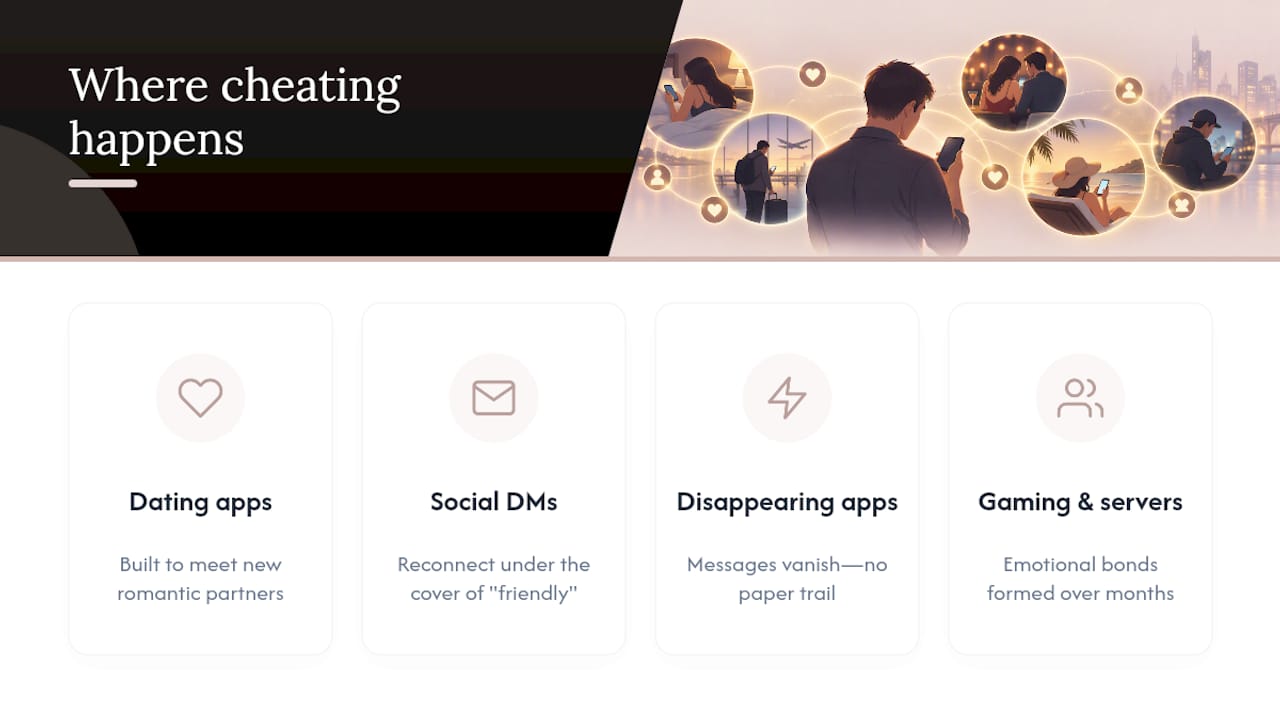
Standard texting and video calls remain the backbone of most of it, since that is where sustained conversation actually happens once initial contact is made elsewhere. The platform matters less than the pattern: private, sustained, and hidden from you.
Legal and Ethical Lines Around Online Cheating
Here is something worth being blunt about: online cheating itself is not illegal. There is no law against flirting with a stranger on a dating app or having a secret emotional connection with someone else. It is a moral and relational violation, not a criminal one, and courts generally treat it that way in most U.S. states.
What can become illegal is how you try to catch it. Installing spyware on your partner’s phone, secretly reading their private messages, or hacking into their accounts violates state and federal computer crime laws. The Department of Justice enforces statutes that make unauthorized access to someone else’s private communications a prosecutable offense, and that risk falls on you, not on the partner you suspect.
The ethical line is a little different from the legal one. Even if something is not against the law, that does not make it right, and even if a behavior is not technically illegal, it can still be a severe breach of the trust your relationship depends on. This is exactly why the disclosure test matters so much: it sidesteps the messy legal question entirely and just asks whether the behavior would survive being seen in the light.
How Online Cheating Differs From Offline Infidelity
The biggest difference is the paper trail, or lack of one. Offline infidelity usually involves physical meetings, which leave gaps in a schedule, receipts, or witnesses. Online cheating can happen from the same room you are sitting in, at any hour, without a single missed dinner or unexplained absence.
Speed is another difference. A physical affair typically takes time to build, since it depends on real-world opportunity. An online connection can escalate from a first message to deep emotional intimacy within days, because the usual social friction of meeting someone new simply is not there.
Despite these differences, the emotional damage lands in a strikingly similar place. The scoping review of 17 studies found online infidelity can be just as distressing as an affair conducted entirely in person, which challenges the common assumption that “it was only texting” makes betrayal somehow smaller. What differs is the mechanics. What stays the same is the breach of trust underneath it.
How Couples Can Prevent Online Cheating Before It Starts
Prevention here has almost nothing to do with restricting phones or demanding passwords. It has everything to do with talking honestly about what counts as a boundary before you are both standing in the middle of a crisis.
Start with a direct conversation about what each of you considers acceptable online behavior. Is following an ex on Instagram fine? What about a private message to a coworker that turns flirty? These conversations feel awkward to initiate, but having them early removes the ambiguity that lets small behaviors quietly escalate.
Check in regularly on how connected you feel to each other, not just logistically but emotionally. A lot of online cheating starts because one partner felt unseen at home and found that attention somewhere else. Addressing loneliness inside the relationship directly, rather than waiting for it to surface as a symptom, closes off the gap that usually gets filled by someone else.
If you notice a partner spending unusual amounts of time online or being secretive about a specific platform, raise it early and calmly rather than letting suspicion sit and grow. A practical guide to catching cheating online covers what those early conversations should look like, along with what to watch for if reassurance does not settle your gut feeling.
What I’d Tell a Friend in This Exact Situation
You are not being paranoid for asking these questions. Trust your gut, but act on it carefully. Preserve what you can lawfully see, have one honest boundary conversation, and if you need real clarity, run a legal scan instead of guessing in the dark. Never install spyware or dig through a locked phone. It puts you at legal risk and rarely gives you the closure you’re hoping for anyway.
— Oleg
Get a Legal Answer Today With CheaterDetectorAI
CheaterDetectorAI is the lawful alternative to guessing, snooping, or risking prosecution over spyware. It only checks publicly available dating app profiles, using a name or photo you already have, and delivers an encrypted, anonymous report fast, with no phone access and no notification sent to your partner.
You do not have to keep wondering. Search their name now with a Deep Person Scan that cross-references public profiles across major dating apps in one pass. Check their profile today with a Partner Check built specifically to answer whether your partner is active on dating apps at all. Found a suspicious photo somewhere? Get a legal scan using reverse-image search to trace exactly where it appears. Every scan is 100% legal, fully encrypted, and built for partners who need real clarity, not more sleepless nights of guessing.
Sources
This article draws on clinical guidance from Tavistock Relationships, peer-reviewed research from the Indian Journal of Psychiatry, a 2026 concept analysis on virtual infidelity, and a scoping review in Contemporary Family Therapy.
- What is cheating online? — Tavistock Relationships (Dr Naomi Moller)
- Online infidelity: The new challenge to marriages — Indian Journal of Psychiatry / PMC
- A Scoping Review on Clinical Implications and Treatment of Online Infidelity — Contemporary Family Therapy (2026)
FAQ
What are the five types of cheating?
Definitions vary by source, but most clinicians group infidelity into physical, emotional, sexual, financial, and online or technological cheating. Online cheating overlaps with emotional and sexual categories since it can involve either or both, carried out entirely through digital platforms.
What are the signs of virtual infidelity?
The clearest signs include a partner suddenly guarding their phone, deleting conversations, keeping a hidden account, and pulling emotionally distant from you. A single sign rarely proves anything; a pattern of secrecy building over time is the real signal to watch.
How many divorces are caused by online infidelity?
There is no reliable statistic that isolates divorces caused by online infidelity alone. Most research combines offline, emotional, and online forms of cheating together, so treat any specific percentage you see quoted elsewhere with skepticism.
What are some examples of online cheating?
Common examples include sexting, cybersex, sustained private flirting, keeping an active dating profile while committed, and hiding or deleting messages from a partner. Whether a specific behavior counts often depends on the couple’s own agreed boundaries, not a universal rule.
Is flirting online considered cheating?
It depends on frequency, secrecy, and what you and your partner have agreed on. A one-off joke is different from sustained flirting hidden from you over weeks, which crosses into emotional infidelity for most couples.
Is it legal to check if my partner has a dating profile?
Yes. Checking publicly available dating app profiles is legal, which is exactly what services like CheaterDetectorAI do. What is illegal is using spyware, tracking apps, or secretly accessing your partner’s private messages without permission.