%20scale(1.05)%20translate(-12,-14.25)'%3e%3cpath%20d='M12%2021s-7.5-4.7-7.5-10.2A4.3%204.3%200%200%201%2012%207.5a4.3%204.3%200%200%201%207.5%203.3C19.5%2016.3%2012%2021%2012%2021Z'%20fill='%23F0384A'%3e%3c/path%3e%3c/g%3e%3c/svg%3e)
Yes, you can sometimes find out if your partner is active on dating apps using public checks or an anonymous scan, and yes, most apps let people hide their status, which is exactly why absence of a green dot proves nothing. Skip spyware and tracking apps entirely. Reading someone’s private messages or installing hidden tracker apps without consent can get you criminally charged.
TL;DR:
- Hiding your partner’s online status on dating apps is common, and absence of active labels does not confirm inactivity or infidelity.
- Public checks, reverse image searches, and linked account investigations are fair ways to gather clues without violating anyone’s privacy.
- Spyware and tracking apps are poorly secured and expose you to criminal charges and data breaches, making them a high-risk approach.
- A missing profile or inactive status often results from privacy settings or filters, not account deletion or disinterest, requiring careful interpretation of evidence.
- Using an anonymous online scan can provide quick, private insights into whether your partner has a presence on dating platforms.
Can You Hide Online Status on Dating Apps?
Every major app shows some version of an “online now” or “recently active” label, and yes, every one of them lets a user turn that label off. That single fact is why chasing a green dot is often a dead end.
Here’s what those labels usually mean before someone hides them:
- Active now / online: Typically means activity within the last two hours, based on when the app last pinged a server.
- Recently active: Usually covers a wider window, often within the last 24 hours, and it’s an estimate, not a live feed.
- Last active [time]: A snapshot, not a guarantee someone is on the app right now.
These indicators update through background refreshes and push notifications, not because a person is staring at their screen. A phone can trigger an “active” flag just by running the app in the background. On Hinge, hiding your status works both ways: if your partner turns off “Last Active,” you lose the ability to see anyone else’s status too, including theirs. That tradeoff is built into most platforms, and it’s the reason a missing status dot tells you almost nothing on its own.
Can You Get in Trouble for Spying on a Partner’s Phone?
Yes. Installing spyware, tracking software, or reading your partner’s private messages without consent is illegal in the United States, and it can lead to criminal charges against you, not just them. The FTC is blunt about this: stalkerware is treated as an abuse tool, and in 2020 alone, tens of thousands of mobile users were identified as survivors of it. You do not want to become the person facing prosecution while your partner walks away as the victim.
There’s a second danger most people never think about. Security researchers at UC San Diego found that many consumer spyware apps are poorly secured and have leaked the very data they collect, exposing photos, location history, and messages to strangers. You could hand a hacker your partner’s private life while trying to catch a cheater.
- Never install tracking software on a partner’s phone without consent.
- Never read private messages you weren’t given access to.
- If you suspect you’re the one being monitored, don’t research help on that device; use a friend’s phone or a public computer instead.
Read more on whether snooping counts as illegal surveillance before you touch anyone’s device.
What Steps Can You Take to Check?
You have real options that don’t involve snooping. None of them require touching your partner’s phone.
- Run a reverse image search. Save a clear photo of your partner and upload it to a reverse image tool. If the same picture shows up on a dating profile, that’s a public match, not a hack.
- Try a reverse username or reverse phone lookup. People reuse the same handle or number across apps and social platforms more than they realize, and a lookup can surface linked profiles.
- Check shared devices for app history. If you share an Apple ID, family plan, or bank account, look for App Store downloads or unexplained subscription charges tied to dating platforms. This only applies to accounts you actually share access to.
- Create your own profile and search with filters. Set your age range, distance, and preferences to match where your partner would likely appear, and be patient. This method has real limits, and it only works if their discovery settings overlap with yours.
- Look for public web signals. Reused profile photos, matching bios, or linked social accounts are open information anyone can find without accessing a private device.
No outside tool can query Tinder’s private database directly. Every legitimate checker works from public signals like reused photos, not internal app records, so treat any service that claims otherwise with suspicion.
Pro Tip: Screenshot anything you find in a public search right away. Public profiles get edited or deleted fast once someone suspects they’re being looked for.
For a more detailed walkthrough, see how to check if your partner is on dating apps using only public information.
Why No Profile Doesn’t Mean They’re Not Cheating
Finding nothing is not the same as finding proof of innocence. Discovery settings on apps like Tinder filter who shows up to whom based on distance, age range, and preferences you can’t see or control.
- Your partner’s profile might exist but simply never surface in your search filters.
- A deleted account looks identical to a dormant one from the outside.
- Fresh photos or a recently edited bio are a stronger sign of active use than any status dot.
- Algorithms decide who gets shown to whom, and that decision is invisible to you.
Weigh partial evidence carefully. One missing search result is not closure, and treating it as such can give you false reassurance you don’t actually have.
If You Find Evidence, What Should You Do?
Finding proof is only the first step. What you do next matters just as much, especially if you fear your partner’s reaction.
- Preserve what you found. Screenshot public profiles, save reverse image search results, and keep dated records.
- Secure your own accounts. Change passwords on your email, banking, and social accounts if you suspect anyone might retaliate by accessing them.
- Avoid direct confrontation if you fear violence. Talk to a trusted friend, a domestic violence hotline, or a lawyer before you say anything.
- Get confidential support. Digital-safety advocates and other professionals can help you plan your next move safely.
Pro Tip: If you think stalkerware might already be on your own phone, use a different device to search for help. Anything you look up on a monitored phone could be seen by the person watching it.
Document everything, but do it the right way. A messy pile of screenshots taken the right way holds up better than anything pulled from a hacked device.
Why an Anonymous Scan Beats Guessing
Oleg, who writes Cheater Detector AI’s blog on privacy in relationships, has covered this exact dilemma repeatedly: people want proof, but most DIY methods are slow, incomplete, or risky.
An anonymous scan checks public profiles across major dating apps using only minimal details you already know, like a name or photo. It’s encrypted, it doesn’t touch anyone’s phone, and it returns matches, photos, and timestamps fast.
That’s the gap between spyware and a scan like Cheater Detector AI’s: one puts you at risk, the other works entirely with public information and protects you while you look for the truth.
Is It Right to Check Your Partner’s Dating App Activity?
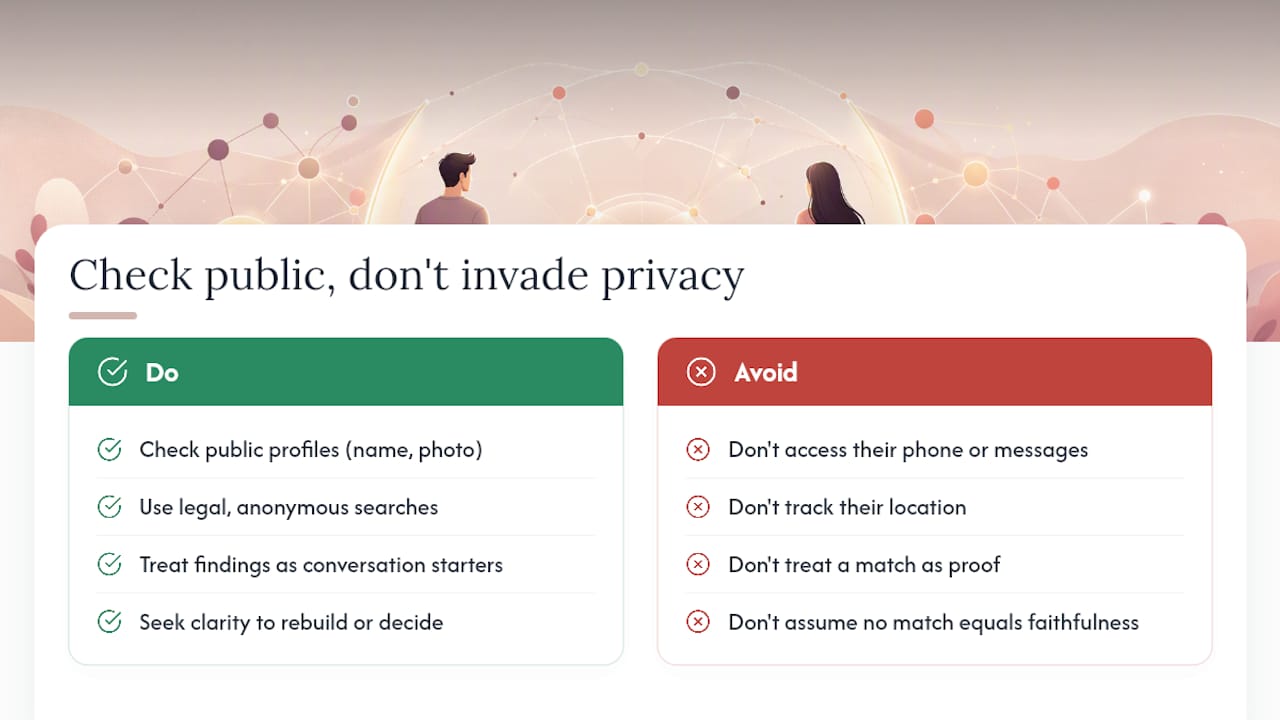
Wanting proof isn’t wrong. Suspicion eats at you, and staying in the dark has its own cost. But there’s a real line between protecting yourself and violating someone’s privacy, and it matters where you draw it.
Checking public information, like a name or photo against public dating profiles, respects that line. You’re not opening someone’s phone, reading their texts, or tracking their location. You’re looking at what any stranger on the internet could already see. That distinction is the difference between a reasonable safety check and an invasion most courts and most people would call unfair.
The harder question is what you do with what you find. If a scan turns up nothing, that’s not proof your partner is faithful; it’s one data point. If it turns up a match, that’s not proof of cheating either; some people keep old profiles active without using them. Treat any result as information to bring into a conversation, not a verdict to act on alone.
Ethically, the goal isn’t to catch someone. It’s to get enough clarity to either rebuild trust or make an informed decision about the relationship. An anonymous check gives you that clarity without turning you into the person who crossed a line to get it.
How Do You Talk to Your Partner About This?
Bring it up before you have proof, not just after. A calm conversation about boundaries around dating apps often prevents the spiral of suspicion that leads people toward spyware and tracking in the first place.
Start with how you feel, not with an accusation. Saying “I’ve been anxious about where we stand” lands differently than “I know you’re on Tinder.” One invites a conversation. The other invites a defensive shutdown, even from someone who’s done nothing wrong.
If you already have evidence from a public check, decide how you’ll share it before the conversation happens. Blurting out screenshots in anger rarely gets you the honest answer you’re looking for. Calmly stating what you found and asking your partner to explain it gives them room to respond, and gives you a clearer read on whether that response feels honest.
Some couples set explicit agreements: delete dating apps together, or agree that keeping one active without discussion is a dealbreaker. Whatever you agree on, write it down mentally or literally, because vague understandings are exactly what leads to “I didn’t think you meant delete it completely” fights later.
Can You Hide Your Status on Tinder, Bumble, and Hinge?
Yes, on all three, though the mechanics differ slightly. Tinder and Bumble both let users toggle off their “active” indicator in privacy settings, which removes the green dot other users see. Hinge works the same way through its Last Active toggle.
The catch is universal: hiding your own status usually hides everyone else’s status from you too. You can’t see who’s active while staying invisible yourself on most of these platforms. That two-way design is intentional. It stops people from monitoring others while staying hidden themselves.
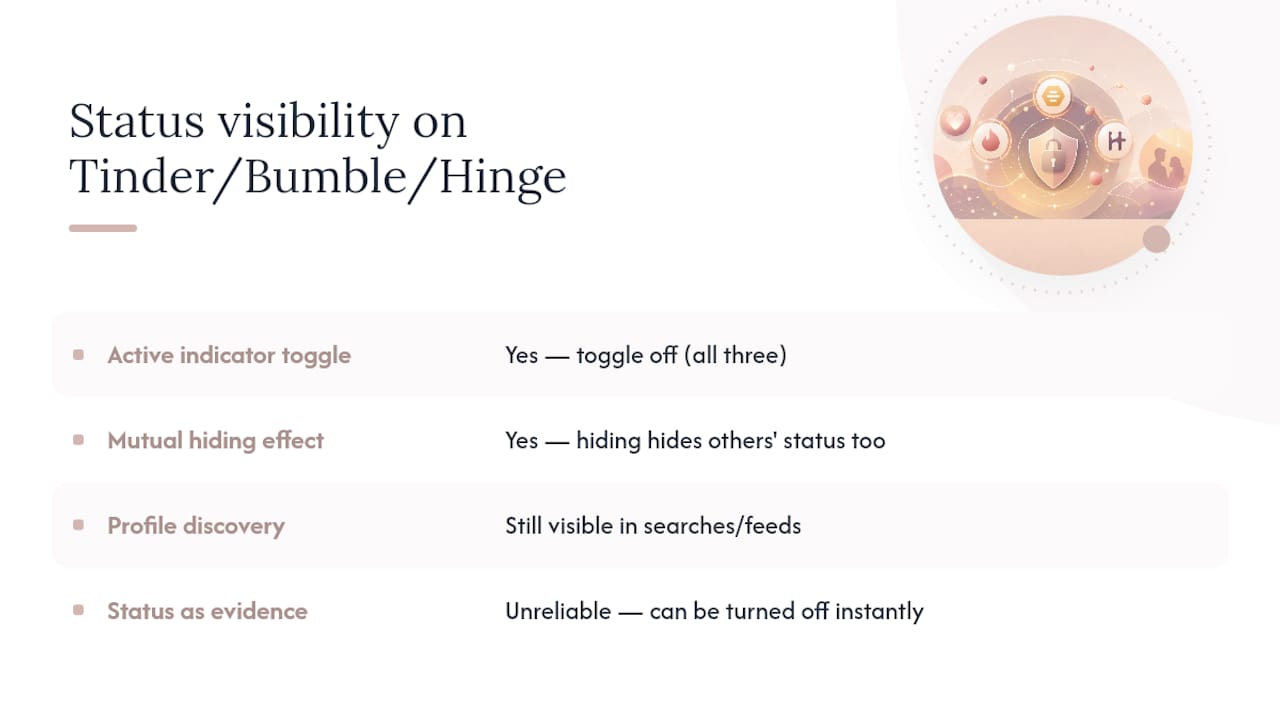
There’s also a difference between hiding status and hiding a profile entirely. Turning off “active now” doesn’t make someone invisible in search results or discovery feeds. They can still appear to other users browsing normally; they just won’t show a live activity badge next to their name. Some people confuse “went offline” with “deleted the account,” and those are very different things.
This is also why chasing status indicators as evidence is unreliable. A partner who wants to avoid detection just flips one switch, and the trail goes cold instantly. That’s a bigger reason to rely on public profile searches and anonymous scans than on watching for a green dot that can disappear the moment someone decides to hide it.
What Do App Privacy Settings Actually Control?
Every dating app buries its visibility controls in a slightly different place, and the settings rarely do what people assume. Tinder’s discovery settings, for instance, control who sees your profile at all, separate from whether your activity status shows.
Read the actual privacy policy of whichever app you’re trying to understand, not a summary someone posted in a forum. Policies change, and features get renamed. What was called “Show Activity Status” last year might be folded into a broader “Discovery Settings” menu this year.
One setting worth knowing about: most apps distinguish between “who can see me” and “what they see when they do.” A person can be fully visible in search results while still hiding their last-active timestamp. That’s not a loophole; it’s how the apps are built. Treat every app’s privacy settings as a menu of separate switches, not one master toggle, and you’ll understand a lot more about why your searches sometimes come up empty.
The Biggest Myths About Online Status on Dating Apps
The most common myth is that a hidden or missing status means someone deleted their account. It usually just means they flipped a privacy switch, which takes ten seconds and can be reversed just as fast.
The second myth: that “recently active” means someone is cheating right now. It’s a rolling estimate, often covering a window of hours, not a live camera feed into someone’s phone. A person could have opened the app once to check a message and closed it, and still show as “recently active” hours later.
The third myth, and maybe the most damaging one: that a clean search means a clean partner. As covered earlier, discovery filters can hide active accounts from your search entirely, regardless of whether they’re using the app. No result is not the same as no activity.
Dating apps don’t design these systems to help partners investigate each other. They design them to keep users comfortable, which means privacy defaults usually favor the person being searched for, not the person doing the searching.
What This Guide Gets Right That Others Miss
Most advice on this topic falls into one of two useless extremes. Either it tells you to install a tracking app and call it “protecting yourself,” which is a fast way to end up on the wrong side of a police report, or it tells you to just “communicate openly” as if trust issues resolve themselves through vibes alone.
Neither approach respects the actual bind you’re in. You don’t want to snoop. You also don’t want to sit around hoping a feeling goes away.
The overlooked truth here is that public information is more useful than people assume, and covert surveillance is less useful than people assume. A reused photo, a linked username, a subscription charge, these are real signals you can act on without a single risky step. Meanwhile, spyware doesn’t even deliver the certainty people expect from it; it delivers risk and, per the UC San Diego findings, a real chance your own data gets exposed in the process.
If there’s one thing to prioritize, it’s this: get your evidence from public sources or a scan first, then have the conversation. Skip the phone hacking. It solves nothing and puts you at risk instead of your partner.
— Oleg
Get a Dating App Scan Today
You don’t have to keep guessing, and you definitely don’t have to snoop to get an answer. Cheater Detector AI checks public profiles across major dating platforms using only minimal details like a name or photo, no phone access required.
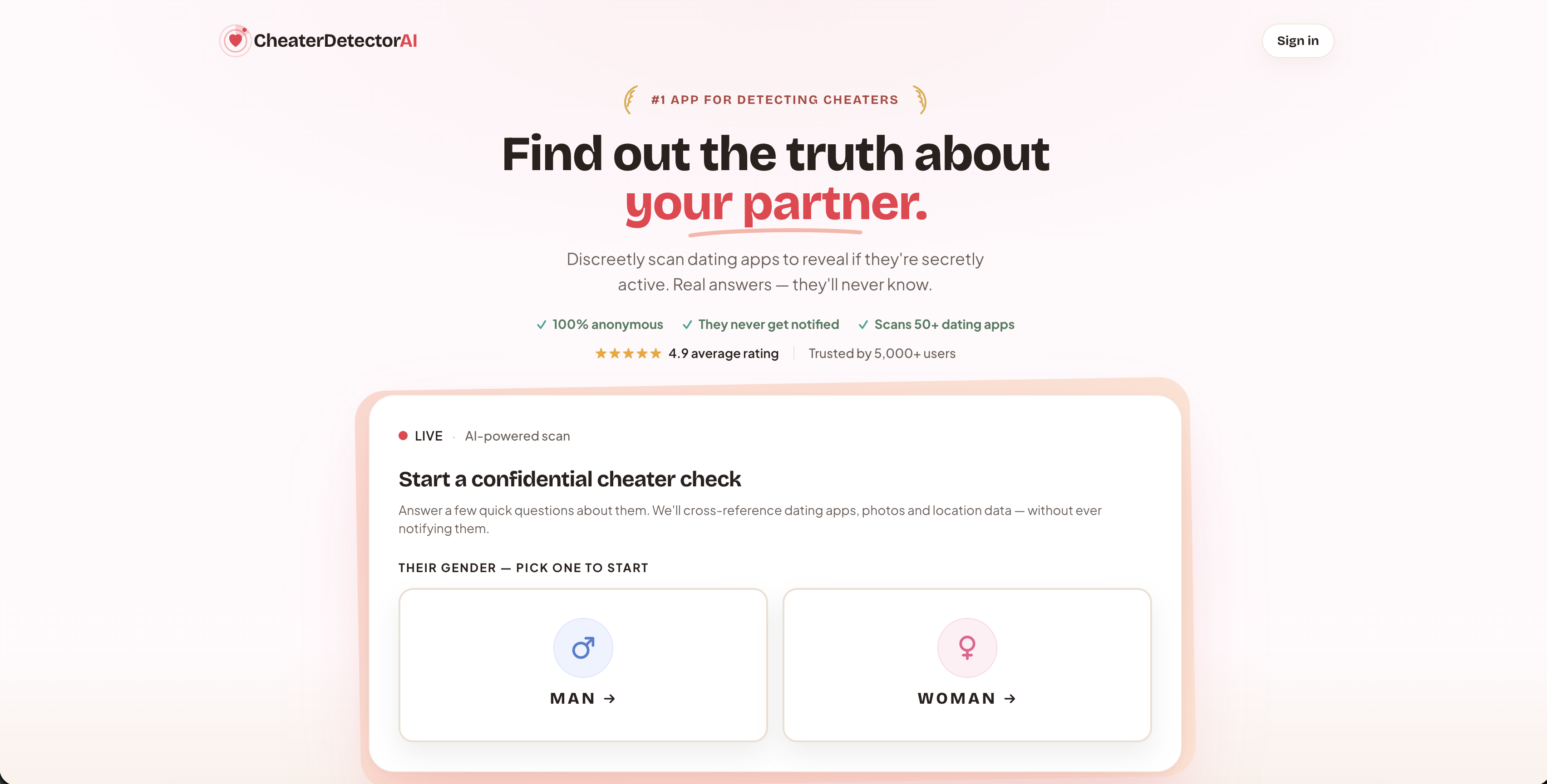
The Deep Person Scan searches for hidden dating profiles fast, cross-referencing what you enter against public listings on popular platforms. If you want a scan built specifically around one question, the Is My Partner on Dating Apps? page walks through exactly how the anonymous process works and what the encrypted report includes: profile matches, photos, and activity timestamps, plus ongoing monitoring alerts if you want to keep watching.
Every scan runs anonymously and stays private. Your partner never gets notified, and you never have to touch their phone.
Search their name now and get answers before another sleepless night goes by. Check their profile today instead of waiting for a status dot that might never tell you the truth. If you’re done guessing, start your scan and get a real report in your hands.
Sources
- Stalkerware: What you should know — FTC
- Spyware security study — UC San Diego
- Last Active status — Hinge Help
- Is he still active on Tinder? — StoryCheck
This article is general information, not professional advice for your specific situation.
FAQ
Is It OK to Check if Your Partner Is on Dating Apps?
Checking public profiles or running an anonymous scan is fine. Installing spyware or reading private messages without consent is not, and it can lead to criminal charges.
Can You Tell if Someone Hid Their Status on a Dating App?
Not directly. Hiding a status is invisible to other users by design, which is why a missing “active now” label doesn’t confirm someone deleted their account.
Does Hiding Your Status Stop You From Seeing Others?
Yes, on apps like Hinge, hiding your own status also removes your ability to see when other people were last active.
What’s the Fastest Way to Find Out if My Partner Is on Dating Apps?
A reverse image search or an anonymous scan through a service like Cheater Detector AI gives you results fast without touching your partner’s phone.
Is a Missing Profile Proof My Partner Isn’t Cheating?
No. Discovery filters can hide an active profile from your specific search without meaning the account is deleted or unused.