
You noticed an app that used to be there. Now it’s gone. Or your partner tilts the screen away when a message comes in. Your stomach drops, and you start to wonder what else you missed.
Here is the honest answer. A hidden app on an iPhone does not prove cheating. But it is a real clue, and you are right to take it seriously. This guide shows you where hidden apps leave traces, what those traces can and can’t tell you, and how to get a clear answer without breaking into anyone’s phone.
TL;DR
- Since iOS 18, any downloaded app can be locked and tucked into a Hidden folder. It vanishes from the Home Screen, Search and the App Library.
- Apple says hidden app names can still show up in Settings, Screen Time, Battery and App Store purchase history.
- None of these clues prove cheating. A hidden app can be innocent. A clean phone can still hide a lot.
- Never install spy software or guess a passcode. It can turn your doubt into a bigger mess.
- The cleaner move: check whether your partner is on dating apps without touching the phone at all.
Why a hidden app feels like such a big deal
Your partner’s phone is personal. Most couples share a lot, but the phone is the one place that often stays private. So when something looks off, your mind jumps to the worst story.
That reaction is normal. It does not make you paranoid. It makes you someone who senses a gap between what you see and what you’re told.
The tricky part is that Apple built the hiding feature on purpose. Apple’s privacy page describes locked and hidden apps as a way to protect sensitive apps and the information inside them. The goal is to stop accidental exposure when someone else holds your phone.
That means a hidden app can disappear from many everyday places at once. It is easy to hide. That is exactly why it creates doubt.
So ask yourself two questions:
- Is there a hidden app?
- If there is, why did your partner hide it?
The phone can sometimes answer the first. It almost never answers the second.
How hiding apps works on an iPhone
On iOS 18 and later, your partner can press and hold an app, choose to require Face ID, then pick hide. Apple’s guide to locking or hiding an app explains the steps. Once hidden, the app leaves the Home Screen and moves into a locked Hidden folder at the bottom of the App Library.
A few details matter for you:
- Hidden apps also disappear from Search results. You can’t just type the name and find it.
- Apple’s personal safety page says only apps downloaded separately can be hidden. Many built-in apps cannot.
- Locking an app also keeps its information out of notification previews, Siri suggestions and some call history.
That last point is why a quiet phone can feel suspicious. No pop-ups. No previews. No buzz that shows who wrote. But that silence is also how the feature is designed to work.
Before 2024, there was no official way to hide an app. People tucked it inside a folder. As Engadget explains, the newer option is much cleaner. That is why this question is suddenly everywhere.
An empty spot on the screen is not a hidden app
Before you decide anything, slow down. Plenty of apps are missing from a Home Screen for dull reasons.
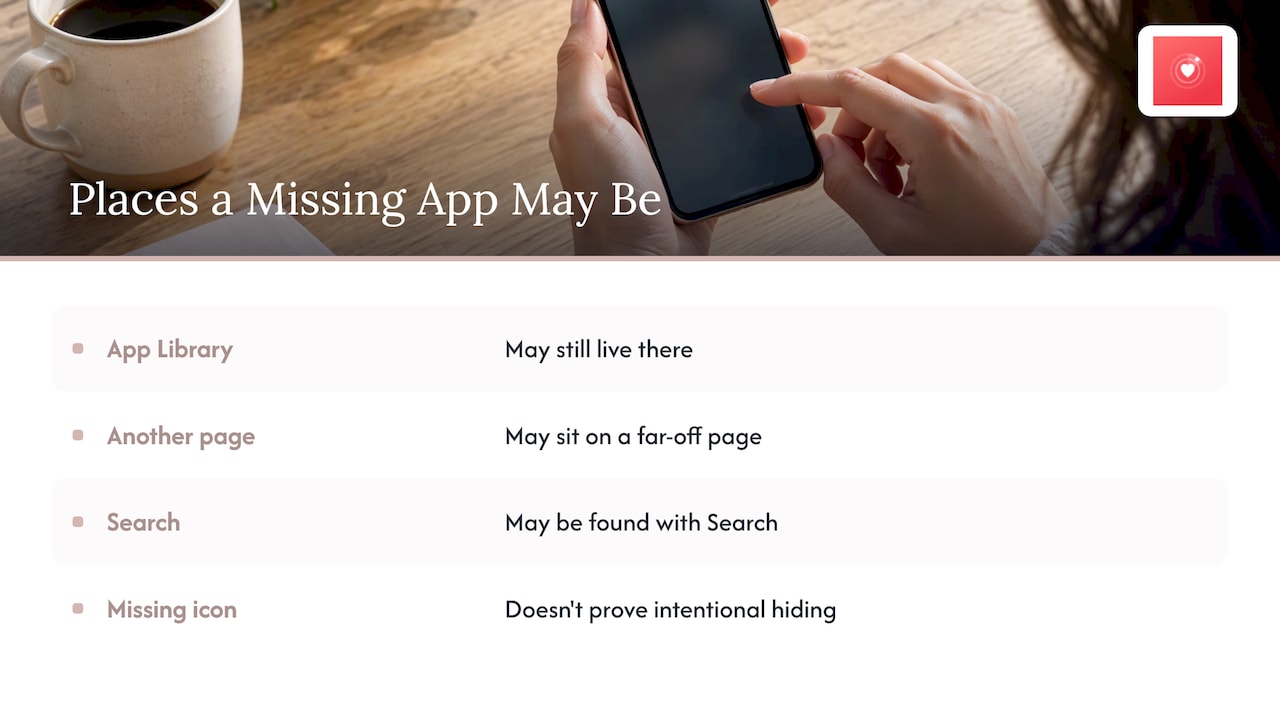
Apple says an app removed from the Home Screen can still live in the App Library, or sit on a far-off page, or be found with Search. So a missing icon alone does not mean someone hid it on purpose.
Your partner may have just cleaned up the screen. Or deleted an app he no longer uses. Or moved things to make space.
But here is the other side. If your partner has gotten oddly protective of the phone, took it into the bathroom, changed habits, or got defensive when you asked a simple question, a missing icon is not the only thing you’re looking at. It is one piece of a bigger picture. And you are allowed to notice the picture.
Where hidden apps can still show up
Apple does not erase every trace. According to Apple’s personal safety guidance, a hidden app’s name can still appear in a few places. Here they are, in the order most people check.
| Where | What it can show | What it can’t show |
|---|---|---|
| App Library, Hidden folder | Hidden apps by name (needs Face ID, Touch ID or passcode) | Why it was hidden |
| Settings > Apps > Hidden Apps | The same list (also needs sign-in) | How it was used |
| Settings > Screen Time | Apps with time spent | What happened inside |
| Settings > Battery | Apps using battery | Who your partner talked to |
| App Store purchase history | Apps downloaded with that Apple account | Whether an app is still installed |
Apple’s step-by-step page says the Hidden folder and the Hidden Apps setting both ask for authentication. That means you can’t open them without your partner’s face, finger or passcode.
Which brings up a hard line.
Where you should stop
If the phone is locked, stop. Do not guess the passcode. Do not hold it up to a sleeping face. Do not pretend to be your partner on any account.
Why? Because it can backfire fast. If you get caught, the conversation stops being about what he hid and starts being about what you did. Now you’re the one on the defensive, and the real question goes unanswered.
If your partner hands you the phone willingly, or you use your own phone and accounts, that is a different story. Just keep in mind what you’d be looking at: clues, not verdicts.
The App Store trick
There’s one more twist. Apple lets people hide an app from the App Store purchase list. Apple’s page on this says hiding it does not delete the app or erase its full purchase record in Settings.
It works the other way too. A clean purchase list does not mean a clean phone. An app can be installed and hidden from the list. Or it can be used through a web browser, with no app at all.
That is the big weakness of phone checking. Even a perfect search can come up empty while the real activity happens somewhere else.
What the phone cannot tell you
Let’s be blunt. Looking through a phone is a poor way to catch a cheater.
The phone can’t tell you who your partner is talking to. It can’t tell you if a profile exists. It can’t tell you if the app was ever opened for the reason you fear.
There are also plenty of ways around it:
- Dating sites work in a web browser. No app needed.
- Your partner could use a second device, like a work phone, an old tablet or a laptop. Apple notes that hidden status is tied to one device, so another device on the same account may look different.
- Apps can be deleted after each use, then downloaded again.
- A profile can sit online for weeks with no app on the phone at all.
So you can spend an hour searching and still have nothing but a knot in your stomach. Or worse, find a hidden app and not know what it means. Maybe it’s a banking app. Maybe a gift planner. Maybe a private chat. Maybe the thing you fear.
That gap is where the doubt grows. And it is why many worried partners look for a way to check the source instead of the phone.
Don’t use spy apps to find out
You will see ads for secret tracking software. The pitch is simple: install it on his phone and see everything.
Don’t. The Federal Trade Commission has warned about this. In a 2021 consumer alert, the FTC said apps like these can expose a person’s location, calls, texts, email, photos and more. It also said to steer clear of spyware sold as a way to catch a cheating partner, since it can put both people’s privacy and security at risk.
Think about what that means for you. You could end up with your own private messages and photos in the wrong hands. And you’d have to get close to the phone to install it anyway.
There is a cleaner route. We’ll get to it below.
Check your own phone too
Sometimes the worry runs the other way. You think someone may be watching your phone. Maybe a partner who got angry fast when you asked questions. Maybe an ex.
Apple’s privacy page points to Safety Check, found under Settings > Privacy & Security. It helps you review what you share with people and apps, see which devices are linked to your Apple Account, reset app permissions and change your passwords.
If you feel afraid of someone, not just suspicious, put your safety first. The FTC’s alert says removing hidden monitoring software can alert an abusive person, so get help and make a plan before you change anything. In the US, you can reach the National Domestic Violence Hotline at 1-800-799-7233 at any time.
Questions to ask yourself before you act
A hidden app is a loud clue only if it sits next to others. Take a quiet minute and think.
- Has your partner’s phone behavior changed in the last few months?
- Does she guard the screen, flip it face down or take it everywhere?
- Are there gaps in her story about where she was or who she was with?
- Did she get less affectionate, or oddly more attentive?
- Do your instincts keep telling you something is wrong?
One yes means little. Three or four yes answers mean you probably won’t feel better by waiting.
Still, be fair to yourself and to your partner. If you want a calm look at the line between worry and control, this piece on relationship control tactics is worth your time. Checking the facts is one thing. Policing every move is another. The goal is clarity, not a cage.
Why not just ask?
You can. Many people do. But think about how that goes.
If your partner is innocent, she may feel hurt that you doubted her. If your partner is hiding something, he will deny it. Either way, you walk away with a story and no proof. And now your partner knows you’re suspicious, which gives time to cover tracks.
That is the trap. Ask too early and you learn nothing. Wait too long and the not-knowing eats you alive.
And what if the answer you get sounds perfect? Hidden apps are easy to explain. “It’s private.” “It’s a surprise.” “I just like my space.” Some of that may even be true. But are you sure? Would you bet your next year on it?
That is the question a phone peek can’t settle.
A different way to get the answer
Here is what a hidden app really points to: dating apps. That is the fear underneath the search, isn’t it? Not the folder. The profile.
So skip the phone and check the source. At Cheater Detector AI, we built a service for exactly this moment. You enter a few basic details about your partner. We scan major dating apps for matching public profiles. Your partner is never told, and you never touch the phone, guess a passcode or install anything.
What you get is a private, encrypted report. It can include profile photos, match confidence and activity timestamps, so you see what’s there instead of guessing. You don’t need to make an account on any dating app. No swiping. No searching by hand.
More than 5,000 people have used the service, and it holds a 4.9 average rating. Still, no scan is magic. A report shows what we can find on public profiles. It is a clue you can act on, not a verdict.
Ready for a straight answer?
- Search their name now with the Partner Check.
- Run a deeper search if you have photos and details: the Deep Person Scan.
- Have a photo? Use the reverse-image dating search to see where that face shows up.
Or start with one app: Tinder, Bumble, Hinge, OkCupid or Plenty of Fish.
Our view: the phone is the wrong place to look
We talk with worried partners all the time. The story is almost always the same. They found something small. A strange icon. A hidden folder. A late-night glow under the sheets. And they spent days or weeks stuck on it.
Here is what we have learned. The phone gives you pieces. A hidden app is a piece. A battery chart is a piece. None of them answer the one thing you need to know: is there a live profile out there?
That is why we built our scans around the profiles, not the device. You skip the risky part. You don’t have to hold his phone, sneak around her bag or lie about why you want it. Your relationship stays out of the crossfire until you have something solid.
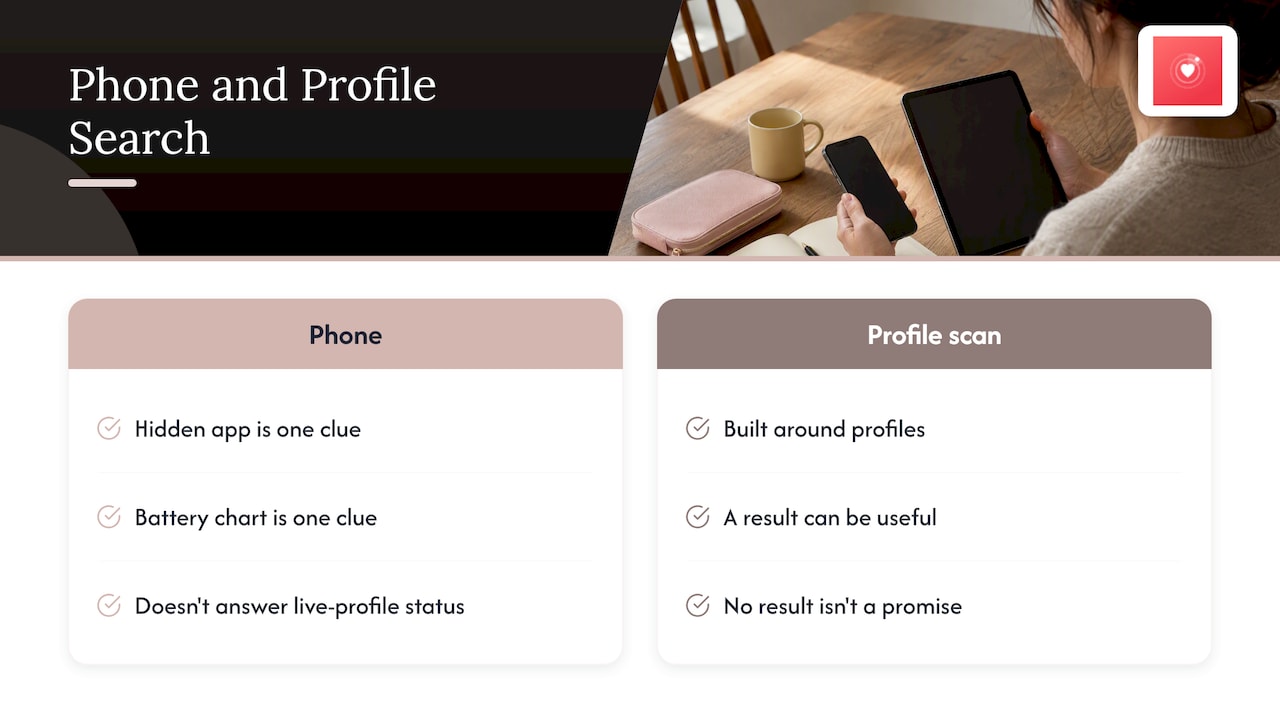
We also think you should hear this plainly. If a scan finds nothing, that is useful, but it is not a promise. Profiles can be under other names, on other apps, or newly made. If your gut still says something is wrong, listen to it. Not knowing is the heavy part, and sometimes one search is not the end of the story.
If you want to know more about what a scan can show, these pages explain it in plain words: how dating profile timestamps work and whether dating apps notify anyone about searches.
— Matt
What to do next, step by step
You don’t have to decide everything tonight. But don’t sit in the dark either. Here is a simple plan.
- Write down what you’ve seen. Dates, changes, odd moments. Facts, not guesses.
- Check your own side first. Make sure the clue is real. A missing icon is not enough.
- Skip the passcode and the spy apps. They create new problems.
- Run a private scan. Check their profile today and see what is actually out there.
- Decide with facts. If you find something, you can talk with your partner from a place of strength. If you find nothing, you can breathe, for now.
Want more background first? Read our guides on apps cheaters use and how to find out if your partner is on dating apps. If you’d rather not touch the phone at all, this guide to checking without a phone walks you through it.
The longer you wait, the longer you carry this alone. Start your scan today and stop guessing.
FAQ
How can I tell if someone is hiding apps on an iPhone?
On iOS 18 or later, a hidden app lives in the Hidden folder at the end of the App Library, and in Settings > Apps > Hidden Apps. Both need Face ID, Touch ID or a passcode, so you can’t open them without your partner. Screen Time and Battery may also list an app name. Remember, a hidden app is a clue, not proof.
Does a hidden app mean my partner is cheating?
No. Apple made the feature to keep private apps private, so people hide banking, health and gift apps too. But if the hiding comes with other changes, like secrecy or lies, it is fair to take it seriously. A scan of dating apps can show whether a profile actually exists.
Can I see a hidden app without my partner knowing?
Not without getting past the lock, and we don’t suggest that. Guessing a passcode or installing spy software can create bigger problems, and the FTC warns against spyware sold to catch a cheating partner. A private scan of dating apps lets you check without touching the phone.
Will my partner be notified if I scan dating apps?
No. Our scan is anonymous and encrypted, and you don’t need to create an account on any dating app. Your partner is not alerted. You get a private report with what we find on public profiles.
Sources
- Lock or hide an app on iPhone, Apple Support
- Lock or hide apps on your iPhone, Apple personal safety guide
- Hide and unhide apps in your App Store purchase list, Apple Support
- If you can’t find an app on the Home Screen, Apple Support
- Privacy: Control, Apple
- SpyFone barred from selling stalking apps, FTC consumer alert
- How to hide and unhide an app on your iPhone, Engadget
- 7 Relationship Control Tactics That Can Undermine Trust and Independence